The 2025-26 Broadway season was characterized by long fallow periods interrupted by an onslaught of eagerly awaited openings. The overall impression was one of a theater industry treading water — the goal being to stay afloat until the culture, the state of national politics and the economics of producing improve.
Don’t hold your breath. The struggle, compounded by technological shifts turbo-charged by AI, won’t be letting up any time soon. But more than ever, the theater seems to be answering the need for collective, in-person experience. If only ticket prices weren’t such a barrier to true democratic access.
The season’s strength was in revivals, a couple of which were so innovative they stretch our understanding of the term. Robert Icke’s “Oedipus” was hardly a retread of an ancient Greek classic and “Cats: The Jellicle Ball” may have hewed faithfully to Andrew Lloyd Webber’s score, but everything else about this production seemed completely reborn.
The frenzy of the new attention economy has only inflated the importance of the Tony Awards — to the detriment of the Broadway calendar. During a trip to New York in early March to serve on an award jury, I was frustrated by the dearth of new Broadway productions. April is always an avalanche, but this year the early parts of the fall and spring season were deserts.
Celebrities no longer guarantee a stampede at the virtual box office, but one encouraging development is the range of big-named actors delivering powerhouse performances in plays that were anything but vanity showcases. Highlights of the starry season not listed here include Daniel Radcliffe in “Every Brilliant Thing” and Adrien Brody and Tessa Thompson in “The Fear of 13.”
Progress may be down, but it’s not out. My Broadway theatergoing had to be selective this year for logistical reasons, but these are the performers and productions that sustained me through the fitful season.
Laurie Metcalf in “Little Bear Ridge Road,” left, and with Nathan Lane in “Death of a Salesman.”
(Emilio Madrid; Julieta Cervantes)
Laurie Metcalf
Metcalf has inherited, by broad consensus, Helen Hayes’ mantle of First Lady of the American Theater. She brought her Everywoman luminosity to two of the highlights of the 2025-26 Broadway season: Samuel D. Hunter’s “Little Bear Ridge Road” in the fall and a revival of “Death of a Salesman” that opened in the spring, both productions directed by Joe Mantello. A two-time Tony winner, she is likely to win a third for her featured performance in “Salesman” as Willy Loman’s bracingly unbending wife, Linda. But her lead performance in “Little Bear Ridge Road” is just as deserving of recognition. In Hunter’s play, Metcalf plays a character who has no time for sentimental niceties. Hitting her prime at 70, she has become the great theatrical interpreter of feelings too profound for facile talk.

Kristolyn Lloyd, Irene Sofia Lucio, Betsy Aidem and Audrey Corsa in the Broadway production of “Liberation” by Bess Wohl, directed by Whitney White.
(Little Fang)
‘Liberation’
The recently-named winner of the Pulitzer Prize for drama and the best I saw this year on Broadway — or anywhere, for that matter — this “memory play about things I don’t remember” by Bess Wohl explores second wave feminism through a daughter’s tentative re-creation of her late mother’s consciousness-raising group in 1970s Ohio. This playfully theatrical work routinely breaks the fourth wall to raise questions about the ethics of the dramatic project underway. The playwright recognizes the speculative and incomplete nature of history, which is always born out of the needs and assumptions of the moment it’s written. But having closed on Broadway in February, it may find itself at a disadvantage as the Tony Awards campaigning heats up. Not that it matters from an artistic standpoint. Both the play and the production, directed by Whitney White and featuring a superbly attuned cast that included Susannah Flood and Betsy Aidem, provided audiences with an unforgettable group session on the ever-fraught politics of equality.

Mark Strong and Lesley Manville in “Oedipus.”
(Julieta Cervantes)
Lesley Manville in ‘Oedipus’
Director-writer Robert Icke’s “Oedipus is strangely classified as a revival. The underlying myth is ancient, but Sophocles has little to do with this modern reworking of a tale of political expediency and human shortsightedness. Manville’s hypnotic performance as Jocasta — a perfect complement to Mark Strong’s urbane, cocksure Oedipus — builds to a harrowing monologue about her character’s past that doubles the tragedy. When her stately voice and crisp hauteur finally give way, the result is shattering. Manville’s Jocasta commands tremendous sympathy without ever mitigating the character’s complicity with power. Shrewder than her husband, she discourages him from asking “how sick we are,” because she already knows the answer.

John Lithgow as Roald Dahl in “Giant.”
(Joan Marcus)
John Lithgow in ‘Giant’
A towering performance that is also impressively contoured, Lithgow’s portrayal of dyspeptic British author Roald Dahl infuses Mark Rosenblatt’s drama with chilling mystery. The play, revolves around a crisis of Dahl’s own making. A book review criticizing Israel for its invasion of Lebanon steps over the line into antisemitism, and the fallout in book sales is expected to be tremendous, especially in America. A representative from his U.S. publisher has been sent to convince Dahl to issue a public apology, something his more conciliatory British publisher reluctantly agrees is necessary. The ensuing debate leaves the parties bitterly deadlocked. But a transformation worthy of one of Dahl’s twisted tales unfolds as the writer perversely makes a bad situation worse. Lithgow, reprising his Olivier-winning performance, is at once terrifying and never anything less than human in one of the bravest performances of the Broadway season.

Joshua Henry and the cast of “Ragtime.”
(Matthew Murphy)
Joshua Henry in ‘Ragtime’
Words can’t really do justice to the profound musical depths Henry plumbs in this searing revival of “Ragtime,” directed by Lear deBessonet for Lincoln Center Theatre. Playing Coalhouse Walker Jr., the tragic protagonist of this musical based on E.L. Doctorow’s novel, Henry suffuses the story of a wunderkind Black pianist rebuffed by racism with a rich baritone lament for America’s original sin. His sublimely moving performance lends operatic heft to a musical that surveys the forces undermining our democratic promise. When Henry sings “Make Them Hear You” at the end of his journey, there’s no one with a functioning heart he doesn’t reach

Lea Michele and Nicholas Christopher in the musical “Chess.”
(Matthew Murphy)
Lea Michele, Aaron Tveit and Nicholas Christopher in ‘Chess’
Even with a spryly playful new book, “Chess” is a complicated musical to figure out. But the triumvirate at the helm of Michael Mayer’s electrifying revival makes a strong case for the show. Michele, demonstrating that her bravura turn in “Funny Girl” was no fluke, delivers a scalding rendition of “Nobody’s Side.” Christopher, in a star-making performance, brings the house down in “Anthem” through both the force of his singing and the scale of his emotion. And Tveit sets “One Night in Bangkok” aflame with Dionysian ecstasy. But the showmanship only works as well as it does because the actors are so adept at tracking the chess moves of characters who are always trying to stay one step ahead of danger. .

The cast of “Cats: The Jellicle Ball.”
(Matthew Murphy and Evan Zimmerman)
‘Cats: The Jellicle Ball’
Andrew Lloyd Webber’s musical juggernaut is re-conceived as a Harlem ball showcase for LGBTQ+ glory. The production, co-directed by Zhailon Levingston and Bill Rauch, ditches the feline masquerade for a parade of costumes designed with unflagging inspiration by Qween Jean. The characters are kitted out for runway battles worthy of “Paris Is Burning” and the TV series “Pose.” Presiding over the competition is the emperor of theatrical fabulosity, André De Shields, in the role of Old Deuteronomy, leader of the Jellicle colony. “Cats” is still “Cats” — now and forever, as the musical’s iconic slogan warned — but this production infuses the old lion with new vitality.

Jake Silbermann, left, and Nathan Lane in “Death of a Salesman.”
(Emilio Madrid)
‘Death of a Salesman’
Mantello’s barnacle-stripping revival of Arthur Miller’s masterwork — elevated by the stalwart brilliance of Metcalf’s Linda — reaches its full cathartic force in the final scene between Nathan Lane’s Willy Loman and Christopher Abbott’s Biff. The father-son reckoning, long postponed, can’t deter the play’s tragic course. But it does momentarily expose the willful illusions and defensive guilt that have prevented Willy from seeing Biff as he really is — not a god who sabotaged himself, but a muddling man, who is exceptional only in his acceptance of his own lowly character. He is a mirror, in other words, for Willy. And in a brief explosive moment of recognition between their characters, Lane and Abbott incite the Winter Garden Theatre audience into a paroxysm of grief.

Maria Wirries and LJ Benet in “The Lost Boys.”
(Matthew Murphy)
‘The Lost Boys’
New musicals have been eclipsed by revivals this season, but “The Lost Boys” has managed to elude the curse that has doomed previous vampire musicals, included “Dance of the Vampires” and “Lestat” through soaring singing, high-flying spectacle and, most important of all, a story that isn’t trampled by special effects. Director Michael Arden, last year’s Tony winner for “Maybe Happy Ending,” has rediscovered his magic touch after “The Queen of Versailles” shuttered on Broadway in the fall. “The Lost Boys,” featuring a well-chosen cast of rising stars and accomplished veterans, is hardly a perfect show. But for a musical about the undead, it’s refreshingly human.
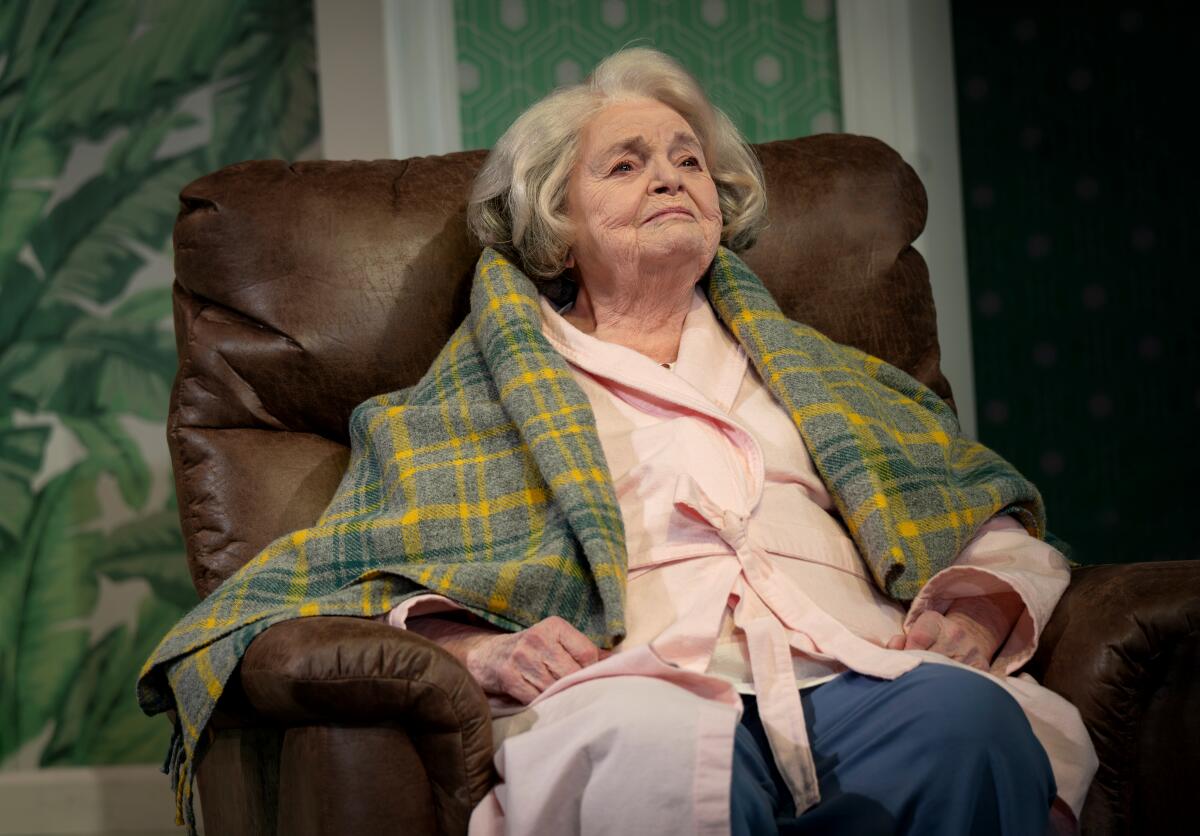
June Squibb in “Marjorie Prime.”
(Joan Marcus)
June Squibb
Starring in a Broadway production at 96, Squibb deserves a medal, not just for longevity but for discernment and daring as well. She didn’t come back to the stage in a warhorse or a vanity project. Instead, she chose a play that is still ahead of its time, Jordan Harrison’s “Marjorie Prime,” which had its premiere at the Mark Taper Forum in 2014. This drama about grief, family secrets and the strange new world of AI, poses age-old existential questions for a dizzying technological era. In this true ensemble production, sharply directed by Anne Kauffman, Squibb was supported by a first-rate cast that included a heartbreaking turn by Cynthia Nixon.
More to Read
Disclaimer : This story is auto aggregated by a computer programme and has not been created or edited by DOWNTHENEWS. Publisher: latimes.com