
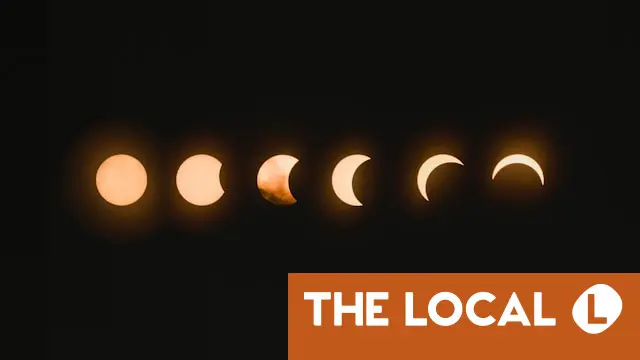
Millions of people will turn their gaze towards the heavens on Wednesday to witness one of nature’s greatest spectacles — a rare total solar eclipse — as it sweeps over mainland Europe to briefly turn day into night.
The Moon is first expected to blot out the Sun, leaving only the shimmering glow of its outer corona, in Russia’s remote Arctic north, before parts of Greenland and Iceland are enveloped in the arc of its eerie shadow.
Excitement was highest in Spain, where tourists thronged the streets of normally quiet villages to experience the dramatic natural phenomenon as the eclipse’s narrow path cuts across the Iberian Peninsula from the northern Atlantic coast to the Mediterranean Sea in the south.
Mainland Europe has not experienced a total solar eclipse for 20 years while Spain has not witnessed one in more than a century.
Iceland’s capital, Reykjavik, however, has not seen a total solar eclipse since 1433.
“It’s the first time and it’s the last time, the only time I’m going to see an eclipse,” Yenny Guevera, a 50-year-old Peruvian living in France, told AFP excitedly in Burgos, northwest Spain.
Supplies of special viewing glasses were in high demand as a partial eclipse will be visible for millions more in most of Europe, Canada, the northern United States and northwest Africa.
READ ALSO: Solar eclipse sparks scramble for protective glasses across Europe
Fleeting
Throughout human history, eclipses have stirred amazement, fear and reverence, as they appear to momentarily halt the normal course of nature.
The shadow or “umbra” cast by the alignment of Sun and Moon creates a strange twilight during which temperatures drop, shadows appear at strange angles and some animals go to sleep.
But the phenomenon is fleeting: in parts of Russia and Greenland, the total eclipse will last under two-and-a-half minutes.
For observers in Spain, it will last less than two minutes just before sunset.
The partial eclipse — which occurs as the Moon starts and finishes crossing the Sun’s path, dimming its light — will last around one hour and 45 minutes.
Self-described “eclipse-chaser” Lucie Green, a British solar physicist, will watch from a boat off the island of Mallorca and called it “a moving experience”.
The event, to be live streamed by both NASA and the European Space Agency, presents scientists with a rare opportunity to study the Sun’s atmosphere and its outermost layer, as they seek to uncover secrets about solar winds and our star’s magnetic field.
READ ALSO: What to do if you can’t find eclipse glasses in Germany
Weather
Weather — specifically clouds — is the enemy of eclipse-chasers and forecast rain could spoil the occasion in the Westfjords region of northwest Iceland.
Scientist and astronomer Saevar Helgi Bragason said he felt “both excitement and heartbreak” because of the unfavourable weather forecast.
“It’s almost like I’ve lost someone,” he told AFP in Reykjavik.
But he said he hoped the skies would clear just long enough so he could see “the shortest, most sudden, most beautiful, most unique and, hopefully, most memorable and beautiful nighttime of our life” from his home.
No such problems are expected in Spain, however, with clear skies forecast, although there are concerns due to high temperatures of more than 35C — and over 40C in the northeast — and the continued risk of wildfires.
Eclipse fever has gripped Spain, with government predictions that the more than 446,000 extra tourists could bring a €347 million ($400-million) boost to the economy.
The main road from the south to Catalonia in the northeast was blocked, an AFP reporter said, while interior Minister Fernando Grande-Marlaska said nearly 25,000 police officers had been mobilised to ensure the event goes off without a hitch.
“The path of totality is very narrow. It’s only a couple of hundred kilometres wide,” British astrophysicist and science communicator Graham Jones told AFP Tuesday from Fontanil de los Oteros in northern Spain.
“That’s what’s so special about Spain. The path of totality really goes across the Spanish peninsula.”
Another total eclipse will cross southern Spain and northern Africa in August 2027, while an annular eclipse — when the Moon is not big enough to completely blot out the Sun, creating a so-called “ring of fire” — is due to visit the Iberian Peninsula in 2028.
READ ALSO: How to get free glasses to see Spain’s total solar eclipse
Disclaimer : This story is auto aggregated by a computer programme and has not been created or edited by DOWNTHENEWS. Publisher: thelocal.de





