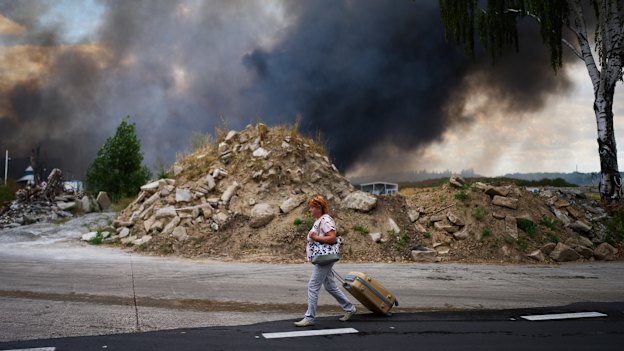
Russia is intensifying its war with a new generation of deadly drones, turning everyday life into a daily gamble for Kyiv’s traumatised inhabitants.
There are times at night when Svitlana Dvorchina will not leave her apartment when the air-raid alarm goes off. It can be more secure to stay at home, she feels, rather than join the rush to a shelter. And her two young children can be so tired from playing in the afternoon that they sleep through the noise.
“They don’t hear it,” she says. “Even when we have these massive night attacks on Kyiv, for example, my kids can sleep well. But me, I do not sleep that way. I hear every explosion.”
Dvorchina, 36, has moved all their beds to a corner of the room so they are as far as possible from the windows, in case a blast sends glass flying. Like so many in the Ukrainian capital, she thinks about the danger from drone and missile strikes, and she knows she can wake the children and run to a damp basement or a crowded underground metro station.
Often, her decision is to stay with Eilisai, 11, and Artem, 6, and let them sleep. She remembers what her husband, Yurii, told her earlier in the war: “Do not run away. Just be home.” She has to do this on her own. Yurii, a professional soldier, died from cancer six months ago.
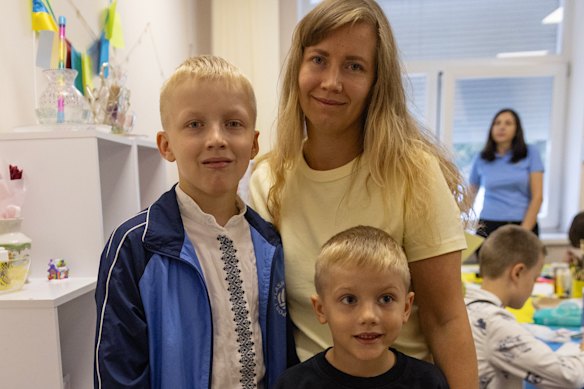
We are talking at a care hub where parents can give their children an escape from the war. Eilisai and Artem are in a library down the corridor with a crowd of other kids listening to stories. Dvorchina speaks with an incredible calm about the choices she has to make as winter approaches, even though the options are fraught: she cannot afford the rent with Yurii gone, and she is not sure if the heating will work.
“It’s hard to explain what this is, but it’s definitely not life. It’s surviving.”Olena Klochik
Every decision is a gamble when Russia is intensifying its drone and missile strikes. In Kyiv, people talk about “total war” from Russian attacks on civilian targets like petrol stations, passenger trains, buses and homes. Ukrainians continue their lives despite the air raid alerts, trying to make the most of every peaceful moment, but the pressure is exhausting after more than four years of war.
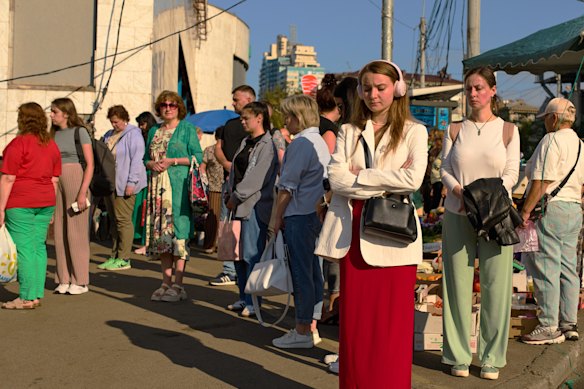
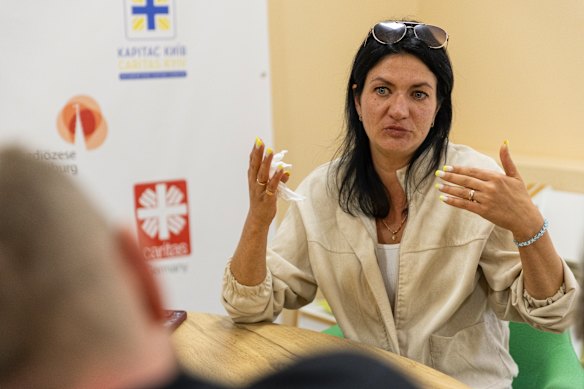
Olena Klochik weeps when she describes life under Russian attack.
“It’s a fear. It’s not a life. It’s surviving,” she says. “What we do is we try to catch a moment of life between air alarms.”
Her tears fall as she talks. Her younger brother, Maxim, a soldier, died in eastern Ukraine one week ago. He left a trench in the fighting around Pokrovsk to rescue a wounded comrade, only to be killed by a landmine. Their mother has been asked to supply a DNA sample so he can be formally identified.
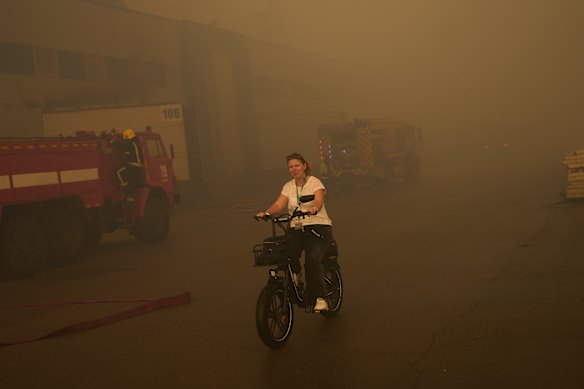
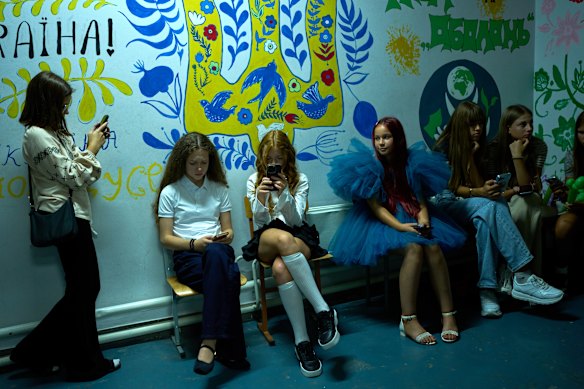
Klochik, 37, is angry and distraught as she speaks about the cruelty of the war. Her three children, Kyrylo, 14, Sofiia, 10, and Petro, 9, are in the library with the others while we talk. Here at the care hub, operated by Caritas Ukraine and supported by donations from Australia, there is at least a respite from hardship.
“Our children have to study in the shelters,” says Klochik, speaking through a translator. “They always have to be somewhere hiding. Here, at Caritas, I come for my children to distract them from the war. And here we are all together, and we do something to help our children.
“It’s hard to explain what this is, but it’s definitely not life. It’s surviving.”
There is exhaustion in her voice, although her words do not sound like despair. She says Ukraine cannot rely on US President Donald Trump and should get more help from Europe to stop the Russian attacks. “We are invincible,” she says. “But to finish this war, we need support from other countries.”
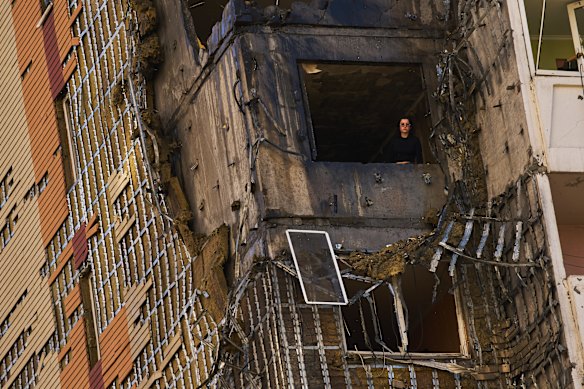
The total war on civilians is not new to anyone who remembers the casual killing of Ukrainians in the towns around Kyiv after Russian soldiers embarked on the full-scale invasion in February 2022. But the war is very different after the arms race of the past four years. Now, civilians are targeted from the air on a dangerous new scale.
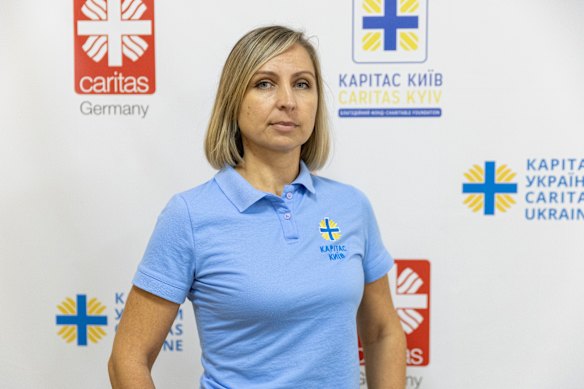
Iryna Peliukhnia, the co-ordinator of the Caritas care hub, is lucky to be alive. She hid in a cellar with her husband and two children when Russian soldiers occupied her village near Kyiv during the assault on the capital in February 2022. They had little food for two weeks, as the temperature fell below zero. Now she worries about what the cold will do to families in Kyiv in the months ahead.
“The families who come to Caritas are now frightened of what they will face this winter,” she says.
Ukraine is more exposed to ballistic missiles because it lacks enough of the Patriot interceptors that can protect its cities. It is more exposed to faster drones because it cannot match the speed of the new Russian weapons fitted with turbojet engines from China. Months may pass before Ukraine can deploy more powerful drone interceptors.
This means energy systems are vulnerable just as the cold sets in. Ukrainian air defence officers estimate the Russians launched 2800 jet-powered drones at targets in August, almost twice the number seen in the previous month. The Ukraine Conflict Monitor, an independent service run by Armed Conflict Location & Event Data, estimates there were 4700 drone strikes of all types on Ukraine in August.
The new weapons, capable of flying at 600km/h, are becoming a bigger part of the Russian arsenal. At this rate, Russia could devastate civilian targets with jet-powered drones in the months ahead.
The threat ahead
Winter could bring a humanitarian disaster. Many residents have been without heating in their apartments after gas and electricity outages over the years. Some talk of temperatures falling to minus 10 degrees inside their homes, let alone out on the street. Families often go to government centres, known as Points of Invincibility, to get hot water, charge their mobiles, connect to the internet or collect basic first-aid kits.
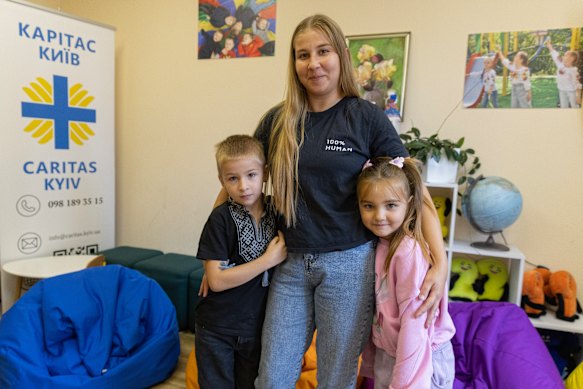
This is where Euheniia Kravtsova, 26, takes her two children on most days. “We spend a lot of time there,” she says. “Sometimes there is heating at home, sometimes not. It’s unreliable. After school, we go to the Point of Invincibility. We have a meal there, then we go home to spend the night.”
Leaving Kyiv is an option for some families, but rents are high in the safer cities to the west, and work is not easy to find in the quiet villages away from the conflict. For Kravtsova, who works as a cleaner, moving west is out of the question because it would mean being even further from her husband, Denys, who is stationed with the armed forces in the east. Their daughter, Alina, 5, cries during some of the attacks. Their son, Oleksii, 7, wants to serve like his father.
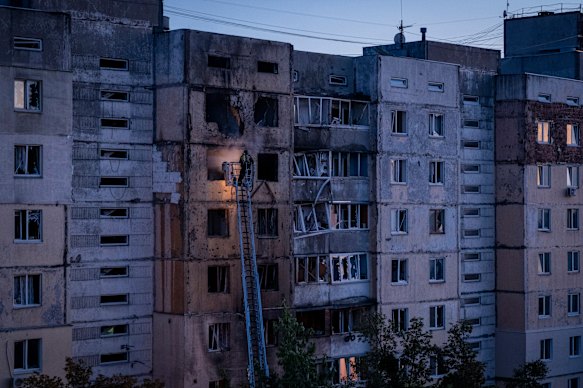
Kravtsova explains all this with a soft smile. “It’s not as difficult as it could be,” she says. She is from Dobropillya, an eastern city under constant Russian fire, and she fled to the capital with the children two years ago. In Kyiv, at least, they are more secure.
Parts of the Ukrainian capital are dominated by blackened buildings – such as the Lukianivska district, where a military factory drew Russian missile and drone attacks. Rents are lower in these neighbourhoods, given the common assumption that living there is more dangerous, but they are still busy.
The McDonald’s at the Lukianivska metro station remains open despite being hit several times. In one strike, its golden “M” melted from the heat and dripped yellow plastic down the wall; it was quickly replaced, and the store was repaired. The response to every setback seems to be a decision to rebuild.
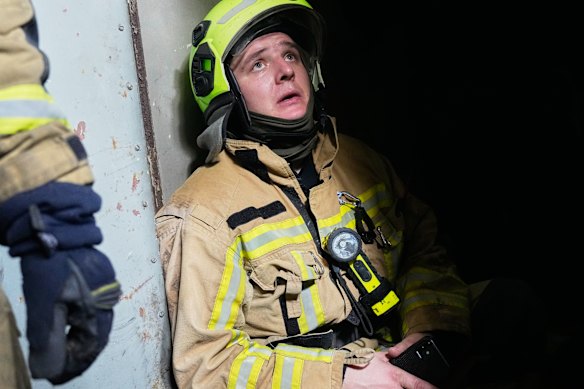
This is not enough, however, when Ukraine desperately needs more firepower. Russia is tipped to make 10 million drones this year, while Ukraine is trying to increase its production from 8 million to 10 million. The essential goal for the Ukrainian commanders is to disrupt the Russian supply lines with long-range drone strikes into Russian territory.
How does Ukraine survive?
Can Kyiv stay alive? Can Ukraine hold out? The questions are urgent now that autumn has arrived. But there is no consensus on how the country and its capital can survive Russian President Vladimir Putin, who has already sent at least 500,000 of his own soldiers to their deaths, according to an estimate from British intelligence officials. The war has brought immense economic damage to Russia, but this does not deter Putin. And the country remains strong enough to inflict even more pain on its neighbour.
When political leaders and others gathered in Kyiv last week to ponder these questions, one common message was that Europe could not afford a Russian victory. Ukraine must survive, said the speakers at the Yalta European Strategy conference, even if that required years of financial and military support from the West.
Former British prime minister Boris Johnson summed up this view. “He’s a creep,” he said of Putin. “He’s a thug. He’s a bully.” Johnson added, however, that Putin would succeed if there was any wavering in the West. If Europe was unclear about its total support for Ukraine, he argued, Putin would be able to tell the Ukrainian people they had been betrayed by their so-called allies.
“What he wants is for the West to have been seen by the Ukrainians to have broken their promises. And that’s the single most dangerous thing. I still fear that that is where we could end up,” he said.
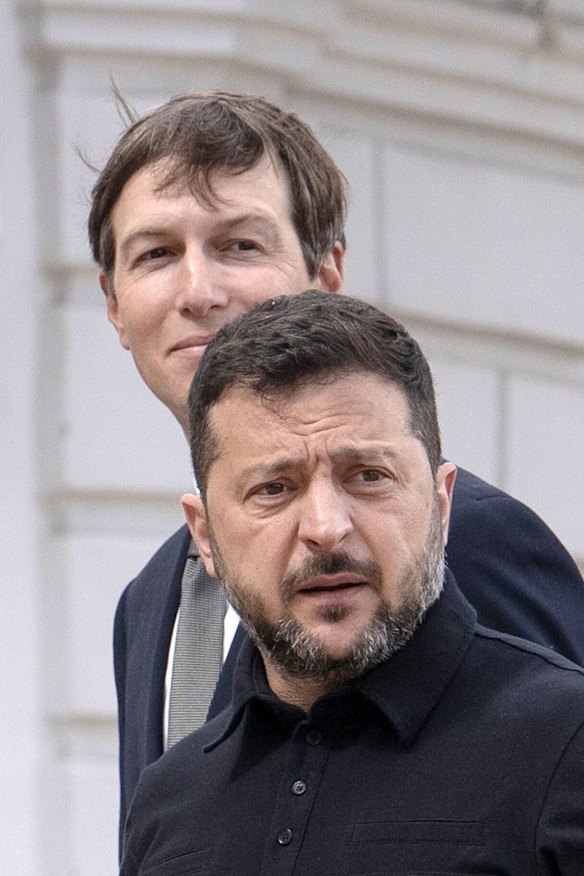
“The Ukrainians are doing incredibly well. They are heroes. Absolute heroes. They are fighting Putin to a complete standstill. But then what? The great advantage Putin has, and always has had, is clarity of purpose. He knows what he wants out of this thing – he wants to prevent Ukraine ending up in the Western column one way or the other. And we’re failing to be clear ourselves.”
This argument highlights Western disunity. There are no agreed answers to two key questions. Should the West defend Ukraine by bringing it into NATO? Should the European Union help Ukraine by swiftly welcoming it into the economic union?
There is no agreement on the military and economic steps to be taken next to defeat Russia. On Wednesday, the US Congress ended two years of debate by passing a sanctions bill led by former Republican senator Lindsey Graham, who died in July. This could be used to punish countries that buy Russian oil and gas, including China and India, but the impact depends on whether Trump, who often complains about Ukraine, would ever put the new power to use.
Former CIA director David Petraeus, a retired US Army general, outlined three immediate measures at the Yalta conference to put greater pressure on Russia. Firstly, give Ukraine more Patriot interceptors to shield it from Russian missiles. Secondly, apply tougher sanctions using powers like those passed by Congress. Thirdly, release billions of dollars in funding for Ukraine.
“Ukraine has to deny further meaningful Russian gains, they have to survive the air campaign in the winter, and they’ve got to scale their defence industry even further,” he said. More broadly, Petraeus argued that Ukraine should be anchored “irreversibly” in the West. Ukraine’s defence sector, he said, should be built into Europe’s industrial base.
Those prescriptions sounded convincing in the conference hall in Kyiv last weekend. In Washington, however, Trump sees no need to help Ukraine and is more likely to blame it for the war. In the capitals of Europe, leaders are struggling to develop their defence industries fast enough to help Ukraine – for instance, by sending it more interceptors to stop drones and missiles.
On the streets of Kyiv, meanwhile, residents are exposed to Russian attack. On the footpath near the Lukianivska metro station, stall-holders sell homegrown vegetables in the hope of making some spare cash. Among them is an elderly woman, Nina Vasylivna, who sits on a small stool and sells flowers near the burnt wreckage of a shopping mall.
“It’s hard – really hard,” she says. “I love Ukraine, and I really care about the younger generation. I go to the shelter to hide when there’s an air alarm. I’m already old. But still, I want to live.”
Get a note directly from our foreign correspondents on what’s making headlines around the world. Sign up for our weekly What in the World newsletter.
Disclaimer : This story is auto aggregated by a computer programme and has not been created or edited by DOWNTHENEWS. Publisher: www.smh.com.au