
Srinagar:The prolonged standoff between Ladakh’s leadership and the Union Government over constitutional safeguards and democratic governance appears to be nearing a decisive resolution.
After several years of sustained engagement and advocacy, both sides have now arrived at a broad understanding aimed at protecting the land, employment, and cultural rights of the people of the Union Territory. This development marks a significant shift from confrontation to constructive dialogue, raising hopes of a stable and representative political framework for Ladakh.
The breakthrough follows a series of engagements, culminating in a renewed push for result-oriented dialogue during Union Home Minister Amit Shah’s recent visit to Leh. Prior to this visit, the Leh Apex Body (LAB) had emphasised the need for direct, high-level discussions, arguing that routine sub-committee meetings would not suffice to address the region’s long-pending concerns.
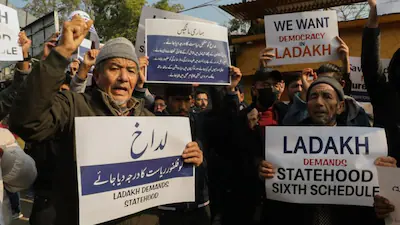
Alongside the Kargil Democratic Alliance (KDA), LAB has been at the forefront of a sustained campaign centred on a four-point agenda: the restoration of statehood, inclusion under the Sixth Schedule of the Constitution, separate Lok Sabha constituencies for Leh and Kargil, and the establishment of a dedicated Public Service Commission to safeguard local employment opportunities. These demands reflect deep-rooted aspirations for political empowerment and institutional safeguards in the region.
The latest round of talks, held under the aegis of the Ministry of Home Affairs (MHA), appears to have yielded substantial progress. Representatives of LAB and KDA have indicated that an in-principle agreement has been reached with the Government of India on providing constitutional safeguards for Ladakh on the lines of Article 371. Such provisions, modelled after Articles 371A, 371F, and 371G applicable to Nagaland, Sikkim, and Mizoram respectively, are designed to protect local customs, land ownership, and socio-cultural identity. The proposed framework signals a recognition of Ladakh’s unique demographic and geographical sensitivities, and the need for tailored constitutional protections.
In addition to safeguards, a key element of the understanding revolves around the restoration of democratic governance in the Union Territory. The proposal envisages the creation of a powerful elected government headed by a Chief Minister, with legislative, executive, and financial authority vested in a Union Territory-level legislative body. Crucially, the administrative machinery—including senior bureaucrats such as the Chief Secretary—is expected to function under the executive authority of this elected leadership. This marks a significant departure from the current administrative arrangement and addresses long-standing demands for greater local accountability and participation in governance.
Both LAB and KDA have underscored that while the agreement is still at a preliminary stage, it represents a major step forward. They have expressed their willingness to work closely with the MHA, as well as legal and constitutional experts, to refine the operational and legal contours of the proposed arrangement. The collaborative approach adopted by all stakeholders suggests a shared commitment to translating the broad understanding into a workable institutional framework.
On the question of full statehood, the Union Government has reportedly maintained that Ladakh’s current revenue generation capacity remains insufficient to meet its expenditure obligations, particularly in terms of salaries and administrative costs. However, the proposed governance model is being viewed as a transitional arrangement that could eventually pave the way for full statehood once the region attains the necessary financial viability. This phased approach seeks to balance immediate demands for democratic representation with long-term fiscal considerations.
The joint statement issued after the sub-committee meeting reiterates that the core aspirations of the people of Ladakh—restoration of democracy, constitutional safeguards, and eventual statehood—remain central to the ongoing dialogue. While some demands, such as inclusion under the Sixth Schedule, may still require further deliberation, the current understanding reflects a convergence of positions on several key issues.
Overall, the emerging consensus between Ladakh’s representative bodies and the Centre signals a turning point in the region’s political trajectory. If translated into concrete policy and constitutional measures, it could usher in a new phase of governance marked by greater autonomy, institutional protection, and democratic participation.
Some political observers say that the coming weeks will be crucial in determining how this in-principle agreement evolves into a formal and enforceable framework that addresses the aspirations of Ladakh’s people.
Disclaimer : This story is auto aggregated by a computer programme and has not been created or edited by DOWNTHENEWS. Publisher: deccanchronicle.com



