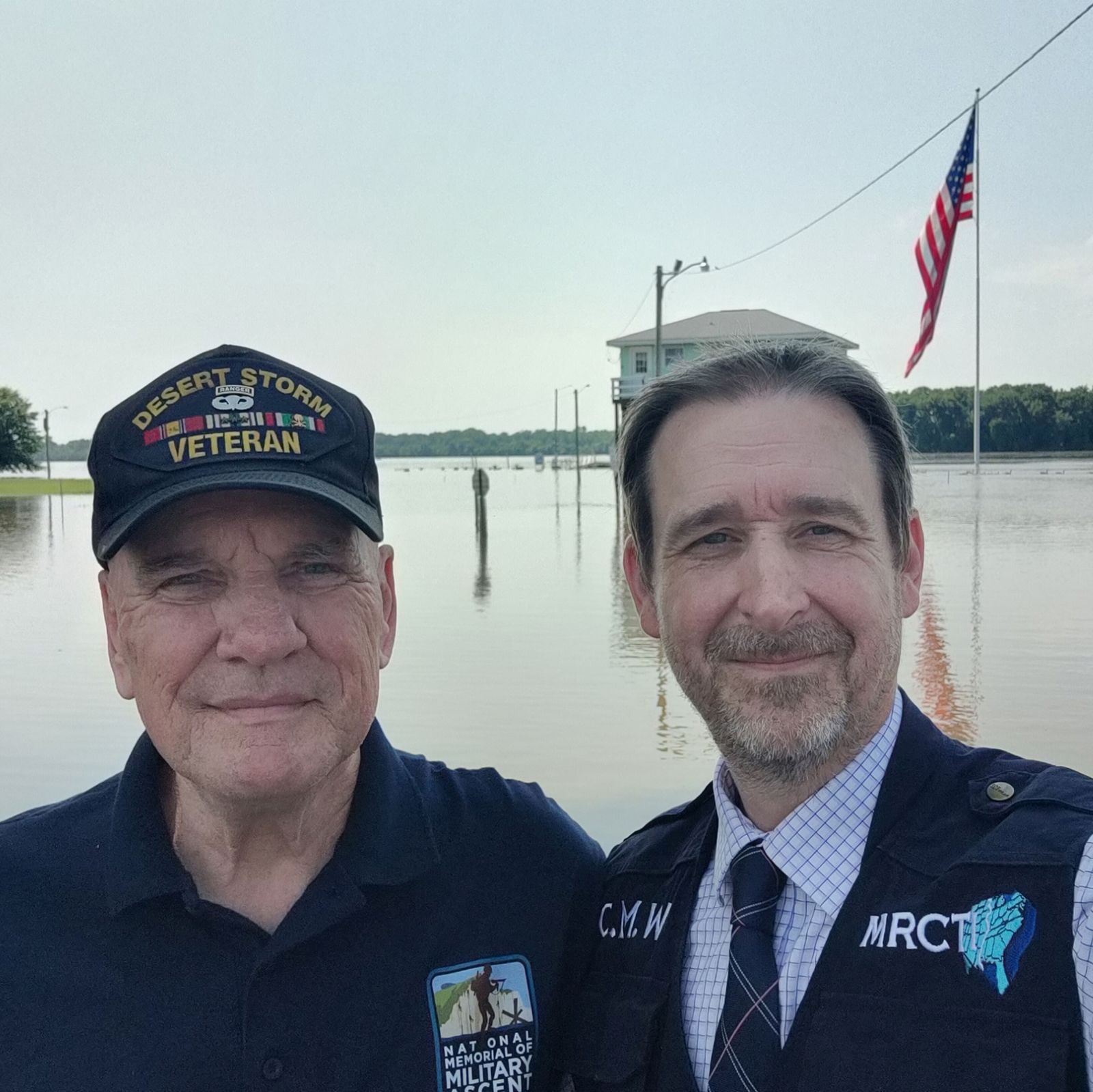
In 2019, when the worst flooding in recorded history spread across the entire Mississippi River basin, Colin Wellenkamp’s phone rang for weeks. Wellenkamp runs a nonprofit called the Mississippi River Cities & Towns Initiative, which coordinates between mayors’ offices in more than 100 river communities from northern Minnesota to southern Louisiana. As he describes it, his headquarters served as “one big virtual situation room” for relief agencies and municipalities up and down the central US.
The damage reports were gut-wrenching: Underneath historic downtowns, sewer systems filled, swelled, and popped; roads above them buckled and collapsed. Not too far from Wellenkamp’s office in St. Louis, stranded residents had to be rescued by boats as rushing waters rose and coursed through their living rooms, and a young couple drowned in a submerged vehicle. In one town—Davenport, Iowa—the sewage treatment plant became an island, and the city had to boat its employees to the site. Workers stayed there for nine solid days, sleeping on cots, to keep wastewater from backing up into homes and businesses.
Wellenkamp knew that in the aftermath of any natural disaster, the first days and weeks can be brutally decisive for the fate of a town. As modest city budgets were being triaged to handle the most dire of emergencies—rescuing the stranded, restacking sandbags, getting power plants back online—damage to other systems was mercilessly stacking up. City leaders could see the future with sickening clarity: Public relief money from agencies like the Federal Emergency Management Agency would take weeks, months, or even years to arrive. As road and sewer repairs waited for funding, destruction would compound over time: Water would continue to flow into busted drainage networks; inundated homes would get moldier. Private insurance payouts would be similarly slow, when they weren’t denied outright. Churches, gas stations, and grocery stores—often the only ones for miles—would close for good. Some residents would leave and never move back. And sure enough, much of it came to pass. “Our cities didn’t need a lot of money to respond. Most of them just needed 50 grand, $75,000, $100,000 … but it wasn’t there,” Wellenkamp says. “Who’s helping you within the first 72 hours? Nobody.”
By chance, a few months before the 2019 Mississippi River flood, Wellenkamp learned about a new, little-known form of insurance that was quietly expanding in disaster-prone areas around the world—not a way to cover individual homes but a means to insure entire towns and ecosystems against calamities. It had started taking off in the farmlands of eastern and southern Africa in the early 2010s, particularly in Malawi and Ethiopia. Then it began to spread into war zones and other settings once deemed uninsurable.
It’s called parametric insurance, and it relies heavily on sensors, satellites, and AI. The idea is just what it sounds like: When sensors confirm that certain predetermined parameters have been hit—say, half an inch of rain falls in a single hour, or winds north of 100 miles per hour are sustained for 60 consecutive seconds—any participating government or business within the qualifying area can get a payout. By making determinations based on remote weather readings instead of actual damage assessments, insurance companies can do away with human field adjusters. And by processing claims with AI, they can get money into people’s hands within days. The cash is usually drawn from a pool that a range of parties pays into: often governments, nonprofits, and businesses with a financial stake in their local ecosystems.
In 2018, some staffers at the United Nations had reached out to Wellenkamp’s nonprofit to discuss disaster resilience, and parametric insurance came up. They’d seen it work in other parts of the world and offered to broker a conversation between Wellenkamp and some major parametric insurance providers to see if a similar model could serve in the Mississippi River basin. Since then, he’s been in conversations with one of the world’s largest insurers, Munich Re, trying to come up with a plan to prevent what happened in the 2019 floods.
Wellenkamp is in good company. As disasters multiply and traditional home insurance crumples under the weight of climate change, the parametric model has been moving steadily into prime North American markets, insuring against a litany of previously hard-to-cover catastrophes. Last year, the Bay Area city of Fremont became the first municipality in the country to take out a city-wide parametric flood insurance plan. A homeowners association near Lake Tahoe, California, has a joint parametric wildfire insurance plan, and a group of nonprofits in New York has partnered with the city to purchase a shared parametric flood insurance plan that will cover a handful of particularly low-lying New York City neighborhoods. Hoteliers and local governments in Hawaii and Cancun, Mexico, have used parametric plans to insure coral reefs against storm damage. For years, 16 national governments in the Caribbean have paid into a single parametric hurricane plan; after 2024’s Hurricane Beryl met the set parameters, the plan quickly sent out payments, including nearly $44 million to Grenada alone. The money allowed hospitals and schools to reopen quickly, fixed roads and public water lines, and supported farmers and small businesses.

The scheme that Wellenkamp and Munich Re have been devising could become one of the biggest parametric plans in North America—a way to insure the entire Mississippi River basin against flooding and other disasters. If all goes as expected, Wellenkamp hopes to roll out a pilot program in the mid-Mississippi region next year. Further on the horizon, the Trump administration has even begun talking about determining FEMA payouts with a parametric model.
Some pragmatists laud parametric insurance as a model that might upend disaster relief as we know it. No more impractically slow, potentially biased assessments or years spent waiting for disbursements—just defined parameters and quick payouts. But to some environmentalists, it looks like a scheme for insurers to use sensors and AI to profit off disasters on terms that are favorable to them, in markets they have previously been unable to enter. Others highlight that measurable weather thresholds don’t always correlate with actual impacts, and they worry about claims being automatically denied even as homes and businesses lie in ruin. On the Mississippi, Wellenkamp is just hoping he can stanch the cascade of flood-related devastation—and the resulting exodus of people from their communities.

If you know how to spot them, the scars of flooding are everywhere along the Mississippi: green algae on highways far from the river, faded black water marks on concrete road barricades, and strings of unoccupied, grassy lots at the ends of city streets as they approach riverbanks.
One day this spring, Wellenkamp—with short graying hair, a phone that kept ringing, and dress shoes he didn’t mind muddying—showed me that subtle reminders are all over the city of East St. Louis, Illinois. Located directly across the Mississippi from the iconic Gateway Arch, East St. Louis is one of the few cities in the basin located almost entirely on a floodplain. Over the last half century, its population has plummeted from more than 80,000 residents to 17,682, due in part to repeated flooding.
Where other cities near the river suffer from what’s referred to as “frontdoor” flooding—water that overflows from the Mississippi itself—East St. Louis often faces more of a “backdoor” threat. Water runs downhill into the city from surrounding developments on higher ground and from the off-ramps of highways that criss-cross the predominately Black community. The city has drainage canals that flow into the Mississippi, but when the river is too high, the mucky water in those ditches reverses course, sending stormwater back into the surrounding neighborhoods. “You’ve got surface water coming from the highways,” said Charles Powell III, the city’s mayor, as we stood with Wellenkamp on an overlook facing the river. “It has nowhere to go, because the canal is filled,” he said. “So now you’re trapped.”
Four years ago, during a major rainfall, an especially bad flood poured into an East St. Louis neighborhood called Mary Terrace, wedged in a low-lying area between Interstate 255 and a set of raised railroad tracks. First responders staged a rescue operation, launching boats into the recessed neighborhood from an elevated strip of pavement near a senior citizens’ center and a Seventh Day Adventist church. Then the city set about blowing out mud that had accumulated in the sewer system, pumping water out of homes, helping families with mold mitigation, and repairing streets that had collapsed when water lines burst. Without extra funding to help them meet these immediate needs, the city had to take significant bites out of its already-tight annual budget, including money to assist residents of a 39-home neighborhood that was submerged for weeks.
East St. Louis is an extreme case, but these are exactly the kinds of municipal traumas that Wellenkamp hopes a parametric plan will alleviate. For the pilot project—which would likely include East St. Louis—Wellenkamp plans to peg the parameters to the flood heights recorded in 2019. If floodwaters reach those levels, the mayors of qualifying river cities could accept a near-immediate payout from the insurance plan. They could use it to restore power or bring in additional pumps, remove water from city streets before they buckle, or suck sewage from residential and commercial basements before they condemn the property to mold.
But some environmentalists have their doubts about parametric insurance’s salvific potential. Critics point to the problem of the parametric cliff: Say an area has been hit with 95 mile-per-hour winds and suffered severe damage; it might not receive a payout, while a nearby neighborhood that has sustained minimal damage but recorded the prerequisite 100 mile-per-hour winds would qualify. In September of 2024, for example, Hurricane Francine caused some damage and power outages to buildings owned by the New Orleans Public Schools, which had purchased a parametric insurance policy—but the storm didn’t meet the predetermined parameters set by the plan, and no money came for repairs. In the 2010s, farmers in Ethiopia relied on a parametric plan to support them in case of drought; in a particularly bad year, many farmers saw extensive crop damage, but satellite readings in their area didn’t register the drought, which disqualified them from receiving aid.
In the private market, insurance companies are building datasets that let them maximize profits while paying out as little as possible. While some insurers use publicly available weather data from places like the US Geological Survey and the National Oceanic and Atmospheric Administration to assess risk, others rely on third-party, proprietary data—often sold to them by private companies that have built robust networks of these high-tech sensors around the target area. Using their own secret formulas, insurance companies develop ultra-granular risk assessments, which they use to get the most money from their policyholders while paying out as little as possible. Advocates have pushed for greater transparency around this data, which could be used by mitigation specialists and engineers to preempt damage rather than profit from it. They haven’t been met with much success.
In the coming months and years, Americans are likely to start hearing a lot more about parametric insurance. In May, President Trump’s controversial FEMA Review Council recommended that the federal disaster relief agency switch to a parametric system in the next three years, replacing the agency’s timeworn, multistep methods of determining payouts to local governments after FEMA has formally declared a disaster.
Some groups, like the intragovernmental National Association of Counties, have said that this change would bring some much-needed speed to the process. But many fear significant downsides: The new system would likely offer much less wiggle room in how much aid could be released, and it’s unclear how the qualifying parameters would be set—especially since many of the federal agencies collecting climate data have been slashed under Trump. Plus there’s the perennial concern that preset metrics—such as hurricane category or flood depth—are not always the best predictors of damage. “Property damage estimates for Hurricane Harvey in 2017 and Hurricane Katrina in 2005 were each roughly $125 billion adjusted for inflation, but Harvey made landfall as a Category 4 storm and Katrina as a Category 3,” wrote Matt Sedlar, a Climate Analyst at the think tank Center for Economic and Policy Research, in a recent article. “Under the ‘parametric trigger’ rationale, survivors of Katrina would have received less aid, despite the fact that the storm wiped entire towns along the Gulf Coast off the map.”
And in any case, many emergency managers doubt that such a sweeping change could take hold on the timeline Trump’s committee recommended. Not only would it take time to design such a high-stakes national parametric model, but the shift may also require Congressional approval.
As for Wellenkamp, he definitely sees the appeal of the potential for faster FEMA payouts. Under the current system, he says, cities sometimes end up leaving nonthreatening storm wreckage—downed trees, damage to condemned buildings—sitting for months or even a year while they wait for assessors to review the devastation. But the devil is in so many details: Will FEMA’s metrics be granular enough? Flooding, he says, can sometimes devastate an area as small as a city block but leave neighboring streets relatively unscathed. “Will that count?” Wellenkamp wonders. He’d also want to see an appeals process, where cities that have been denied claims can make their case. “It’s inevitable that there’s going to be gaps,” he says, “and you should allow localities the opportunity to try and fill those gaps.”
For now, on the Mississippi River basin, he hopes that the smaller, private pilot program he’s been designing may soon offer communities a quick complement to federal emergency relief, however it gets to them. In the meantime, he and the mayors he works with are trying to mitigate flooding ahead of the next crisis. Up and down the basin, they’ve been working to restore large wetlands near the river, creating strategically positioned natural catchment areas and floodable riverside parks that would absorb water before it hits cities and towns.
A few miles in from the Mississippi in Illinois, at a park called Horseshoe Lake, one such project is about halfway done. Situated just northeast of East St. Louis, downhill from a growing constellation of newer suburbs but uphill from the river, Horseshoe Lake is perfectly positioned to absorb stormwater runoff and flash floods before they hit the riverside city. The project involves creating a pumping system and a set of low-profile, one-way gates that will let floodwaters into the wetland but not out. When complete, it will direct an additional 100-plus acre-feet of water into the park instead of allowing it to inundate East St. Louis. “Any way we can assist with preventing water coming here and overloading the system,” says Powell, the East St. Louis mayor, “we are 100 percent in.”
After years of aggressive flooding, inadequate infrastructure, and depopulation, leaders of towns on the Mississippi aren’t Pollyannaish. They know a parametric plan isn’t a silver bullet. An insurance economy fueled by opaque data that allows insurance corporations to analyze risk better than many public entities makes many people squirm. But for now, residents of flood-prone areas have few options. Many feel that any payout made in the immediate aftermath of a disaster is better than nothing—and nothing, often, is the alternative.
With new plans rolling out every year, the march of parametric insurance doesn’t seem to be slowing down. And neither is extreme weather. As Wellenkamp drove me around greater St. Louis to see the scars of recent storms, a heavy rain pelted us; more was on the horizon. A few days later, much of the area was under a flood warning.
Disclaimer : This story is auto aggregated by a computer programme and has not been created or edited by DOWNTHENEWS. Publisher: wired.com