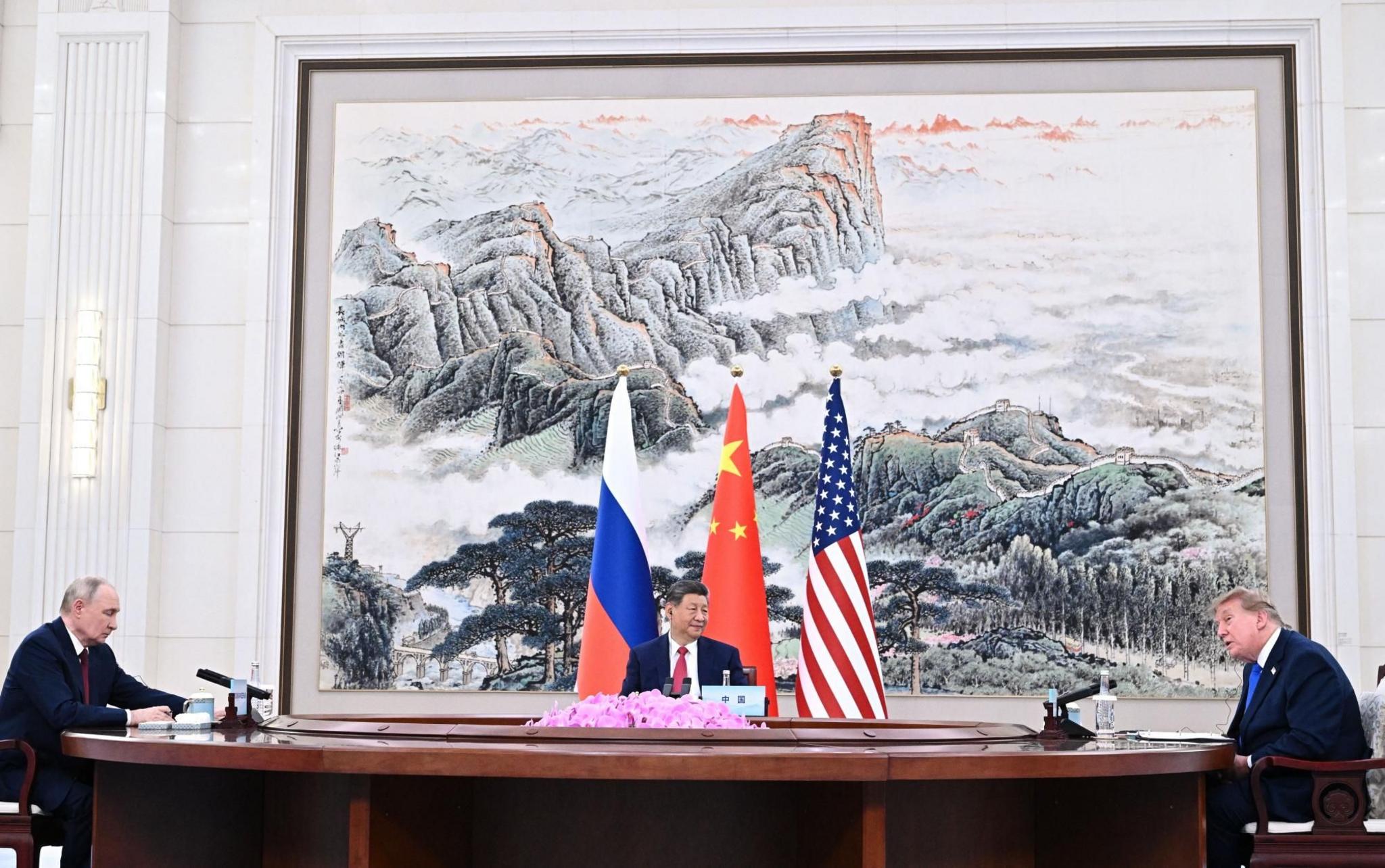
Trilateral summit high on spectacle, short on substance
 Image source, EPA
-
Published
Donald Trump went into his trilateral meeting with Vladimir Putin and Xi Jinping with little on the agenda and no clear asks – and it appears that he left with little in return.
In the end, the visuals of the meeting – the “optics”, as political wags like to say – may be the only lasting impression from the summit, billed by some as an historic “Yalta 2.0” meeting of great powers.
The pomp and the ceremony, in the end, may be what the US president wanted most. Trump, bruised by his Republican Party’s drubbing in midterm congressional elections earlier this month, clearly relished the global spotlight during his three-day trip to Asia and the historic nature of the first-ever US-Russia-China trilateral meeting.
-
This is a remarkable diplomatic moment for China’s Xi – but it comes with pitfalls
-
Published13 hours ago
-
In an interview on Wednesday with Fox News, Trump noted his prominent seat at the Asia-Pacific Economic Cooperation (APEC) dinner on Tuesday and his reception upon arriving in China – “the fanfare, the beauty, the pageantry, the thousands of people” – as evidence that the trip already was a success.
That might appear to be a low bar, but it’s one that could satisfy the American president.
To play this video you need to enable JavaScript in your browser.
This video can not be played
So far, however, the US has been remarkably silent following the three-party meeting.
While China was quick to release a joint communique detailing the discussions and Putin expounded during an hour-long post-meeting press conference, Trump has made minimal public comments, instead promising a news conference at the White House on Friday.
On his trip to China earlier this year and following his meeting with Xi at the APEC summit in South Korea last October, Trump spoke with the press early in his flight back to Washington.
For the moment, the White House is letting the joint communique, released Thursday after the three met, do the talking. But the document is mostly a vague endorsement of efforts to ensure “strategic stability and international security”.
That, along with the visuals of three powerful men sitting in the same room to amicably discuss global issues, might offer some reassurance no catastrophic conflicts are on the horizon. But pledges of further “dialogue” and an acknowledgement that nuclear war “must never be fought” provide minimal substance beyond the rhetoric.
“In general, it’s good for the leaders of the major global players to come together in various formats, even if the results appear to be modest at best,” David Firestein, head of the Bush Foundation for US-China Relations, told the BBC.
A line about boosting “the production and supply of refined petroleum products” seems directed at Putin, given that nation’s role as a major source of fossil fuels on the international market. And it was hard to miss the condemnation of the International Criminal Court – a recent target of American ire.
If there’s one thing the leaders of the three major world powers can agree on, it’s that multilateral global organisations that attempt to enforce international law shouldn’t have the teeth to back up those efforts.
Once Trump returns to Washington, he is likely to face a political environment where views of his Asia trip range from measured concern to outright criticism.
“I am concerned by how we are characterising our relationships with geopolitical adversaries. Vladimir Putin and Xi Jinping are not our friends,” Republican Senator John Curtis of Utah said in a statement to the BBC on Thursday.
“Diplomacy is important, but it should never come at the expense of clarity about who our adversaries are.”
Democrats, for their part, did not mince words.
“American security cannot be traded away for photo opportunities or personal aggrandisement,” nine senators on the foreign relations committee wrote in a letter to the White House.
Trump is hardly the first American president to seek an international diplomatic breakthrough as a salve following domestic political setbacks. Democrats Bill Clinton and Barack Obama took overseas trips as presidents shortly after their party’s own midterm electoral defeats.
In those cases, any boosts to their standing proved short-lived. And while Trump may have gotten the images he wanted from his Asian summit, the lack of substantive progress accompanying them likely means this trip also will be quickly forgotten.
Brandon Drenon contributed to this report.

Follow the twists and turns of Trump’s second term with North America correspondent Anthony Zurcher’s US Politics Unspun newsletter. Readers in the UK can sign up here. Those outside the UK can sign up here.
-
-
Published43 minutes ago

-
-
-
Published9 hours ago

-

Disclaimer : This story is auto aggregated by a computer programme and has not been created or edited by DOWNTHENEWS. Publisher: BBC