
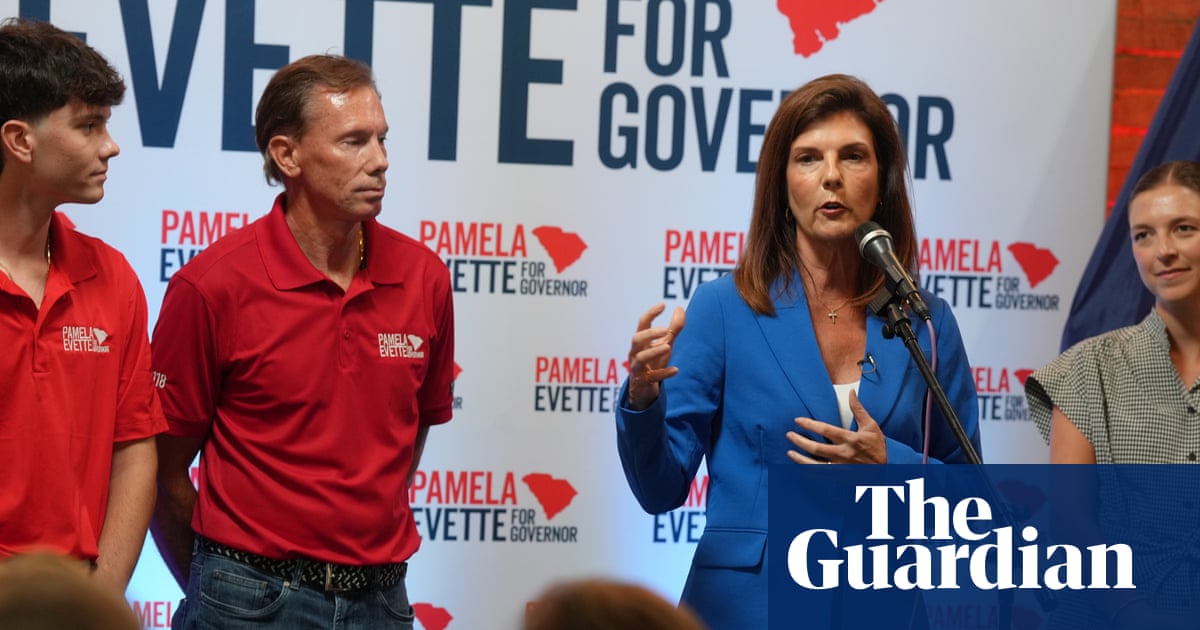
Donald Trump-backed Pamela Evette, South Carolina’s lieutenant governor and Alan Wilson, the state’s attorney general, have advanced to a runoff in a competitive race to represent the Republican party in South Carolina’s gubernatorial election.
The winner of the Republican primary is favored to win the closely watched general election, given South Carolina’s conservative tilt, although Democrats are hoping to ride a wave of progressive enthusiasm to make political gains across the ticket.
That result also signaled a decisive defeat for Nancy Mace, the controversial Republican congresswoman. She attributed her fifth place loss to her support for releasing the Epstein files, an issue that has continued to dog Trump.
“I voted to release the Epstein files and lost some support for that. As a survivor, I chose to stand on principle and stand against the Epstein cover-up. I chose to expose the names hidden in the sexual harassment slush fund. I chose to expose DEI judges. I chose to expose the abusers of children. And apparently, I chose wrong if the goal was winning an election,” she said in a statement posted to X.
The Republican gubernatorial nominee in South Carolina will face Jermaine Johnson, the Democratic state representative and a former professional basketball player representing a Columbia-area district, who won broad endorsement from party officials before winning the Democratic primary on Tuesday night.
South Carolina changed its election process in 2012 so that the governor and lieutenant governor run on the same ticket in a general election; outgoing governor, Henry McMaster, chose Evette as his running mate in 2018.
As an entrepreneur, Evette grew Quality Business Solutions, an HR and accounting software company, into a billion-dollar revenue business before entering politics. She led the contest in fundraising, with a war chest of about $3.5m, including $1m of her own money.
Meanwhile, Wilson, who has served as South Carolina’s attorney general since 2011, is a reserve colonel in the national guard’s judge advocate general corps and the adoptive son of long-serving Republican US representative, Joe Wilson.
The other two defeated candidates were Ralph Norman, a US representative, is – per GovTrack, a government transparency site – one of the most conservative members of the US House of Representatives, and also one of its wealthiest, after building a fortune as a real estate, trailed Evette and Wilson. Rom Reddy, child of immigrants and former Exxon Mobil executive, also sought the nomination and entered the governor’s race with $5m of his own money, citing the frustrations of a years-long dispute with environmental regulators over a seawall he had built to protect his Sea Island mansion.
In another closely watched contest, Lindsey Graham was confirmed as the Republican candidate for his US Senate seat, after facing five challengers – the most since he took office in 2003 – on Tuesday night. The former air force attorney’s hawkish positions on Israel and the US-Israel war on Iran made his campaign a measurement of conservative discontent on the conflict.
Trump-backed Graham chairs the powerful Senate budget committee, and South Carolina’s lawmakers view his position as core to the state’s political interests. He has been instrumental in convincing Donald Trump to escalate tensions in Iran, a war that has proven unpopular across the US as gas prices rise and an end date remains fuzzy.
Graham’s allies had poured money into the fight against his most likely opponent, Mark Lynch, who owns an appliance repair store in Greenville. Lynch had positioned himself as an outsider who would focus on housing and immigration instead of foreign entanglements.
Graham will face Democrat and pediatrician Annie Andrews in November.
South Carolina has been in the president’s crosshairs recently. State senators in South Carolina – including the Republicans who last month defied Trump over his bid to redraw the state’s congressional map – are elected in four-year cycles, and none are up for re-election this year. This has helped insulate them from immediate political blowback from the White House, as was seen in Indiana’s Republican primaries this year.
Disclaimer : This story is auto aggregated by a computer programme and has not been created or edited by DOWNTHENEWS. Publisher: theguardian.com






