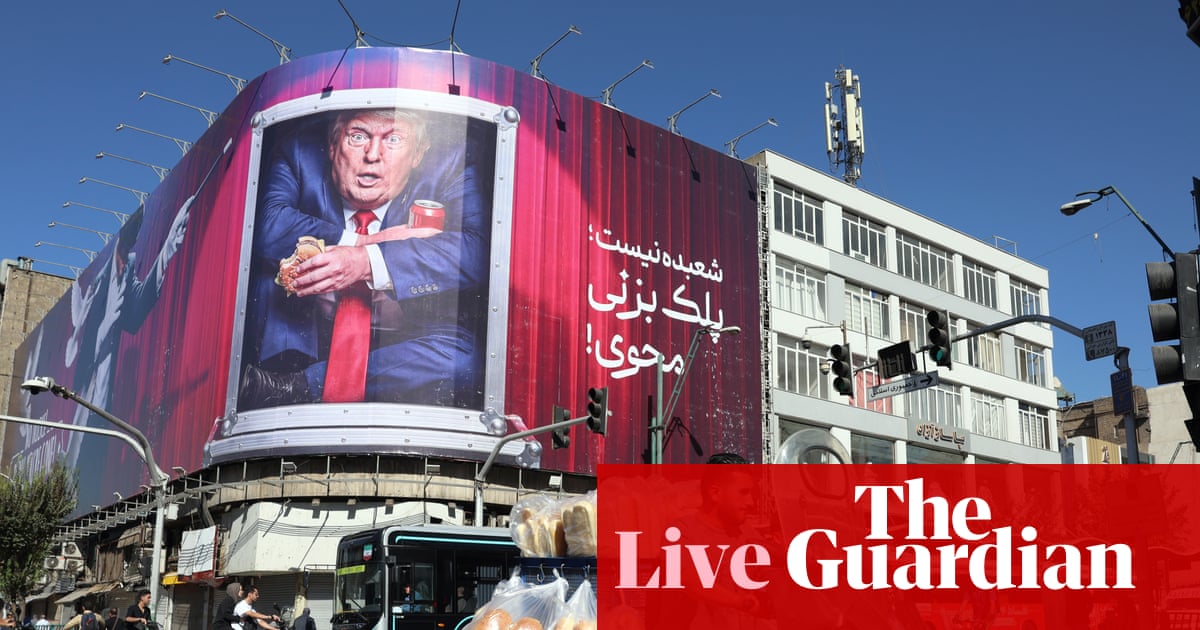
Donald Trump claimed that the US will not strike Iran “at any time prior” to the midterm elections on 3 November.
This comes after reporting from the Atlantic suggested that the White House has asked the Pentagon to develop strike options against Iranian targets that could be carried out ahead of the midterms.
On Truth Social today, the president said there were no plans to carry out attacks as long as “Iran is in very bad condition, both Economically and Militarily, and while the Blockade [in the strait of Hormuz] will remain in full force and effect”.
The missive comes as the president’s approval rating sinks to a new low, according to polling this week, and gas prices remain elevated, with the average gallon still costing more than a dollar more than before the war with Iran began in February. The conflict has arguably become the most politically toxic issue plaguing Republicans ahead of the November elections, with a number of Trump-endorsed nominees in key battlegrounds calling for an end to the war to ease prices for voters.
Donald Trump is currently hosting a science summit to honor top tech leaders including Elon Musk amid growing concerns over the risks of artificial intelligence.
At the US Institute of Peace on Thursday, Trump honored Tesla and SpaceX CEO Elon Musk, Google co-founder Sergey Brin, AMD CEO Lisa Su, as well as Nvidia CEO Jensen Huang – all of whom will receive the National Medal of Science.
“I recognize so many of you for an important summit on how we can revitalize the scientific enterprise in the coming years, and so we’re going to have lots of meetings and other things,” Trump told the audience.
Other industry leaders honored at the event include Microsoft CEO Satya Nadella and Dell Technologies CEO Michael Dell, both of whom will receive the National Medal of Technology and Innovation.
The event comes amid growing ties between the Trump administration and the AI industry as concerns mount over the technology’s rapid development and potential risks.
The US has imposed additional sanctions on entities including ships with ties to what the US treasury department has described as Iran’s “shadow fleet.”
In a statement on Thursday, the justice department said it is targeting “the aging network of tankers the regime relies on to move billions of dollars’ worth of petroleum and petroleum products to foreign markets.”
Treasury secretary Scott Bessent said that the US will “continue exposing those who enable the regime’s oil sales,” adding: “No enabler of Iranian sanctions evasion is safe from the full force of Treasury’s authorities.”
The US has imposed sanctions on 17 shadow fleet vessels that are responsible for transporting millions of barrels of Iranian crude oil and petroleum and petrochemical products to a variety of South and East Asia markets, the treasury department said.
Eric Leventhal knows he’s going to vote for a Democrat in Congress when he goes to the polls in Missouri this November – the problem is he has no idea which candidate is going to be on his ballot.
In the state’s August primary, he voted for Fred Wellman, a Democrat running in the state’s second congressional district. But after a long and complicated legal battle sparked by Donald Trump’s desire to gain every advantage in the upcoming midterm contest, the districts have changed for the general election that will determine which party controls Congress. Leventhal said he lived right near the border of the first and second congressional district, so now he’s not sure which one he’s in.
“It is dizzying and embarrassing, frankly,” said Leventhal, a 35-year-old stay-at-home father.
Leventhal’s experience crystallized the mix of anger and confusion felt in Missouri, where an effort by Republicans to redraw the state’s congressional map devolved into a saga that seemed to have as many twists and turns as the gerrymandered districts themselves.
For the full story, click here:
The Trump administration pressured multiple countries to withdraw their sponsorship of a leading European disinformation conference, with Canada, Lithuania and the EU’s diplomatic service agreeing to do so, the Guardian has learned.
The US intervened after taking issue with a panel examining the US as a potential foreign information threat, according to people familiar, as well as internal state department docs showing Washington thanking Lithuania, the conference’s host country, for “taking US concerns seriously”.
Lithuania’s withdrawal also comes just after the prime minister, Mindaugas Sinkevicius, said Lithuania would pay for a permanent US military base if the US agreed, a day after Trump said he would consider the request. The US state department has taken an increasingly interventionist posture towards free speech and civil society in Europe over the past year.
My colleague Aisha Down revealed earlier this year that the state department is awarding millions of dollars in non-competitive grants to organisations across the continent supportive of Trump’s agenda.
Read my full report with Aisha and our colleague Jennifer Rankin here:
Donald Trump claimed that the US will not strike Iran “at any time prior” to the midterm elections on 3 November.
This comes after reporting from the Atlantic suggested that the White House has asked the Pentagon to develop strike options against Iranian targets that could be carried out ahead of the midterms.
On Truth Social today, the president said there were no plans to carry out attacks as long as “Iran is in very bad condition, both Economically and Militarily, and while the Blockade [in the strait of Hormuz] will remain in full force and effect”.
The missive comes as the president’s approval rating sinks to a new low, according to polling this week, and gas prices remain elevated, with the average gallon still costing more than a dollar more than before the war with Iran began in February. The conflict has arguably become the most politically toxic issue plaguing Republicans ahead of the November elections, with a number of Trump-endorsed nominees in key battlegrounds calling for an end to the war to ease prices for voters.
In closing, the lawyer for the newsrooms said that it is a “very dangerous, chilling doctrine” if a journalist’s press pass is at risk “because President Trump decides something you said is false”.
However, he noted that the first amendment imbues reporters with protection while covering the government, and requested that the Judge Kelly convert the temporary restraining order of the ban to a preliminary injunction.
Kelly said that he expects to issue a ruling by Tuesday, but possibly earlier. In the meantime he extended his pause of Trump’s ban, which was set to expire today, until then.
The lawyer representing the Trump administration, Michael Velchik, argued today that there are two reasons behind banning the three outlets. First “packaging verifiable falsehoods” and failing to meet “minimum journalistic standards”, and second national security.
“We’ve never argued that this is solely and only because of national security,” Velchick said, but later conceded that there is “overlap” between the two ideas and they are not mutually exclusive.
Interestingly, Velchick argued today that it would be a tall order for the outlets to claim irreparable harm for being blocked from the White House, because of the pool members who acted in solidarity by refusing to carry television feeds while their newsrooms were blocked from the White House.
“I would ask the court to try and analyze how, in practical terms, can they say that it is irreparable,” he said.
The administration has argued that it tried to ban CNN, Politico and MS Now from the White House on national security grounds. The White House claimed that the outlets have failed to meet basic standards of “professionalism and decorum”, including allegedly publishing sensitive or classified material.
However, the lawyer representing the outlets said today in court that the government hasn’t backed up their claims that their reporting affected national security.
“They haven’t said they haven’t shown with any evidence that this was ban was implemented because of national security concerns,” Ted Boutrous said. “They haven’t shown that the ban that the reports jeopardize national security … They haven’t found that the ban helped them protect national security, and so the harm would be irreparable.”
Earlier, Boutrous argued that “one of the most important areas that journalists report on is national security, and it’s been going on in the White House and outside the White House since the beginning of our country”.
He added: “It’s extremely important for reporters to report on that andhold the government accountable.”
We’re following the key hearing in the Trump media ban case now, which is under way in DC district court.
Ted Boutrous, the lawyer representing CNN, MS Now and Politico, said today that Trump has “unambiguously said” that the grounds for barring these outlets is “because of what he perceives as negative, false, bad, not positive enough reporting”.
He also repeated to Judge Timothy Kelly, the Trump-appointed judge presiding, that the outlets received “no notice whasoever” about the ban – an issue that Kelly brought up explicitly when he issued his temporary injunction two weeks ago.
Boutrous noted that Steven Cheung, the White House communications director who he described as “no shrinking violet” also issued no declaration that there was a specific problem.
“President Trump has been making these nasty comments about my clients for a long time, and suddenly there’s an emergency,” Boutrous said.
Also today, the administration announced it had launched investigations into nine universities, they allege are committing J-1 visa fraud.
These temporary visas that are often used by higher education institutions for specialized work and study exchange programs. The justice department announced these investigations into Harvard, Yale, Stanford, Brown, University of Pittsburgh, University of Califonia Davis, Caltech, Arizona State, and Massachusetts Institute of Technology.
“Subpoenas have been served. Investigations are underway, and nobody will be getting a free pass because their name is carved into an expensive building,” said Anthony D’Esposito, the inspector general of the labor department.
Today, the Trump administration announced it would block Microsoft from a program sponsoring foreign workers for green cards – which grant permanent residency in the US.
These workers are already in the US on H-1B visas, a temporary work visa that allows US companies to hire skilled foreign workers for specialized jobs. Since returning to office last year, Donald Trump has sought to restrict the use of the program, including by imposing a $100,000 fee on new H-1B visas. That order was later blocked in court.
Today, the administration said it was suspending Microsoft from the so-called Perm program, the first step employers must complete when sponsoring workers for employment-based green cards. The move would prevent Microsoft from using the process to seek permanent residency for many employees currently on H-1B visas.
“Our message to Microsoft is: you’re a great American company, but you’ve got to hire great American workers. You cannot lay off American workers and then replace them with foreign indentured servants,” said vice-president JD Vance. “We cannot allow visa programs that were designed to ensure that American corporations had access to the best and the brightest to use them to undercut the wages of American workers.”
Vance also claimed that that foreign workers are “earning wages that are far below the average for American citizens”. However, according to a 2025 study from the University of Massachusetts, Amherst, while immigrants in the US earn 10.6% less than similarly educated US-born workers, but this is because they are concentrated in “lower-paying industries, occupations and companies”, not getting paid less for the same work.
Reporting from Athens
US secretary of state, Marco Rubio, has used his latest tour of Europe to voice fears over the spillover effects of the war in Ukraine.
On the third day of his tour in Europe, Rubio expressed Washington’s mounting concern over the ability of the war in Ukraine to spread, more than four years after Russia invaded the country.
In an interview with Greece’s authoritative Kathimerini newspaper – published hours before he departed Athens for Portugal – Rubio said the conflict appeared to be mired in a “strategic stalemate which is a dangerous thing,” because a negotiated settlement was still far off.
“In the meantime, we watch with great concern as escalation could happen. Just yesterday, some ships were attacked in the Black Sea through a coordinated drone attack. We’re worried about a sabotage operation in a neighboring country that can spiral out of control,” he said.
It was clear, he told the paper, that Russia was now bent on using the upcoming winter to destroy Ukraine’s electricity grid in a bid to get Kyiv to surrender.
“Meanwhile, Ukraine has grown more effective in its ability to conduct long-range strikes deep into Russia. So, we share the same concern. The whole world is going about this thing like something that could escalate and perhaps become a broader conflict.”
Rubio also predicted that Tehran was only weeks away from “facing the most cataclysmic economic catastrophe in the history of modern Iran,” saying the country’s oil shipments were about to run dry because it no longer controlled the Strait of Hormuz.
About 20% of the world’s oil and liquefied natural gas (LNG) is shipped through the waterway connecting the Gulf with the Arabian Sea. “Now, as it stands today, the Straits are open, and Iran does not control them. Oil shipments through the southern lane, which we cleared of mines, are now at almost 80% of pre-conflict levels. The only country that cannot reliably get oil out of the Middle East is Iran, whose shipments have all been blocked or stopped by a blockade. They’re facing crushing economic pressure, which will only grow exponentially in the next few weeks.”
Former president Barack Obama has endorsed Troy Jackson, the Democratic nominee in the US Senate race in Maine.
A reminder that Jackson, a logger and former state lawmaker, replaced Graham Platner – the embattled former nominee – after he faced allegations of sexual assault and rape, which he denies.
Platner’s withdrawal from the race set off a frantic search for an alternative, and resulted in a special party convention where Jackson secured nearly all the delegates from across the state. He’ll now face the five-term Republican incumbent, Susan Collins, in November. Who, for years, has boasted her “moderate” credentials and proven unbeatable in a purple state that Trump has lost three times.
In a straight to camera video, Obama touted Jackson’s achievements as Maine senate president, said the state needs a “fighter like Troy” in Congress and emphasised Jackson’s work to protect reproductive rights in the state legislature in the wake of the Dobbs decision, which overturned the constitutional right to an abortion.
On the trail, Collins has received blowback for her 2017 vote to confirm conservative justice Brett Kavanaugh to the supreme court. In 2022, Kavanaugh joined the majority opinion overturning Roe v Wade, the landmark abortion rights protection. This year’s midterm elections mark the first time Collins is on the ballot since the ruling.
As I noted earlier, we’ll have the second debate between Jackson and Collins in Maine at 8pm ET.
Disclaimer : This story is auto aggregated by a computer programme and has not been created or edited by DOWNTHENEWS. Publisher: theguardian.com