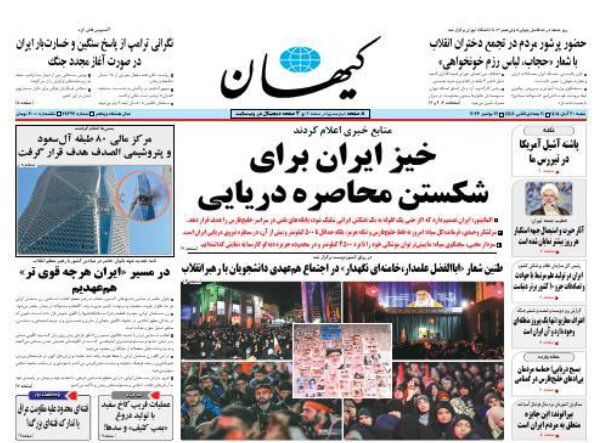
Kayhan assessed Donald Trump’s approach following what it described as the failure of confrontation and pressure against Iran. According to the paper, after encountering setbacks, Iran’s enemies have shifted their focus toward negative media campaigns and efforts to generate unrest. It argued that recent economic, social, and media developments inside the country have coincided with the activities of opposition groups and statements from US officials.
Viewed together, these events form a coordinated “hybrid war” strategy. Kayhan said Trump is pursuing a broader plan aimed at weakening Iran and that, after reaching a dead end through confrontation and pressure tactics, he now sees domestic instability as his most practical option. The commentary argued that attempts to fuel disorder are intended to occupy Iranian security institutions and create conditions favorable to future pressure. Recent developments should therefore be understood not as isolated incidents but as interconnected elements of a larger strategy directed against Iran.
Iran: ECO is a capacity that should be utilized
Amid shifting regional geopolitics, efforts by the United States to disrupt trade routes, and continuing economic pressures, the need for Iran to strengthen economic relations with neighboring countries has become increasingly important. In this context, the Economic Cooperation Organization (ECO) is viewed as a potentially significant platform for expanding trade and transit cooperation. In an interview with the Iran newspaper, Tehran University professor Akbar Valizadeh highlighted the growing geopolitical and geoeconomic importance of ECO. He argued that the organization has substantial potential to become an effective framework for regional cooperation. However, he stressed that this potential can only be realized if member states move beyond broad declarations and focus on practical projects that generate mutual benefits. ECO could help reduce part of the economic pressure facing Iran by facilitating transit, harmonizing trade procedures, expanding financial cooperation, and diversifying transportation routes. Tangible economic initiatives and greater coordination among member countries will determine whether the organization can play a larger role in regional development.
Jam-e-Jam: Admission of failure
Jam-e Jam examined a joint statement issued by the United States, France, Germany, and the United Kingdom at the International Atomic Energy Agency’s Board of Governors. The statement reaffirmed support for the agency’s safeguards and verification functions and called on Tehran to resume full cooperation without delay. Quoting political analyst Abbas Salimi Namin, the report argued that the renewed focus on this issue amounts to an acknowledgment that previous pressure strategies failed to achieve their goals. He maintained that military and confrontational policies did not succeed in stopping Iran’s peaceful nuclear activities and that Western governments are therefore returning to diplomatic and political mechanisms in an effort to exert influence. The analysis portrayed the emphasis on IAEA cooperation as evidence that alternative approaches are being revisited because earlier methods did not produce the desired results.
Donya-e-Eqtesad: Overlapping interests among China, Russia and US favor diplomacy over war
Donya-e-Eqtesad analyzed the possibility of a trilateral meeting involving the leaders of the United States, Russia, and China in Shenzhen. According to the article, such a gathering would be less likely to signal the start of a new conflict involving Iran and more likely to represent a calculated diplomatic display amid a tense security environment. The significance of the proposed meeting lies in its ability to preserve both diplomatic engagement and strategic pressure simultaneously. It also discussed the deployment of three US aircraft carriers in the region. While acknowledging that these military movements have heightened tensions, the article suggested they also indicate that key actors are still assessing one another and searching for alternatives to confrontation. To understand the situation, the newspaper proposed examining three dimensions separately: the rationale behind a summit among the three leaders, the practical role of military deployments, and the factors that encourage or discourage war. In its assessment, overlapping interests among major powers are a more important driver of diplomacy than any immediate movement toward conflict.
Arman-e-Melli: Netanyahu seeks another war
Arman-e-Melli argued that Israeli Prime Minister Benjamin Netanyahu is experiencing political and strategic uncertainty and is attempting to persuade Trump and his team to adopt a tougher stance toward Tehran. According to the article, these efforts are unfolding while Iran and several regional actors, particularly mediators, are trying to reduce tensions and create conditions for a possible agreement. The paper claimed that Netanyahu seeks to obstruct this process and prevent closer engagement between Tehran and Washington. The analysis concluded that Israel continues to advocate stronger pressure on Iran, but it also stressed that significant regional and international forces oppose a return to open conflict. As a result, despite ongoing tensions and political maneuvering, many actors remain focused on avoiding another war and pursuing diplomatic alternatives instead.
Disclaimer : This story is auto aggregated by a computer programme and has not been created or edited by DOWNTHENEWS. Publisher: tehrantimes.com