
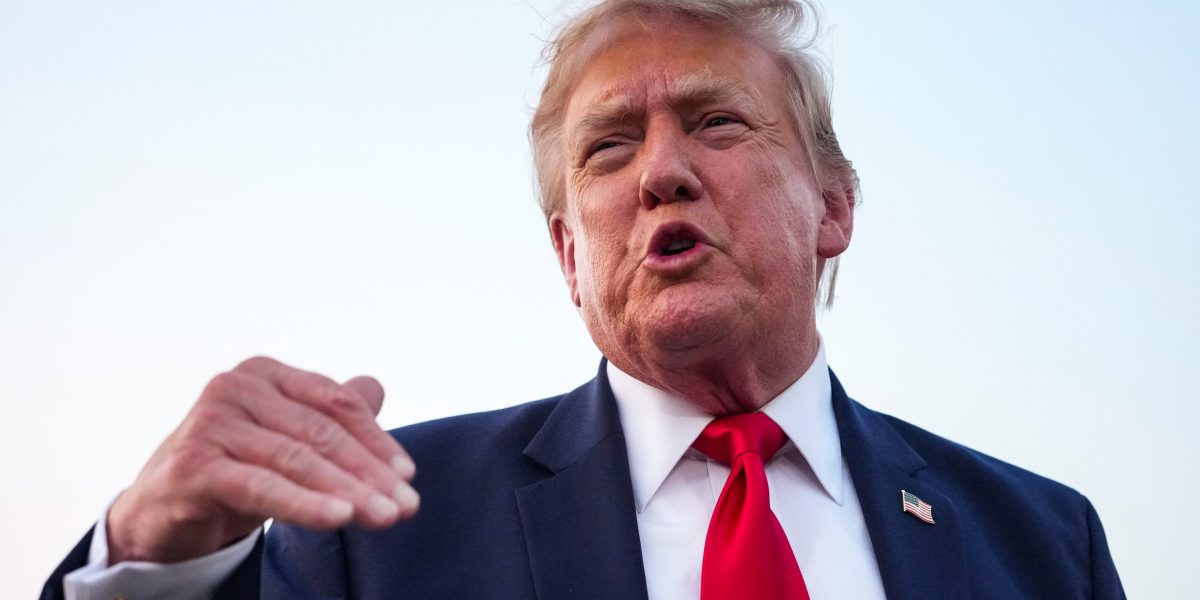
President Trump told a cheering crowd at Wheeler High School in Marietta, Georgia, on July 22 that “affordability” was a term invented by his political opponents, recounting the exact moment he says he first heard it: at his very first press conference after taking office, when a reporter pressed him on rising egg prices.
“They used the word — first time I heard it. It was a word, you know, made up by the Democrats. Affordability,” Trump said, describing his response at the time as, “I’ve been here one day. Don’t worry. I’ll take care of it”. He blamed his predecessor Joe Biden and the “radical left Democrats” for what he called “the worst inflation in 48 years,” citing Treasury Secretary Scott Bessent as his source for the figure. In fact, the 2022 inflation surge was the worst in roughly 40 years, with Yale economist Stephen Roach noting that Trump often repeats the claim, one of his “biggest economic lies.”
Trump’s rally in Marietta was a case study in what that reframing costs him. The president’s economic narrative — eggs down, oil coming, stocks up, 401(k)s flush — is accurate in pieces and misleading in sum. The stock market has hit 73 all-time highs since the election while consumer confidence is near historic lows, and both things are true because the market rally is riding on a rickety bet on AI, with tech megacaps’ earnings not translating into lower grocery bills or affordable mortgages. The president spent Wednesday night celebrating one half of that picture and dismissing the other as a word his opponents made up.
Georgia gubernatorial candidate Rick Jackson, who spoke alongside Trump, offered his own reframing of the affordability debate: “The other side talks about affordability as if that’s a solution. Affordability is not a political problem. Affordability is a business problem,” a remarkable statement for many reasons, not least for undercutting Trump’s tendency to blame high prices on Joe Biden. He spent Wednesday night celebrating the record-setting stock market and dismissing the affordability squeeze weighing on voters as a word his opponents made up.
Trump’s comments about the price of oil told a similar story.
The oil prediction
When Trump turned to energy prices, he framed recent spikes as temporary friction on the way to a much larger drop. “Oil will be coming — it’s going to be tumbling down,” he told the crowd, describing a collapsed deal with Iran three weeks earlier: “They thought we had a deal. I said, ‘I don’t think we have a deal with these guys. They break every deal they make.’”
The next day, oil surged on renewed fighting in the Middle East. Brent crude rose more than 6% to over $100 per barrel in early Thursday trading, its highest level since the end of May, while U.S. crude jumped for a second straight day to almost $92 — its highest since early June.
On Wednesday night, Trump had insisted prices would eventually fall — “maybe lower than when we even started” — but asked supporters for patience: “just give me a little time”.
The escalation also collided with Trump’s framing of the conflict as a mere “skirmish” that Iran wants to end. Houthi attacks on Saudi Arabian oil tankers in the Red Sea forced at least five vessels to reroute around the Bab el-Mandeb strait to avoid the danger zone. “They’re getting hit so hard, and they want to make a deal,” Trump said. “But I say they’re not ready to make a deal because every time they make a deal, they want to change it.”
Buried in the speech was a moment of concession Trump rarely offers on cost-of-living messaging. “I just want you to remember that if you’re paying a little bit more, a lot of it’s come down now. We got it coming down very rapidly, actually,” he said. Trump seemed to be talking about the slowing rate of inflation, which is coming down, while voters nationwide are angry that prices actually haven’t gone into reverse after years of what they see as unfair profit-taking. Since Trump told voters that he’d “won” on affordability in February — during another rally in Georgia, in fact — his polling numbers have served as a strong counter-argument. The latest polling available shows a more than 30-point plunge in voters’ opinions on his handling of the economy since his inauguration, with the net rating for his handling of inflation and prices at -43, the lowest for this term.
Eggs as the model, oil as the test
Trump held up falling egg prices as proof that his approach works, recalling that Easter egg hunt organizers once suggested using “plastic eggs” because real ones were too expensive. He credited his agriculture secretary with getting egg prices “lower than it was when we started” — a claim that lines up with independent data showing egg prices down nearly 28% year-over-year, though economists attribute the drop primarily to flock recovery after avian flu outbreaks rather than administration policy.
Several weeks earlier, the Justice Department and 17 states reached settlement agreements with three major egg producers this week over allegations that they had illegally colluded for years to raise prices. Cal-Maine — the only public company among the settling parties — reported a profit of $1.22 billion for the 2025 fiscal year; it agreed to pay $1.5 million and donate 30 million eggs, without admitting wrongdoing.
Oil is a different story. Unlike eggs, crude prices are hostage to an active shooting conflict Trump has repeatedly declared nearly over, only to see it reignite. He told the Marietta crowd that Venezuela was now helping fill the gap — claiming the U.S. and Venezuela together control “about 62% of the world’s oil market” and don’t “need the Hormuz Strait” — but added, “we do it because we have to do it because we cannot let Iran have a nuclear weapon.” Another source disagreed with this statement: President Trump himself, who estimated the U.S. and Venezuela have 55% of the world’s oil market in January. In fact, BP and EIA data indicate both of those are massive overstatements, and the true percentage is roughly 24%.
In other remarks in Marietta, Trump seemed to celebrate business as something that isn’t problematic at all, noting that the stock market has hit 73 all-time highs since the election and that the typical American’s 401k is up by $34,000, “setting records day after day.” What he left unmentioned is a divergence Wall Street’s own research desks have been flagging for months. J.P. Morgan Private Bank found that stock valuations are trading near record highs while consumer confidence sits close to record lows, attributing the gap to what strategist Jason Seydl called “the inescapable word — affordability.” The University of Michigan’s Consumer Sentiment Index should be running near 93 based on stock performance, unemployment, and inflation trends alone — instead it’s roughly 40 points lower, closer to historic lows.
The mismatch traces to who actually owns the rally. Much of the 2026 market surge has been concentrated in a handful of AI-driven megacaps, whose earnings gains rarely translate into higher household spending power. Meanwhile, median-income families now need roughly $50,000 more in annual income than they did in 2019 just to afford a median-priced home, and a typical family earning the nation’s median income of $106,800 still needs 32% of that income just to cover a mortgage payment — the exact “affordability” squeeze Trump dismissed as a made-up word. Those are the people paying a “little bit more,” as the president said.
For this story, Fortune journalists used generative AI as a research tool. An editor verified the accuracy of the information before publishing.
Disclaimer : This story is auto aggregated by a computer programme and has not been created or edited by DOWNTHENEWS. Publisher: fortune.com






