
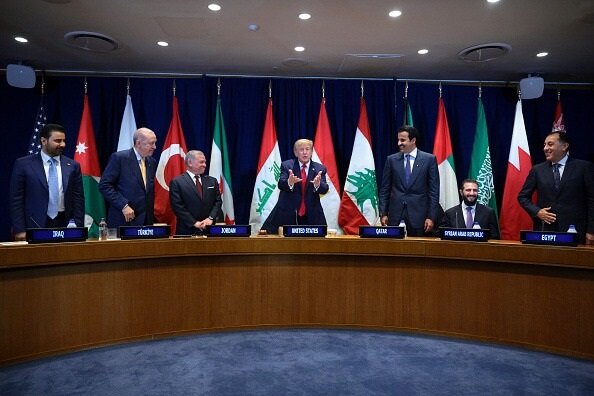
TEHRAN – US President Donald Trump convened a closed-door meeting with leaders of Arab and Muslim states on Tuesday on the sidelines of the UN General Assembly, as uncertainty continues to loom over the nearly seven-month-long war against Iran.
The meeting—attended by heads of state and senior representatives from the Persian Gulf Cooperation Council (GCC), alongside leaders and envoys from Egypt, Turkey, Lebanon, Syria, and Iraq—came under the shadow of widespread regional anxiety over the disruption of maritime transit across the Strait of Hormuz and the Red Sea, which has sent global energy markets into a tailspin and strained regional economies.
Addressing reporters ahead of the talks, Trump renewed his threats to “annihilate” Iran while talking up the US military campaign. He also claimed to have brokered a “historic peace deal” in Gaza.
Washington has reportedly floated an initiative to establish a $10 billion joint reconstruction fund with Arab states to repair the infrastructure damaged and destroyed during the conflict. According to sources cited by the Financial Times, US officials actively discussed the proposal with regional partners ahead of the gathering.
However, political observers argue the US administration is reluctant to exit the war without securing a symbolic victory to sell to domestic audiences and international media, given its self-styled image as the “leader of the free world.”
Trump’s latest remarks and diplomatic overtures coincide with a growing reassessment across the Persian Gulf regarding long-standing reliance on American security guarantees.
Throughout the conflict, Iranian missile and drone strikes have directly targeted American military installations across the Persian Gulf. The vulnerability of heavily fortified US bases has demonstrated that Washington cannot single-handedly safeguard its own assets, let alone guarantee the absolute security of neighboring Persian Gulf nations.
This development was highlighted earlier this month by Qatari Foreign Ministry spokesperson Majed al-Ansari at the Hili Forum in Abu Dhabi, who emphasized that relying solely on external alliances is insufficient.
“We need to realize in the [Persian] Gulf that having international forces in the region, having a strategic alliance with the US is very important, but it is not enough,” al-Ansari said. “Self-sufficiency when it comes to security is the only way forward.”
Analysts view the ongoing hostilities as a major turning point for Persian Gulf foreign and defense policy, signaling that reliance on external powers offers a false sense of security. To secure long-term stability, regional capitals are increasingly emphasizing the necessity of defense self-sufficiency and deeper, direct security cooperation among neighboring states.
Disclaimer : This story is auto aggregated by a computer programme and has not been created or edited by DOWNTHENEWS. Publisher: tehrantimes.com




