
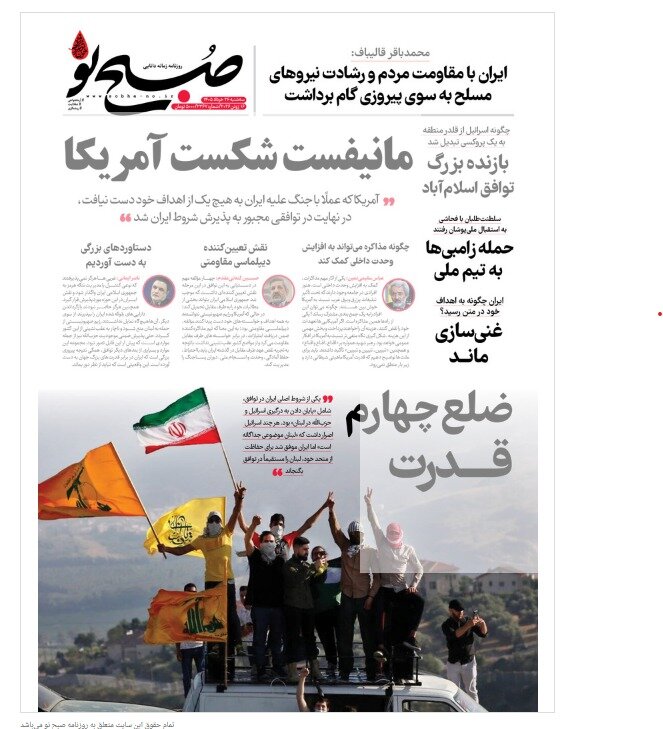
Sobh-e-No: Recent weeks have shown that Donald Trump is so eager for an agreement that even during Iran’s attacks on Israel last week, the US refrained from intercepting Iranian missiles. Trump has openly criticized Israel’s attack on Lebanon—indicating that, contrary to his earlier claims, the unity of fronts based on the demands and logic of the Islamic Republic has been firmly established.
The United States now fully understands that Iran will not accept any ceasefire or agreement unless all fronts are de-escalated, and Iran continues to firmly support Resistance groups in the region. Ultimately, the US—which before the war insisted that Iran must commit to ending support for Resistance groups—now finds itself offering a form of security guarantee for those same groups, including halting attacks on Hezbollah and Lebanese territory. Washington knows that otherwise, Iran’s armed forces will find other ways to support their regional allies.
Deterrence in danger
Khorasan, in an article, addressed the lack of restraint on Israeli attacks and the resulting weakening of regional security. According to the paper, the renewed Israeli strike on Beirut’s Dahiyeh—precisely on the day when talk of a new Iran–US understanding was circulating—carries a strategic message directed at Iran and the future of any regional security arrangements.
The core problem in the cases of Lebanon, Gaza, and even Iran–US negotiations has always revolved around a fundamental question: Is the United States capable of controlling Israel’s behavior or not? A significant portion of Israel’s military, intelligence, and political power depends on US support. If Washington truly wants an agreement, it must demonstrate the ability to restrain its strategic ally. If attacks and violations become routine in the middle of negotiations, no sustainable agreement will ever emerge. An agreement only becomes meaningful when the other side understands that the era of simultaneously exploiting negotiations and applying pressure has come to an end.
Jam-e-Jam: A challenge to the Persian Gulf security order
Jam-e-Jam analyzed the emerging challenges among Persian Gulf states after the Ramadan War. Throughout the conflict—despite heightened tensions, hostility, and reciprocal military actions—the leaders of Iran and most Arab Persian Gulf states tried to preserve political and diplomatic channels and prevent a direct, full-scale, and overt military confrontation. However, the current war has led to a serious escalation of mistrust between the parties. This situation has had significant negative consequences for relations between Tehran and Arab capitals and may start in a new phase of negative competition, especially in military and arms-related domains, further fragmenting the Persian Gulf’s security order. Still, the intensity of tensions and rivalries between Iran and Arab actors will depend on two key factors: the level of confrontation or potential agreement between Iran and the United States in the coming days and months, and the willingness and capacity of Arab leaders to strengthen multilateralism and reduce their security dependence on the US in the medium and long term.
Resalat: A breathing space
Resalat emphasized the need for full diplomatic vigilance during the 60‑day ceasefire with the United States. From the newspaper’s perspective, diplomatic signals indicate that Iran–US confrontation and indirect negotiations are converging toward a specific point—one whose initial aim appears to be ending wartime tensions and immediately afterward launching a 60‑day marathon of nuclear talks. The undeniable reality, the paper argues, is that the country’s main project must never be reduced merely to negotiations. Past decades have shown that for Washington and Tel Aviv, the negotiating table is not a path to lasting peace but a tactical tool alongside other pressure mechanisms. Thus, the upcoming talks should not be viewed as the end of the struggle. Instead, these 60 days—and any potential agreements—should be treated as a breathing space, a window of time to repair, update, and reinforce the country’s military and security deterrence machinery.
Hamshahri: Why the assassination failed
Hamshahri examined why Israel’s long‑standing policy of targeted assassinations has failed against the Axis of Resistance. For decades, Israel has used assassination as a strategy to weaken or destroy the Resistance and its allies. However, political and military trends show that assassination, as a short‑term tactic, has not only failed to deter but has produced reverse and provocative effects. Despite the assassination of commanders during the Ramadan War, the firing of multiple waves of missiles toward Israeli‑occupied territories demonstrated the effectiveness and resilience of Iran’s military capabilities. Assassinations did not halt the quantitative or qualitative development of Iran’s missile program. The continued expansion of Iran’s missile diversity and power shows that assassination may have a limited short‑term impact but cannot stop Iran’s long‑term strategic trajectory or that of its allies.
Disclaimer : This story is auto aggregated by a computer programme and has not been created or edited by DOWNTHENEWS. Publisher: tehrantimes.com




