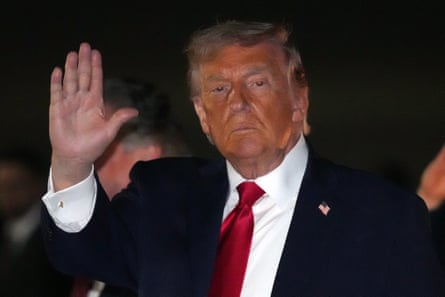
Donald Trump has said the US will attack Iran on Wednesday, and accused Tehran’s peace negotiators of “playing us for suckers”, just a day after claiming again that a peace deal was imminent.
The threat came hours after the two sides had traded fire, drawing neighbouring Gulf states back into an on-and-off war that has consumed the region since late February.
“We hit them hard yesterday and we’re going to hit them hard again today,” the US president told reporters at the White House on Wednesday.
Trump, seemingly frustrated by the lack of progress in talks to turn a temporary ceasefire into a permanent truce, added: “We were really close to a deal, but they keep tapping us along, they keep playing us for suckers.”
In the early hours of Wednesday, the US launched strikes against Iran in retaliation for what it said was Iran’s downing of a US army helicopter near the strait of Hormuz. Iran then launched a wave of retaliatory airstrikes, claiming hits on US bases in Bahrain, Jordan and Kuwait.
Iranian state media said US strikes had hit two reservoirs in southern Iran, leaving 20,000 residents without water and creating a “major problem for the region’s water supply network”.
“Unfortunately, following this attack, 20,000 residents of the region have lost access to safe drinking water, and with temperatures ranging between 45C and 50C, conditions have become extremely difficult and critical for local inhabitants,” Iran’s state television said, quoting local water company officials.
The latest tit-for-tat attacks were the most severe escalation since a ceasefire was established in early April.
Talks to turn the ceasefire into a durable peace have been stalling for weeks, with periodic flare-ups as both sides continued to launch limited strikes and to trade blame for violating the truce.
Iran’s foreign ministry spokesperson, Esmail Baqaei, said US strikes had jeopardised the ongoing ceasefire negotiations. He accused the US of undermining diplomacy with its attacks and contradictory messages, and said Israel was also harming the diplomatic process by continuing to violate the ceasefire in Lebanon.
“Following overnight events, we need to reassess … any diplomatic process requires a minimum stable environment,” Baqaei said.
Fox News reported that Trump had said in a phone interview that he could order new strikes on power plants and bridges because Iran was taking too long to make a deal.
Trump has frequently threatened to resume military action since the ceasefire was established, but has not yet fully followed through. He has also repeatedly claimed – including as recently as Tuesday – that a peace deal was imminent.
In his White House remarks on Wednesday, Trump also said that the US has been taking oil out of Iran: “I’m just announcing today for the first time, but we’ve been taking out millions of barrels of oil, millions of barrels every night.”
He added, without sharing any other details: “Millions of barrels of oil has come out, and that’s why it’s at $85-$90 a barrel, instead of $250.”
Regional mediators have been trying to de-escalate tensions and revive the sputtering diplomatic track. A delegation from Qatar – a key mediator – landed in Tehran on Wednesday to discuss the latest developments related to efforts to end the war, Iranian media reported.
The war has spilled over to the rest of the Middle East and the wider region. The Turkish president, Recep Tayyip Erdoğan, told Turkish lawmakers on Wednesday that Israeli strikes in Syria and Lebanon, and Israel’s “aggression”, posed a threat to Turkey and the whole world.
The Israeli prime minister, Benjamin Netanyahu, hit back, calling Erdoğan an “antisemitic dictator” who was unfit to criticise Israel.
The US military described its overnight attacks as a “proportional response” to the downing of a helicopter, saying its two crew members had been rescued.
The US said it had hit Iranian air defences, ground control stations and radar sites. Iran said Qeshm island and the port city of Sirik were attacked, while Iranian media reported explosions in the seaside city of Bandar Abbas.
Two crew members of a tanker were reported missing and another injured after a suspected missile strike by the US military enforcing its blockade of Iran’s shipping routes, according to UK maritime security company Ambrey.
The Iranian Islamic Revolutionary Guard Corps responded to the US strikes by attacking US bases in Bahrain, Jordan and Kuwait, and said it was ready to give a “crushing and decisive” response if the US attacked again.
The US military said nearly all Iranian missiles and drones had been intercepted, with no immediate reports of US casualties or damage to its facilities. Bahrain, Jordan and Kuwait all said the Iranian projectiles had been intercepted.
Hours before the US strikes, Iran’s parliament speaker, Mohammad Bagher Ghalibaf, said in a post on X: “We prefer the language of diplomacy, but we speak other languages far more fluently. Break your commitments, and we’ll switch to what we speak best.”
Despite the attacks and escalating rhetoric, a US official suggested that a deal with Iran could still be close.
“Nothing changes where the deal stands right now,” an anonymous senior white house official told Politico. “There’s a military bucket and then there’s a negotiation bucket … so, two things can happen at the same time.”
Trump is keen for a peace deal as US midterm elections approach amid rising inflation and plummeting presidential approval ratings. But despite him frequently claiming a deal with Iran is close, and several rounds of mediated talks, significant gaps remain between the two sides.
Iran is seeking the lifting of international sanctions, the unfreezing of billions of dollars in assets, and control over the strait of Hormuz. Trump has said that any future peace deal must prevent Iran from developing a nuclear weapon, while Iran denies that it wants one.
Access to the strait of Hormuz – a choke point for about a fifth of the global oil supply – remains restricted by Iran, while the US maintains a blockade on Iranian ports. The interruption to global shipping and energy supplies have had knock-on effects around the world, increasing the prices of food, energy and other goods.
A significant obstacle to a lasting peace deal between Iran and the US has been the fighting between Hezbollah and Israel in Lebanon. Iran has insisted that any ceasefire must include the Lebanese front, while Israel and the US have been eager to separate the two.
Disclaimer : This story is auto aggregated by a computer programme and has not been created or edited by DOWNTHENEWS. Publisher: theguardian.com