Experts doubt America’s bunker-busters can reach Pickaxe Mountain’s chambers, carved up to 100 metres into hard granite.
Donald Trump has bombed southern Iran for four consecutive nights, hitting radar posts, missile sites, Revolutionary Guard speedboats, and the ports and islands that line the Strait of Hormuz.
Now the US president is eyeing something much bigger.
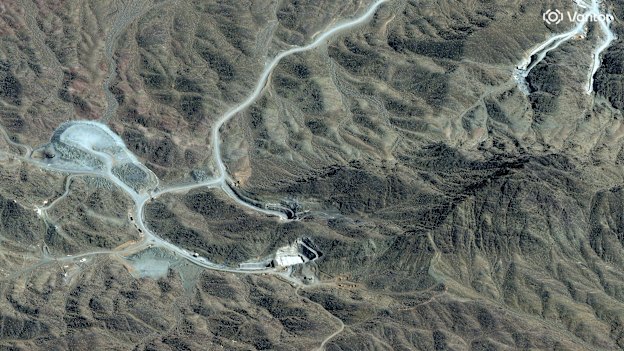
Trump says he intends to strike Pickaxe Mountain, the vast, half-built granite fortress in central Iran that Western officials believe may hold the most closely guarded pieces of the country’s nuclear program – and which many experts doubt any American bomb can reach.
“Pickaxe is a possible target for a nice, big, fat shot right in the front door,” Trump said on Monday.
“We’re going to take out Pickaxe Mountain. Tell the Iranians to be ready. Let them know we’re coming, OK? There’s not a damn thing they can do about it.”
Known in Persian as Kuh-e-Kolang Gaz La, the site is about 144 kilometres south of the Fordow enrichment plant and only minutes from the Natanz nuclear complex in Isfahan province.
It has been quietly reinforced and expanded for four years and new satellite images show construction still in progress, with trucks moving in and out of its tunnel entrances.
What sets Pickaxe apart from Iran’s other nuclear sites is geology.
Experts estimate its underground halls have been carved between 80 and 100 metres into hard granite – and in places, by some assessments, far deeper.
That is deeper than Fordow, the plant long described as the crown jewel of Iran’s enrichment program, whose chambers lie about 60 to 90 metres deep.
The mountain itself stands 1608 metres above sea level, more than 50 per cent taller than the peak that shelters Fordow, offering both greater cover and room for larger chambers.
Where Fordow has two tunnel entrances, Pickaxe has at least four – two on the eastern flank, two on the west.
Given the facility’s depth, many military analysts doubt that even the most powerful weapon in the US arsenal could inflict decisive damage.
The GBU-57 Massive Ordnance Penetrator, the 30,000-pound bunker-buster developed specifically to reach sites such as Fordow, is designed to punch through about 60 metres of earth before detonating.
Against granite at a depth of 100 metres or more, experts say, it may simply not get there. Iranians have taken to calling the site their impregnable “granite fortress”.
In 2020, Mossad agents, posing as dissidents, recruited employees to sabotage Natanz by smuggling in explosives disguised as boxes of food.
The explosions completely destroyed the plant’s independent internal power system, which powered centrifuges for enriching uranium. In response, Tehran resolved to move its most sensitive work somewhere unreachable.
Ali Akbar Salehi, then head of Iran’s atomic energy organisation, confirmed the strategy in 2021 after a second act of sabotage at Natanz, telling reporters – without naming Pickaxe – that Iran was building “numerous and advanced halls in the heart of the mountain” so that production of advanced centrifuges would not be interrupted.
Tunnelling in the area had begun as early as 2007.
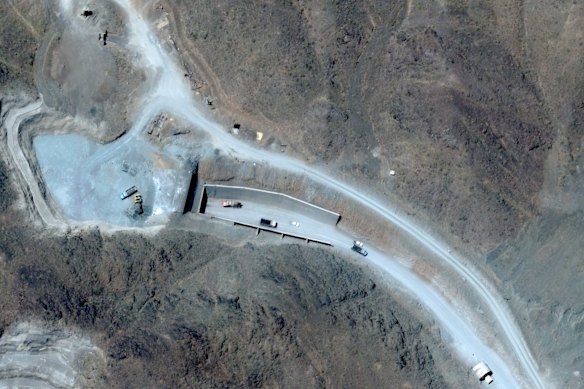
But the conversion of Pickaxe into an industrial-nuclear stronghold started in 2020, with a view to sheltering Iran’s strategic assets from the air. Its existence was brought to international attention by a Telegraph investigation last year.
Iranian analysts have offered the London Telegraph three theories about what really lies beneath the ground.
The first is that it houses a centrifuge assembly plant, the replacement for the destroyed Natanz hall, producing the highly specialised, high-precision gas centrifuges required for uranium enrichment.
The second is that it houses uranium metallurgy capabilities. These encompass the extraction, purification, fabrication and enrichment of uranium for nuclear fuel and industrial applications. The process transforms raw ore into highly reactive fuel pellets.
This work was damaged when above-ground industrial sites in Isfahan were struck in the 12-day campaign last year. Moving them underground would make them better protected.
The third, and the one that most alarms the West, is that Iran has equipped the mountain as a covert enrichment facility, installing cascades of centrifuges deep in the rock to enrich its stockpile out of reach of any attack.
Iran has refused to say what is inside.
When International Atomic Energy Agency director-general Rafael Grossi pressed Tehran on what lay beneath the mountain, he received a blunt reply: “It’s none of your business.”
As of the agency’s assessment in June 2025, Iran had amassed more than 400 kilograms of uranium enriched to 60 per cent.
The threat to strike the mountain comes amid an escalating war at sea.
Iranian forces renewed attacks on tankers in the Strait of Hormuz, hitting two UAE-flagged vessels and wounding six Indian crew members and two Ukrainians.
Iranian reporting indicates no traffic is passing through the waterway at all, and that transit is effectively impossible.

According to an Iranian military source, Washington has been negotiating with governments and shipowners, offering to escort vessels through in exchange for about 20 per cent of the value of their cargo.
Ships joining the scheme, the source said, switch off their navigation and radar systems on entering the area and attempt to slip through the strait’s southern channel unseen.
The source said all such movements were under surveillance and that running dark offered no protection from detection or interception: any vessel attempting the crossing, he said, would “be confronted by the armed forces of the Islamic Republic”.
The Strait of Hormuz was open when Trump began the war in February. Tankers moved freely, and Tehran’s periodic threats to close it were treated as bluster it could not afford to act on.
But now with Ali Khamenei buried and the country convulsed by calls for revenge – from the streets, the clergy, commanders, and the new supreme leader himself, who vowed that his father’s killers would never enjoy “a peaceful death in bed” – morale inside the Revolutionary Guard is higher than at any point since the war began.
That changes the calculus around Pickaxe Mountain.
An attack on the site would be seen in Tehran as an assault on one of the key remaining pieces of the nuclear program the war was ostensibly fought to destroy – and it would land with the Guard emboldened, rather than cowed.
Iranian commanders have already made clear they would defend it.
The escalation strategy would include a total shutdown of oil from the strait and a closing of a second crucial waterway in the Red Sea, where the Houthi rebels have already started preparing for it, The Telegraph understands.
Closing Hormuz and Bab el-Mandeb together would give Iran control of two of the arteries linking Europe, the Middle East and Asia at once.
That is now Washington’s calculation to make. The strike Trump is threatening may be the one that turns a war over shipping lanes into a still bigger regional war that would harm global oil supplies even more than before.
The Telegraph, London
Get a note directly from our foreign correspondents on what’s making headlines around the world. Sign up for our weekly What in the World newsletter.
Disclaimer : This story is auto aggregated by a computer programme and has not been created or edited by DOWNTHENEWS. Publisher: www.smh.com.au