Traders seem to be betting that the U.S., Israel, and Iran are all trying to find a way out of the mess they’re in. Deutsche Bank’s “World Outlook”—published Monday and reiterated in another note this morning—says, “Amid lingering uncertainty, our oil forecast assumes a re-opening of Hormuz later in June.” Jim Reid’s team said today: “Our baseline expectation is that a US-Iran deal is reached this month that allows shipping through the Strait of Hormuz to resume, with Brent crude falling back to $86/bbl in Q4.”
ONE BIG THING
New rules for the S&P 500 could benefit SpaceX and Anthropic and hurt investors
To get into the S&P 500, a company is supposed to make money, writes Fortune’s Eva Roytburg. The sum of its last four quarters of earnings must be positive, as must its most recent quarter. That’s a decades-old rule, and it’s the reason the S&P 500 is regarded as the premier ranking of public, high-quality, large-cap U.S. companies.
Soon, that rule will likely be broken, three times. On purpose. S&P Dow Jones is considering relaxing its rules on profitability, trading history, and ownership concentration in order to allow SpaceX, OpenAI, and Anthropic to go public with—potentially—lower-quality earnings than the other stocks in the benchmark index.
Ordinary investors could be forced to eat this whether they like it or not: S&P index funds and ETFs are required to buy the entire index, they cannot pick and choose. The rule change would dilute retail investors, 401(k)s, and institutional investors alike with lower quality stock. “It’s the opposite of what an index is supposed to be,” says Nell Minow, a longtime expert on corporate governance.
“AIR POCKET AHEAD”
Bank of America is suddenly skeptical about the AI story
The big AI hyperscalers are shifting from being “capital light” to “capital intensive,” seeing their cash flow shrink, and issuing too much debt, according to a deep dive from Savita Subramanian et al at Bank of America. “We are long-term [technology] bulls but we see an air pocket ahead,” she advised clients recently.
She notes that of the IPOs in the late 1990s dotcom boom, only one of every five survives today, even though all the broadband fibre they laid remains in use. Thus it is time to get picky when it comes to big tech stocks, she suggests. One symptom of the problem is the way that companies like Amazon, Google, Meta, Microsoft and Oracle are burning through cash to spend on AI capex and issuing debt to fund it. The sector has gone “from [a] source of cash to user of cash, shrinkage to issuance,” she tuts.
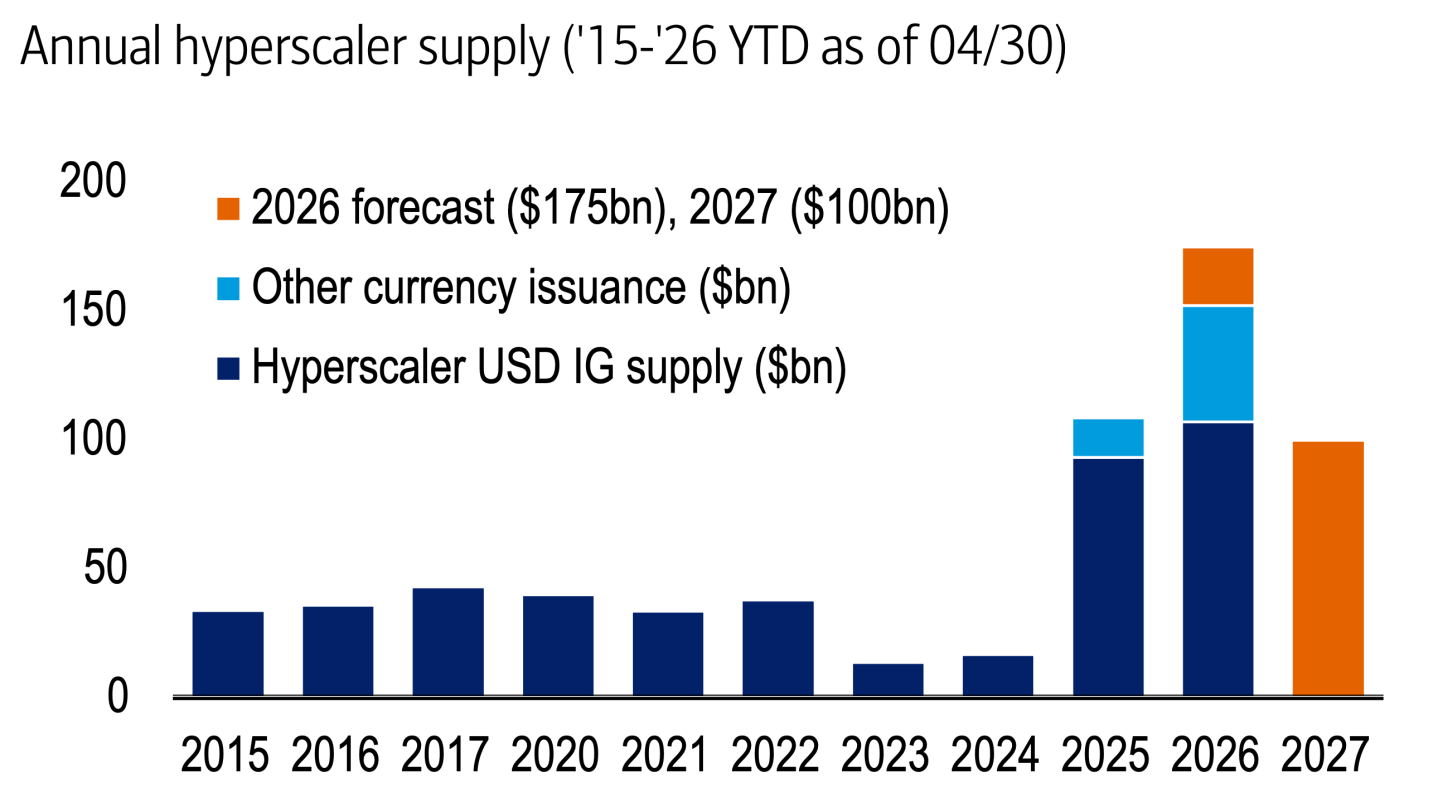
This chart shows the new debt the companies have piled on. It’s more than triple what it used to be:
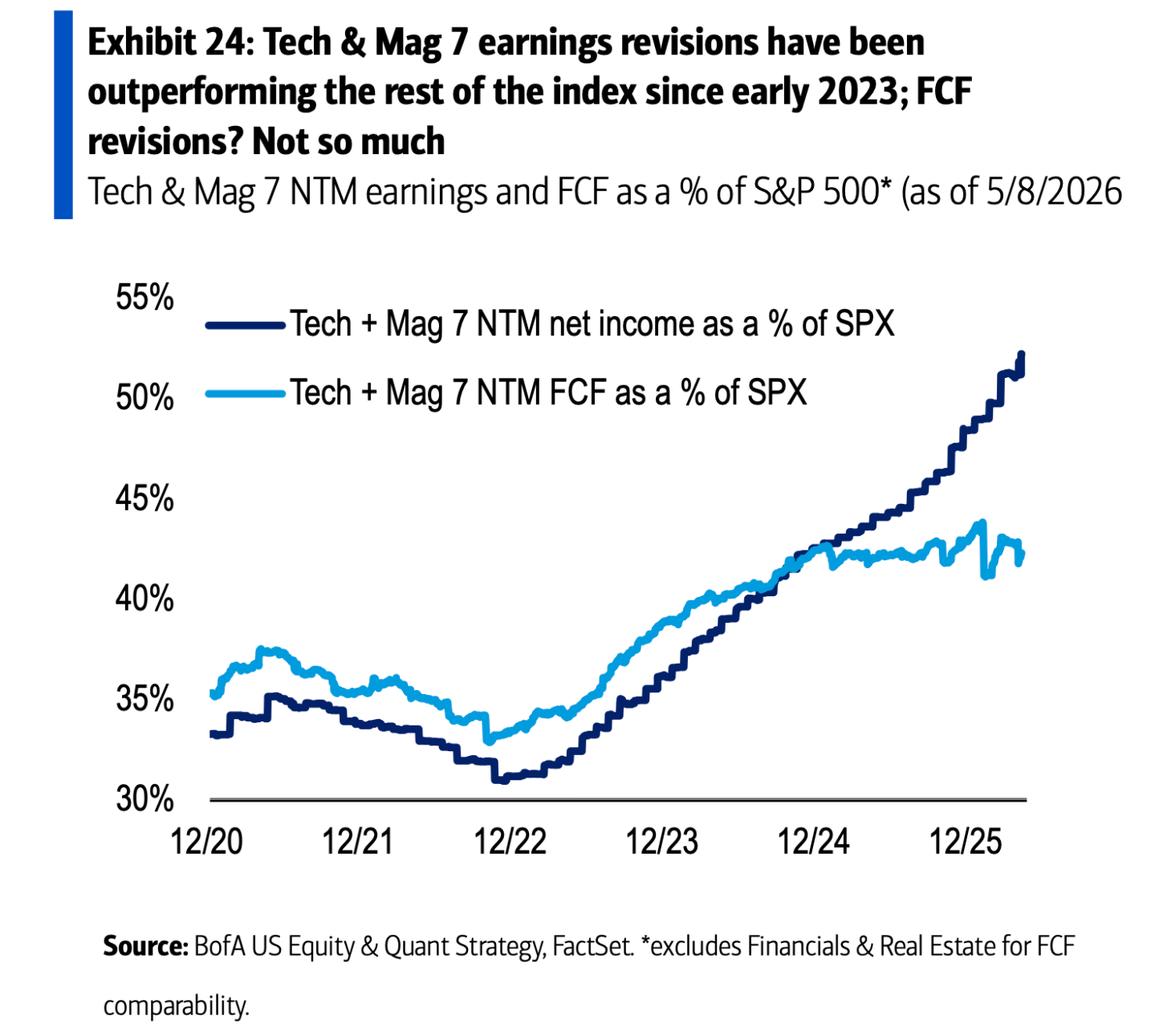
And this one shows how that capex has reduced the quality of their financials. The earnings of the Magnificent Seven continue to march upward as a percentage of the S&P 500 as a whole. But their free cashflow has flatlined—because it is being blown on data centers:
IRAN
Trump to Netanyahu: “You’re fucking crazy. You’d be in prison if it weren’t for me. I’m saving your ass. Everybody hates you now. Everybody hates Israel because of this.”
There is confusion this morning over whether a ceasefire still exists in Israel and the U.S.’s conflict with Iran and Axios reports a major split between President Trump and Israeli Prime Minister Benjamin Netanyahu. Trump wants Israel and the Iran-backed Hezbollah terror group to stop fighting in Lebanon. Iran said it was suspending talks with the U.S. as a result of Israel’s ongoing strikes, per Bloomberg.
Trump blew up at Netanyahu in a call on Monday, sources told Axios. It’s worth reading verbatim:
- Summarizing Trump’s remarks to Netanyahu, the U.S. official said: “You’re fucking crazy. You’d be in prison if it weren’t for me. I’m saving your ass. Everybody hates you now. Everybody hates Israel because of this.”
- A second source briefed on the call said Trump was “pissed” and at one point yelled at Netanyahu: “What the fuck are you doing?”
Officially, Trump said both Iran and Israel “agreed that all shooting will stop,” according to the BBC. On Truth Social, the president said: “I had a conversation with Bibi Netanyahu today, asking him not to go into a major raid of Beirut, Lebanon. He turned his Troops around. Thank you Bibi! I also had a conversation with Representatives of the Leaders of Hezbollah, and they agreed to stop shooting at Israel, and its soldiers. Likewise, Israel agreed to stop shooting at them.”
But Netanyahu had a different take: Strikes on Beirut would continue “if Hezbollah does not stop attacking our cities and civilians,” he said, and Israeli forces would not move out of southern Lebanon.
Trump seems to be out of patience with the whole situation, according to CNBC. “I don’t care if [peace talks] are over, honestly … I really don’t care. I couldn’t care less,” he told the channel. The discussions “started to get very boring.”
Bottom line: Israel and Hezbollah were still bombing each other overnight.
Good news? The blockade is being broken. The Greek shipping line Dynacom Tankers has moved eight ships through the blockade of the Strait of Hormuz and is preparing another six to transit the shipping lane. The FT doesn’t report details on exactly how Dynacom is achieving this, but the context is that the Greeks do not mess around when it comes to shipping: “Greece has a tradition of breaking blockades since the antiquity,” founder George Prokopiou told a conference in Athens on Monday,
MORE FROM FORTUNE
Anthropic confidentially files its S-1 first—but the IPO race with OpenAI is just beginning – Allie Garfinkle
Jeff Bezos’ 25-year-old stress cure is to ‘make the first phone call, or send the first email’— and a recruiter says it lands even harder in 2026 – Orianna Rosa Royle
It’s not a recession. But Goldman says your paycheck is acting like it – Nick Lichtenberg
CHART OF THE DAY
Goldman Sachs’ insanely detailed World Cup brackets
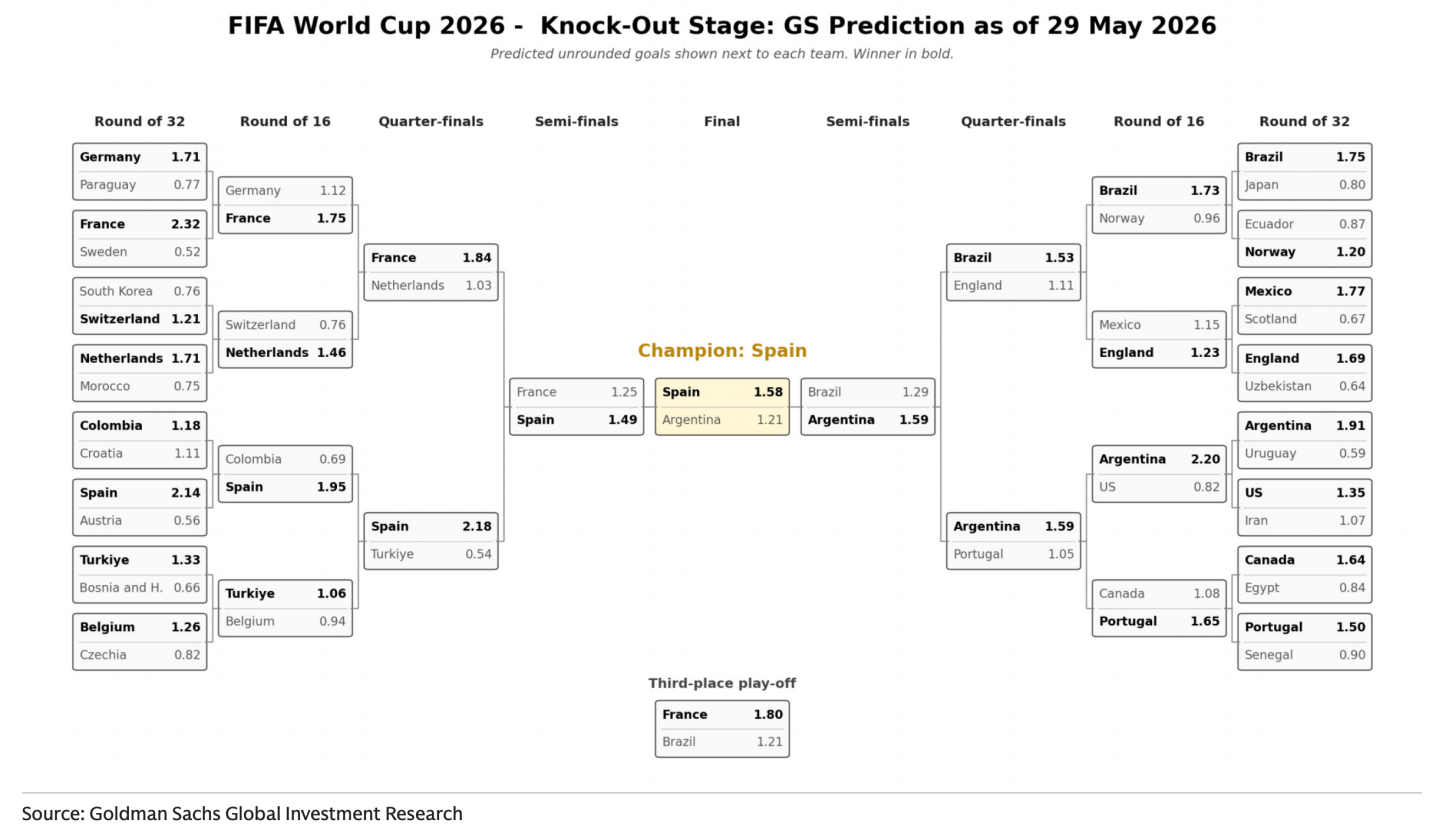
Spain will beat Argentina in the final of the World Cup this summer, according to Goldman Sachs.
I’m not saying that Jan Hatzius—the bank’s chief economist and head of its global investment research—and his colleagues have too much time on their hands. But their World Cup prediction model is thorough, to put it diplomatically. Here’s a description of the statistical model they used to predict the results of all 104 matches. I won’t even try to translate this into plain English. Just know that I’m leaving out all the minor variables they’ve weighted into it, including things like stadium altitude and pre-match momentum:
“We estimate a regression model to predict the number of goals scored by a particular team (‘team i’) against a particular opponent (‘team j’) using the entire history of mandatory international matches since 1978 … we assume that the number of goals scored by team i is described by a so-called ‘Poisson’ distribution … The main determinant of the number of goals scored is the difference in team performance as reflected in Elo ratings prior to the match. The Elo system was originally devised to rank chess players … We can also leverage the Poisson distribution underlying our model to run a Monte Carlo simulation with 50,000 draws, which yields a set of probabilities that a particular team wins.”
The big calls: The U.S. gets past Iran but is knocked out in the round of 16. England make it to the quarter-finals, where they are dispatched by Brazil. Scotland actually makes it out of the group stage (bold call from Goldman!). And France get their hearts broken in the semis.
NUMBER OF THE DAY
$2.95 trillion
The amount of wealth moved across foreign borders and booked in the largest markets for offshore riches. Hong Kong has narrowly overtaken Switzerland to become the world’s largest offshore wealth hub according to Boston Consulting Group’s 2026 Global Wealth Report. The report found an influx in capital from mainland China had driven significant growth, with Hong Kong hosting $2.95 trillion in cross-border wealth in 2025, compared to Switzerland’s $2.946 trillion. Next on the list were Singapore ($2.1 trillion) the U.S. ($1.6 trillion) and the U.K. ($1 trillion).
THE FRONT PAGES TODAY
US in talks to expand nuclear weapons deployments in Europe – FT
Prominent Short Seller Andrew Left Convicted of Fraud – WSJ
How One Tech Company Created 13 New Types of Jobs Because of A.I. – NYT
Lacking money and support, Trump’s Board of Peace stalls in Gaza – WP
ONE MORE THING
Elon Musk’s $1.45 billion Bitcoin hoard is bigger than crypto sleuths thought
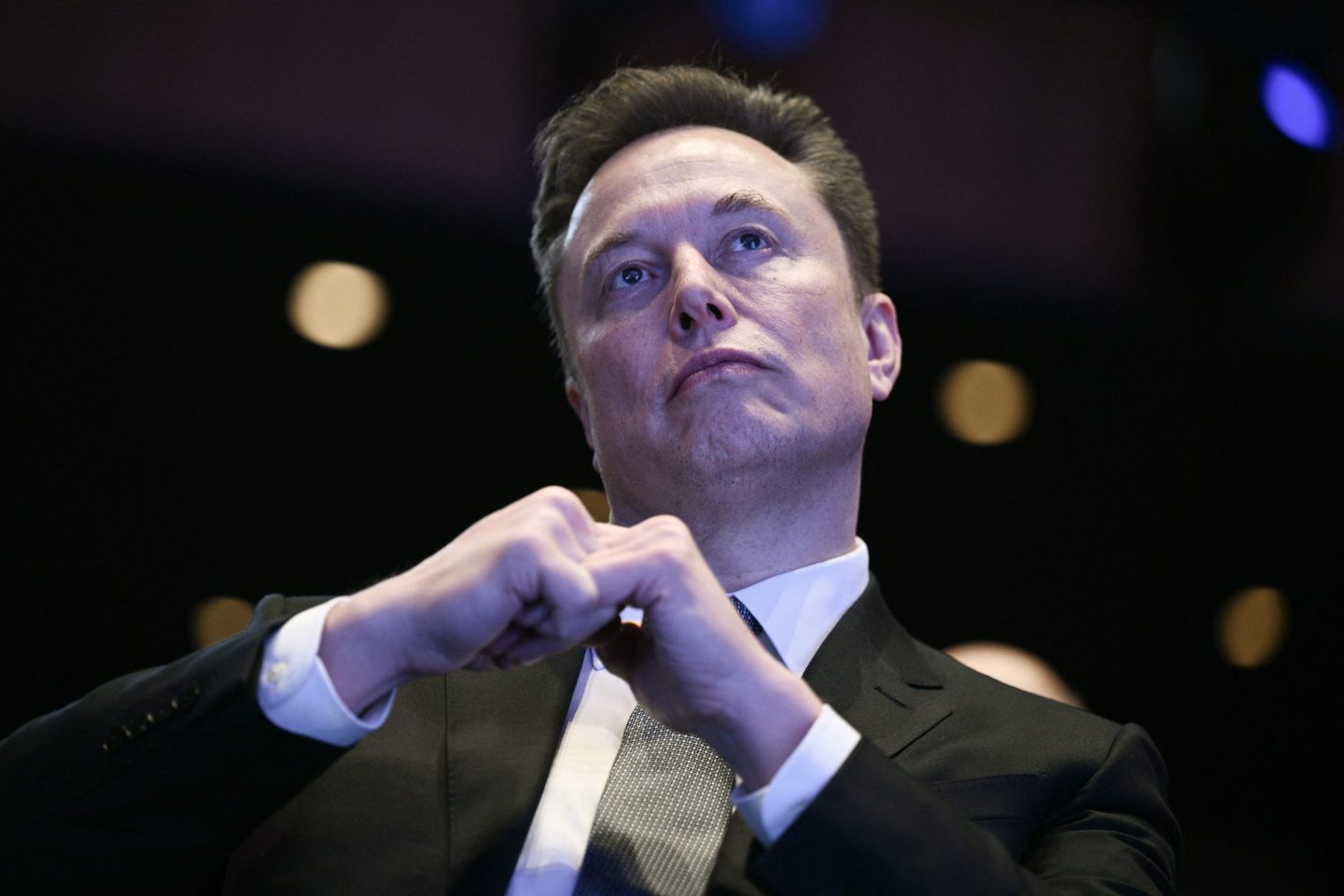
BRENDAN SMIALOWSKI/AFP—Getty Images
SpaceX is holding $1.4 billion in Bitcoin, according to its S-1 IPO filing, substantially more than previously thought. Elon Musk’s rocket company holds 18,712 BTC, more than the 11,509 that Tesla holds separately, according to Fortune’s Jack Kubinec.
Bitcoin is volatile, of course. It has lost nearly 50% of its value since its recent all-time high. And that high was double the previous peak. Big swings like that will need to be reflected on the balance sheet and marked as non-cash expenses or gains on quarterly financial statements.
“Marking $1.45 billion in Bitcoin to market each quarter can produce wild swings into reported earnings that have nothing to do with rocket launches or satellite performance,” according to David Krause, a finance professor emeritus at Marquette University.
Disclaimer : This story is auto aggregated by a computer programme and has not been created or edited by DOWNTHENEWS. Publisher: fortune.com