
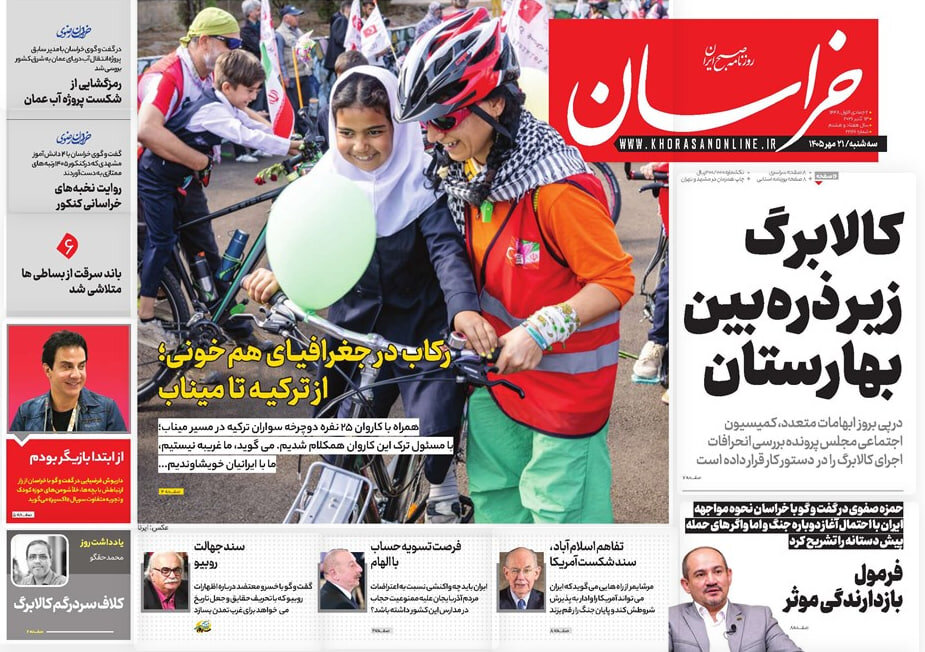
Khorasan argued that Trump’s contradictory behavior has weakened his credibility. Pro-Israel circles in Washington portray Trump’s unpredictability as a sign of strength, claiming that Iran should always remain uncertain about his next move.
However, this approach comes at a cost. When a president’s statements are seen as unreliable, even promises of agreements or conflict resolution lose their ability to inspire confidence. For Iran, the political lesson is straightforward. Strategic decisions should be based on measurable actions, verifiable commitments, and the preservation of leverage. Regional developments have created conditions in which Iran sees resistance to pressure from Trump as necessary for protecting its security and interests. The country is currently working to rebuild its military capabilities, a process that should be accompanied by active diplomacy. Stronger deterrence would increase the cost of military action for the United States, while diplomatic efforts should raise the political costs associated with Washington’s perceived lack of credibility.
Jam-e-Jam: Marco Rubio’s efforts are ineffective
Jam-e-Jam discussed recent remarks by US Secretary of State Marco Rubio in Athens, describing them as unconvincing and lacking both scientific and moral foundations. Rubio is attempting to justify what it views as an unjustified war allegedly launched by the United States, with Israeli support, against Iran. More than a year has passed since the conflict began, and Rubio’s comments represent a delayed attempt to provide a historical rationale for it. Struggles for power inside the United States often impose costs on the wider world, with Iran currently bearing a significant portion of those burdens. The speech was designed to legitimize the use of military force and to provide Republicans with historical and ideological backing. In the paper’s view, such arguments are intended to compensate for political weaknesses and help Republicans avoid setbacks in competition with Democrats.
Resalat: Direct US involvement in Yemen would escalate tensions
Resalat examined recent developments in Yemen and placed them within the broader framework of regional tensions. The paper argued that direct US involvement in the conflict could expand the scope of hostilities beyond a regional dispute and transform it into a broader confrontation. A key aspect of the crisis is the tendency to interpret events in Yemen solely through the lens of rivalry between Tehran and Washington. Such a view minimizes the role of Yemeni political actors and overlooks the domestic and historical roots of the conflict. The newspaper noted that the growing connection between developments in Yemen and the larger confrontation between Iran and the United States has increased the strategic importance of the country. Greater foreign military intervention would make it more likely that the crisis evolves into a component of wider regional competition rather than remaining focused on Yemen’s internal political disputes.
Donya-e-Eqtesad: Elections will not change Washington’s policy
Donya-e-Eqtesad analyzed Tehran’s perspective on its ongoing confrontation with Washington. According to the paper, Iran’s main concern is not only military pressure but also a deep distrust of US commitments. Iranian policymakers believe they can withstand pressure and impose additional costs on both the United States and the global economy. Tehran remains skeptical about Washington’s willingness to honor agreements, including those signed by Trump himself. From this perspective, US elections do not guarantee a change in policy because, according to some Iranian analysts, Democrats and Republicans differ more in their methods of dealing with Iran than in their overall approach. The paper noted that indirect negotiations between the two countries continue, but disagreements over the sequence of implementing commitments remain a major obstacle. Iran is reportedly seeking a return to the framework of the short-term June agreement while also obtaining economic benefits that, in its view, were not fully realized under previous arrangements.
Arman-e-Emrooz: Successful economic diplomacy in Africa requires institutional support
Arman-e-Emrooz argued that Africa is no longer a peripheral region in international politics but an increasingly important part of the emerging global order. For Iran, one of the most significant developments is the growing geopolitical importance of the Red Sea and the Horn of Africa. Recent events in the Red Sea and the Bab al-Mandab Strait have demonstrated close links between the security of that region and the security of the Persian Gulf, the Indian Ocean, and major trade routes connecting Asia and Europe. As a result, developments there have direct and indirect implications for Iran’s strategic environment. The newspaper emphasized that Iran’s primary challenge is transforming potential opportunities into sustainable economic partnerships. Past experience, it argued, has shown that economic relations with African countries have often been limited by inadequate financial mechanisms, weak transportation links, insufficient market knowledge, and a lack of consistent private-sector engagement. Consequently, the article concluded that successful economic diplomacy in Africa requires institutional support and infrastructure development. Political agreements alone, without practical economic foundations, are unlikely to produce lasting and meaningful cooperation.
Disclaimer : This story is auto aggregated by a computer programme and has not been created or edited by DOWNTHENEWS. Publisher: tehrantimes.com





