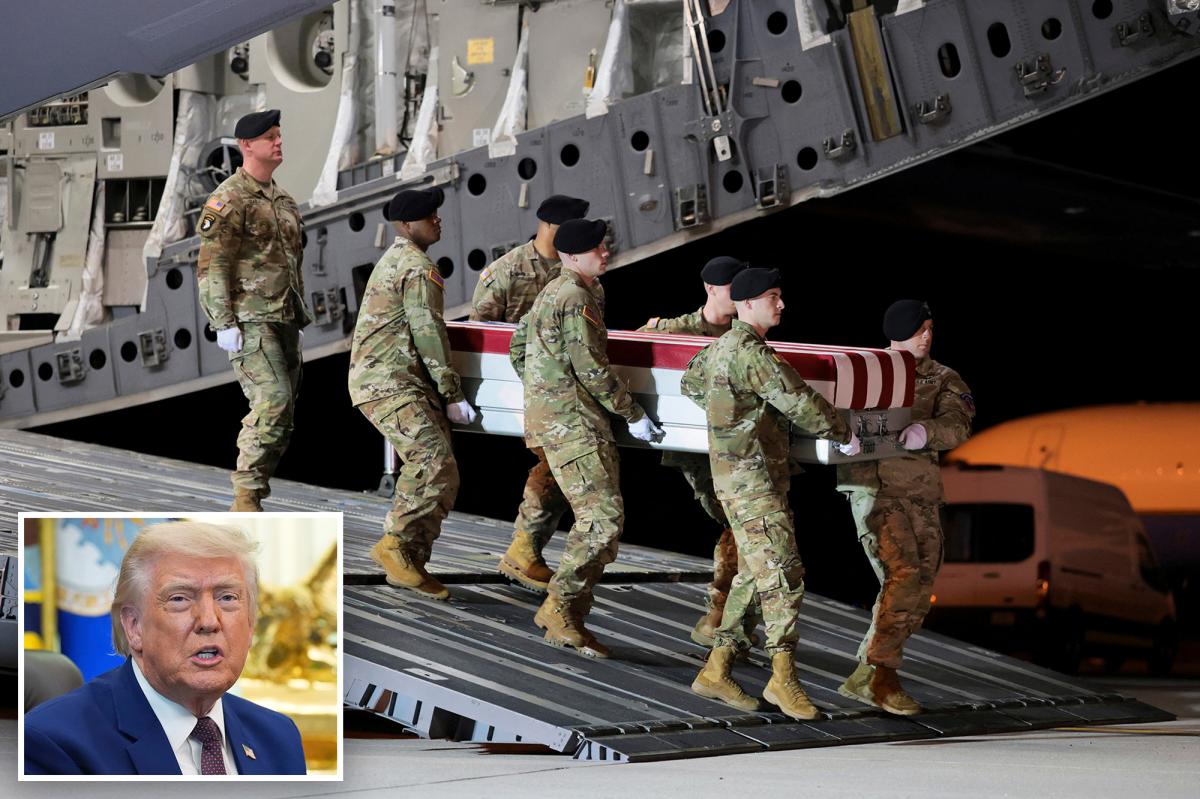
Kill an American service member, and we’re back to war, President Trump said Thursday.
“If they killed US troops, that would be a good reason [to end the cease-fire],” he told reporters at the White House on Thursday. “If they killed US troops, I think I would do that very quickly.”
Trump’s warning comes as Iran appears set on continuing strikes on US troops in the region, as its Foreign Minister Abbas Araghchi on Thursday tried to justify Tuesday night strikes on Kuwait that targeted American troops but killed a Kuwaiti civilian and injured dozens of others.
“We had previously warned regional countries about the United States using their bases,” he told IRGC-affiliated media. “Our response is directed at American bases and not the territory of regional countries.”
“Many regional countries opposed the use of their airspace and territory against Iran. Unfortunately, the United States used these facilities against us,” he added.
Since the Feb. 28 war on Iran began, 13 US service members were killed in Operation Epic Fury. Seven were killed by Iranian strikes on US forces, while six died when their aircraft crashed over Iraq while carrying out refueling operations.
But since the US and Iran entered into a shaky April 8 cease-fire, Iran has been unable to kill any US military members — though there have been exchanges of fire.
While the administration has not given the military explicit direction on responding in kind to a fatal attack, it’s been understood that crossing that line may burn up Trump’s remaining patience, a source familiar with US Central Command’s planning told The Post.
Trump on Wednesday downplayed the strikes that saw 13 ballistic missiles and 17 drones rain down on Kuwait, explaining that “in that part of the world, ‘cease-fire’ is when you’re shooting in a more moderate manner.”
But the moment an American service member dies, his calculus would change.
Secretary of State Marco Rubio on Thursday vowed that the US would help protect Kuwait from future attacks, easing Kuwaiti anxieties over the risks they face by hosting the US.
“The secretary reiterated the commitment of the United States to Kuwait’s security, to ensuring that Iran never acquires a nuclear weapon, and restoration of freedom of navigation through the Strait of Hormuz,” the State Department said in a readout of a call between Rubio and Kuwaiti Foreign Minister Sheikh Jarrah Jaber Al-Ahmad Al Sabah.
“The secretary also condemned Iran’s outrageous and unacceptable attacks targeting Kuwait International Airport and other parts of the country and expressed condolences for those killed and injured in that attack. We stand with the Kuwaiti people during this difficult time,” it added.
Iran’s overtures targeting troops in host nations meant to scare local leaders into expelling the US from their borders, a regional source told The Post on Thursday. So far, it hasn’t worked — but they have been enough to push many Gulf states to lobby Trump to refrain from striking Iran.
Such was the case with Project Freedom, the naval operation that lasted less than 48 hours until Trump said Saudi Arabia and other Gulf allies pressed him to cancel it — allegedly because “Great Progress has been made toward a Complete and Final Agreement with Representatives of Iran.”
Almost a month later, and regional sources have privately admitted the real reason the countries lobbied the president was fear that Iran would target their oil and gas infrastructure as retaliation — and that the US would not protect them from such attacks.
There’s evidence to support the theory, with some interpreting the Kuwait strikes and other recent Iranian provocations as retaliation for quiet, almost covert US efforts to guide commercial ships through the Strait of Hormuz.
Instead of a large-scale, in-your-face operation to forcibly reopen the strait a la Project Freedom, the military for the past three weeks has instead been providing remote guidance to ships aiming to pass — and at least 70 so far have made it through, the New York Times reported this week.
While the estimated average of roughly three ships per day passing through the strait with the US’ help is just 3% of pre-war traffic, it’s a substantial jump from the zero-ships-per-day figure that plagued the strait for much of the US-Iran standoff.
“Though US forces are not escorting, we continue to communicate and coordinate with commercial ships seeking to freely and safely transit the Strait of Hormuz, a critical international corridor for regional and global economies,” CENTCOM spokesman Tim Hawkins said in a statement on Saturday.
The same day, Secretary of War Pete Hegseth alluded to the operation, telling reporters that traffic through the strait would resume because of “what we’re able to do, and are doing – whether it’s known or unknown – in the strait.”
Rubio also acknowledged the operation while testifying before Congress on Thursday, explaining that “a ship will go through the route, particularly both the northern and southern route of Hormuz, those ships will come under attack, the US will respond to that attack by shooting down those drones.”
“At that point, the Iranians will respond to that by targeting some facility in the region in retribution,” he said. “On occasion, in order to protect our own forces, we don’t just strike the drones, we strike the people who launch those drones.”
Despite Iran violating the cease-fire agreement, CENTCOM has been successful in shooting down missiles and drones launched at US military bases. Poor Iranian targeting has also prevented more US casualties— but some fear what could happen if one slips through.
The US still maintains the forces it would need to restart the war at the drop of a hat, should Trump choose to go that route. For now, he is focused on diplomacy, banking that the sanctions and ongoing blockade on Iranian ports will force the regime to make a deal or collapse.
Still, the Pentagon has repeatedly stated that the protection of US forces remains its top priority and that attacks causing American casualties would be met with an appropriate response.
Disclaimer : This story is auto aggregated by a computer programme and has not been created or edited by DOWNTHENEWS. Publisher: nypost.com