
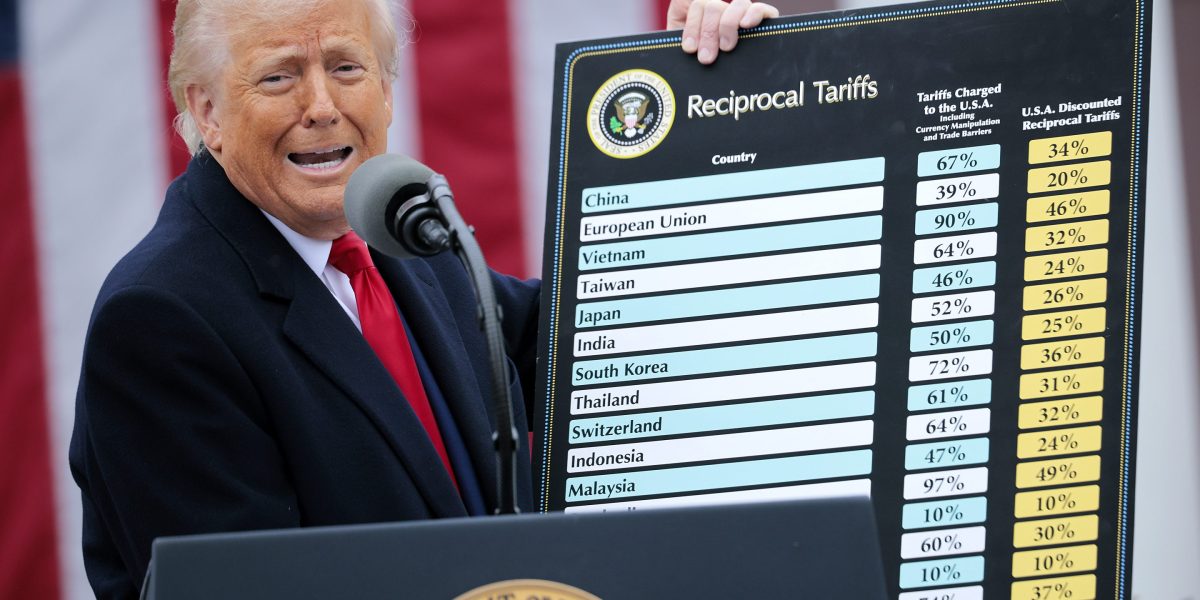
“They’re a national emergency that threatens our security and our very way of life,” he said at the time. “It’s a very great threat to our country.”
But 17 months later, the administration’s import taxes haven’t closed that deficit at all. In fact, the trade deficit is now the largest it’s been since Trump implemented tariffs, and economists are pouring cold water on the very idea that a widening trade gap is even a threat.
The trade deficit grew by 13.7% to $105.6 billion from July to August, according to the Bureau of Economic Analysis, the highest it’s been since March 2025’s $140 billion. While imports increased by 4.3% to $420.8 billion, exports increased, but at a slower rate, growing 2.2% to $205.7 billion.
Experts suggest the growing deficit is largely a result of the AI boom, which has created a mass demand in the U.S. for overseas hardware, spiking imports. AI demand single-handedly added $200 billion to the U.S. trade deficit in April, according to the Federal Reserve Bank of Minneapolis.
“The U.S. economy does a bunch of stuff that other countries can’t do; one of them is … this AI boom,” Tarek Hassan, a professor of economics at Boston University, told Fortune. “And because of the AI boom, foreigners still want to invest in the United States, which is a good thing.”
Tariffs have been the cornerstone of Trump’s second administration, and the president has justified the levies with promises of more U.S. manufacturing jobs, as well as a cash windfall to be redistributed to the American people—neither of which has come to fruition.
To Trump, the trade deficit was representative of other countries taking advantage of the U.S., or of America’s wealth leaving the country, and protectionist measures were the only way to restore U.S. trade dominance.
But economists see things differently. They argue Trump’s whipsaw tariff approach that was meant to slash the deficit was actually, in part, responsible for its widening. They also say they believe Trump’s insistence on the gap being a negative economic indicator is actually ignoring evidence of a resilient U.S. economy.
Why Trump’s tariffs backfired
The ineffectiveness of Trump’s tariffs in closing the trade deficit have less to do with the magnitude of the duties and more to do with their ever-fluctuating nature. For example, tariffs on China spiked at 145% following Liberation Day, but have since fallen to around 30% following the Supreme Court ruling against tariffs imposed under the International Emergency Economic Powers Act (IEEPA) and a series of trade agreements with the country. While companies often look to make supply-chain adjustments in the face of tariffs, that really hasn’t happened because the trade landscape is too uncertain to make long-term adjustments. As a result, American businesses are still heavily reliant on overseas goods.
“There’s so much volatility that, essentially, companies are not going to change their behavior,” Hassan said. “They’re just going to adjust prices and continue on, and that’s why this tariff regime has been somewhat ineffective.”
Donald Boudreaux, a professor of economics at George Mason University, explained that the AI boom is not just fueling demand for overseas intermediate goods like hardware parts. It has also created economic optimism among U.S. companies of future productivity increases, driving importers to continue buying tariffed goods, despite higher costs.
“American businesses must be looking at the U.S. economy and their expectations about the future of the U.S. economy, and they’re optimistic,” Boudreaux told Fortune. “They’re saying, ‘Even though we have to pay higher prices for steel, higher prices for machine parts, higher prices for whatever it is we are importing from abroad, those higher prices are not high enough to dissuade us from providing these inputs that we believe we’ll need to meet future demands for our outputs.’”
Be careful what you wish for
Ultimately, the continued investment from other countries in the U.S. is what makes the trade deficit a good thing in Boudreaux’s eyes. While economists like Peter Navarro believe lowering the deficit would prevent the hollowing out of American manufacturing, Boudreaux argued that by receiving more goods from foreigners, dollars typically come back to the U.S. via global investments in U.S. equity, buoying the American economy.
“President Trump thinks, on his terms and the administration’s terms, this is unambiguously bad news,” Boudreaux said. “But in my view, it’s, I would say, unambiguously good news. It points overwhelmingly to health in the American economy, and not to any problems in the American economy.”
If Trump really wants to close the trade deficit, Hassan said, he should be careful what he wishes for. As foreign investors continue to pour dollars back into the U.S., including through Treasuries, they are essentially extending cheap credit to Americans.
The White House did not immediately respond to Fortune’s request for comment.
But should the trade deficit close and exports outnumber imports, foreign investment would also taper, Hassan suggested. Bond yields would increase, and financing the ballooning national debt would become even harder.
“It’s going to be a crisis where the trade deficit is going to close because foreigners are unwilling to extend further credit to the U.S.,” Hassan said. “Complaining about the trade deficit is like complaining that the bank keeps giving us all this cheap credit.”
Disclaimer : This story is auto aggregated by a computer programme and has not been created or edited by DOWNTHENEWS. Publisher: fortune.com







