Trust in Australia’s politicians has plunged, fewer than half of voters believe they have a meaningful say in government and almost three-quarters think the country has become more divided over the past year.
A sweeping assessment of Australia’s democratic health has also exposed a striking divide between university graduates and those whose education ended at high school, with the former far more satisfied with democracy and confident in the integrity of elections.
The 2026 McKinnon Index reveals trust in federal politicians has fallen from 35.9 per cent to just 30.5 per cent in a year, while trust in state and territory politicians has dropped six percentage points to 32.7 per cent.
The findings come amid a profound realignment of Australian politics, with Pauline Hanson’s One Nation surging in national opinion polls, the major parties struggling to retain voters and fierce debates over immigration, antisemitism and social cohesion following the December 2025 Bondi massacre.
The Index suggests Australians are increasingly losing confidence not in democracy itself, but in the politicians who represent them and their ability to bridge the country’s divisions.
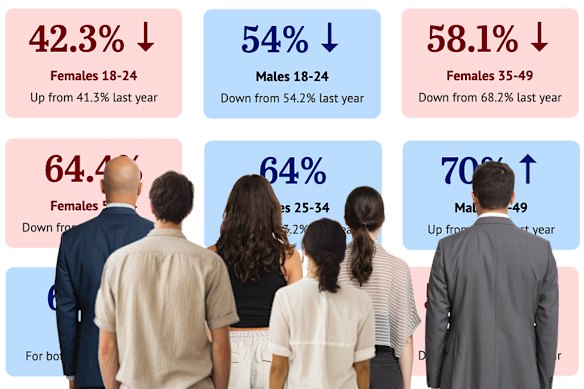
Trust in the federal government has slipped from 37.6 per cent to 33.1 per cent, with fewer than one in four Australians expressing high trust in political parties. Confidence that Australians can freely express political opinions has plunged almost 10 percentage points, from 67.9 per cent to 58.1 per cent, while fewer than half believe the political system allows people like them to have a say.
Overall satisfaction with democracy has fallen from 54.5 per cent to 50.7 per cent, although more than three-quarters still believe democracy is preferable to any other system of government.
But the national figures conceal a deeper divide along education lines. Just 39.7 per cent of Australians whose education ended at high school are satisfied with democracy, compared with 59 per cent of university graduates.
The gap is wider still over elections, with almost three-quarters of graduates confident in election outcomes, compared with fewer than half of Australians with a high school education or below.
The findings suggest educational attainment is now a much stronger dividing line than income across several measures of democratic confidence and participation, raising questions about whether Australia’s political institutions are equally accessible to all citizens.
The research, based on interviews with 4273 Australians conducted by Roy Morgan between June 19 and July 21, comes amid heightened concern about political hostility following the alleged attack on independent MP Helen Haines outside her Wangaratta electorate office this month.
McKinnon interim executive chairman John Thwaites – a former Victorian deputy premier – said the findings revealed growing disconnection between Australians and their elected representatives.
“People need to know their voice matters,” Thwaites said. “They also need to see leaders acting with integrity, keeping their promises and delivering outcomes that make a difference to their lives. Both matter if we want to rebuild trust.”
Broken promises were cited by 25 per cent, dishonesty by 22.1 per cent and politicians being out of touch by 19 per cent. Another 15.5 per cent nominated self-interest, while just 5.8 per cent cited the cost of living.
The deterioration in political confidence has coincided with growing concern about the quality of national debate. More Australians now view political discussion as unhealthy, while 74.4 per cent believe the country has become more divided over the past year.
Political divisions are increasingly spilling into personal relationships, with more than one in five young Australians admitting they would rule out friendships with people who hold different political views. It found 21.8 per cent of men aged 18 to 24 and 21.2 per cent of women in the same age group agreed they could not be friends with someone whose political opinions differed from their own.
The intolerance of opposing views was markedly less pronounced among older Australians.
Just 4.5 per cent of men and 6.3 per cent of women aged over 65 expressed the same sentiment, compared with 11.1 per cent across the population.
The survey also exposed a troubling willingness among younger Australians to contemplate political violence. More than one in four men aged 18 to 24 — 27.5 per cent — agreed that extreme measures such as violence could sometimes be justified to advance a cause they cared about, compared with 16.9 per cent of women the same age and 10.1 per cent of Australians overall.
The education divide extends beyond confidence in politicians and elections. Just 41.7 per cent of Australians whose education ended at high school believe people like them have a say in government, compared with 54.6 per cent of university graduates.
Fewer than half of those without tertiary qualifications feel confident accessing reliable information about public policy, compared with almost two-thirds of graduates. More than 80 per cent of university graduates say they understand how Australian democracy works, compared with fewer than two-thirds of those whose education ended at high school.
Yet the research also points to a distinction between Australians’ deepening distrust of political leaders and their continuing confidence in democratic institutions. Trust in the Australian Electoral Commission has increased to 72.9 per cent, while confidence in the public service, courts, independent regulators and anti-corruption commissions remained stable or improved.
This article is part of a content partnership with McKinnon, an independent, non-partisan, not-for-profit that focuses on the importance of democracy and good government.
Cut through the noise of federal politics with news, views and expert analysis. Subscribers can sign up to our weekly Inside Politics newsletter.
Disclaimer : This story is auto aggregated by a computer programme and has not been created or edited by DOWNTHENEWS. Publisher: www.smh.com.au