
A small bird rested in a 10-year-old boy’s hands. It looked like a house sparrow, except for one detail that refused to fit what he knew: a patch of yellow on its throat.
The bird had been brought down by a toy gun, one of many childhood games played by boys of that era. But instead of putting it aside, the child kept looking at it. Why did it look different? What bird was it?
That question would become the turning point of a life that would change the way India understood its birds.
The boy was Salim Ali.
Born on 12 November 1896 as Salim Moizuddin Abdul Ali, he was the youngest of nine children. His father died when he was barely a year old, and by the time he was three, he had lost his mother too.
Orphaned at an early age, Salim and his siblings were brought up by their maternal uncle, Amiruddin Tyabji, and aunt, Hamida Begum, in Mumbai.
Years later, India would know him as the “Birdman of India”, the ornithologist whose work transformed bird study from scattered observations into systematic science. But that journey began not in a forest or a laboratory, but with the curiosity of a child who simply wanted an answer.
The bird that became the starting point
Unable to identify the unusual bird, Salim’s uncle took him to W.S. Millard, the Honorary Secretary of the Bombay Natural History Society (BNHS).
Millard identified it as a yellow-throated sparrow, now known as the chestnut-shouldered petronia. But he did something far more important than naming the bird.
Recognising the boy’s curiosity, he showed him the Society’s collection of preserved birds, introduced him to the remarkable diversity of India’s avifauna, lent him books, and encouraged him to keep observing birds closely.
For Salim, the visit was nothing short of a revelation.
The excitement of finding the matching bird among hundreds of specimens stayed with him long after he left the museum. He returned to BNHS repeatedly, reading, watching and learning. The search for one bird had opened an entirely new world.
That moment, more than a century ago, shaped the course of Indian ornithology.
Watching birds, not collecting them
Salim Ali grew into one of India’s most influential naturalists at a time when much of the country’s wildlife remained poorly documented.
Rather than studying birds only through museum collections, he believed they had to be understood where they truly lived, in forests, wetlands, deserts, mountains and grasslands.
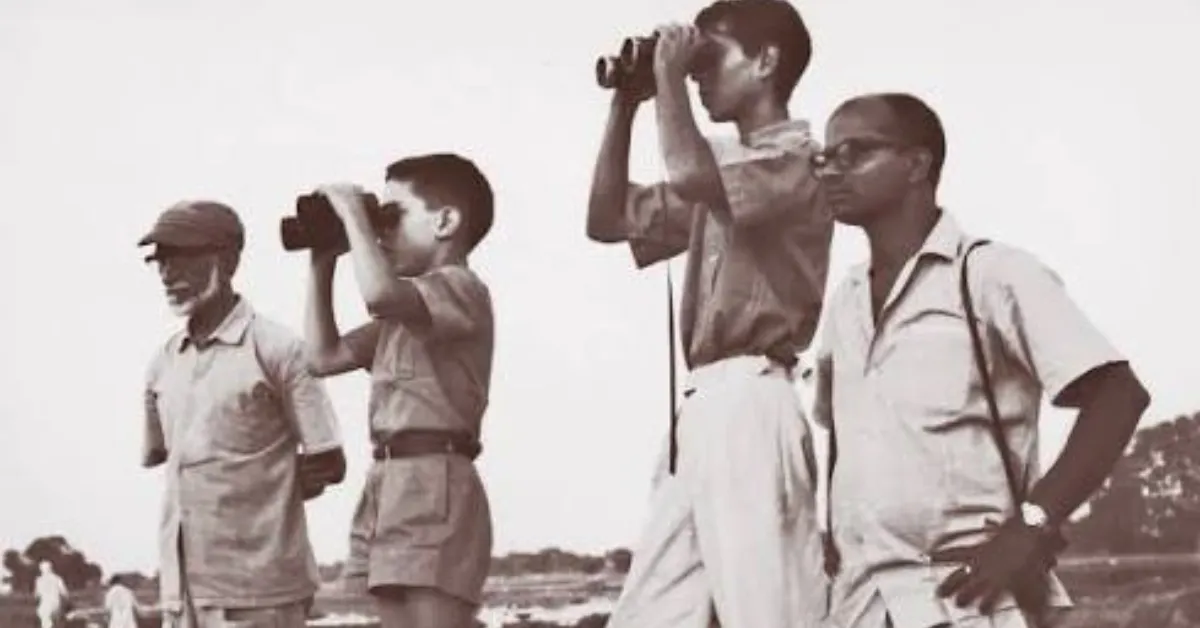
He travelled across the Indian subcontinent, often through remote landscapes, observing birds in their natural habitats, recording their behaviour, migration, breeding and distribution.
/filters:format(webp)/english-betterindia/media/media_files/2026/08/11/salim-ali-2-2026-08-11-16-07-00.png)
For nearly two decades, he undertook extensive regional bird surveys for the Bombay Natural History Society. Much of this work was done voluntarily, with only travel and camping expenses covered. The surveys created some of the earliest scientific records of India’s birdlife and laid the foundation for modern ornithological research in the country.
In his autobiography The Fall of a Sparrow, published in 1985, Salim Ali reflected that his real interest had always been “the living bird in its natural environment.” That philosophy defined both his science and his legacy.
A legacy that still guides conservation
Salim Ali authored more than 20 books on the birds of the Indian subcontinent, making birdwatching accessible to both scientists and ordinary readers.
His Book of Indian Birds, first published in 1941, introduced generations of Indians to the country’s avian diversity and continues to be regarded as an essential field guide for aspiring birdwatchers. Along with American ornithologist S. Dillon Ripley, he also produced the landmark ten-volume Handbook of the Birds of India and Pakistan, which remains a standard reference for ornithologists.
He played a key role in supporting the protection of Bharatpur Bird Sanctuary, today known as Keoladeo National Park, and was among the voices that helped prevent the destruction of Kerala’s Silent Valley, now one of India’s most significant biodiversity landscapes.
Today, countless birdwatchers step into wetlands before sunrise carrying binoculars instead of guns, recording sightings instead of collecting trophies. Scientists continue to rely on methods that Salim Ali helped establish, while citizen science platforms have introduced millions to the simple act of observing birds.
It is a legacy rooted in an idea that remains as powerful now as it was more than a century ago: conservation often begins with curiosity.
For Salim Ali, it started with a bird that did not look quite like a sparrow.
Source:
‘Remembering India’s Birdman’: by The Hindu, Published on 12 November 2020
‘The Birdman Of India’: by Aadya Singh, Published on 12 November 2017
‘The Birdman Of India’: By Sadaan Ahmad Khan, Indian Wildlife Club Ezine, Published On June, 2017
Disclaimer : This story is auto aggregated by a computer programme and has not been created or edited by DOWNTHENEWS. Publisher: thebetterindia.com





