
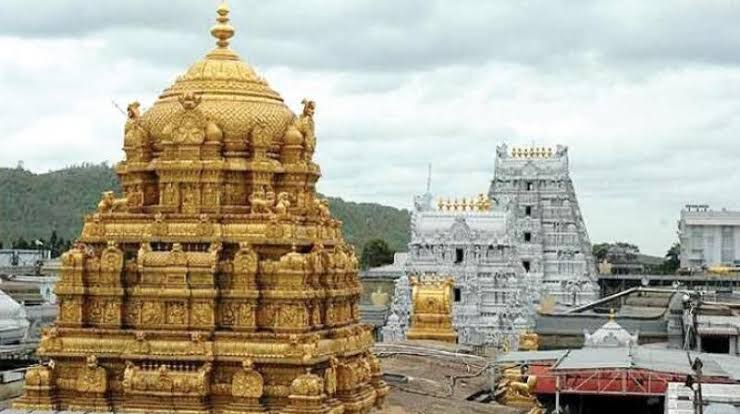
Tirupati: Tirumala Tirupati Devasthanams (TTD) on Tuesday performed the Koil Alwar Tirumanjanam at the Sri Venkateswara Swamy Temple in Tirumala ahead of the annual Salakatla Anivara Asthanam, to be observed on July 17.
The purification ritual was conducted in accordance with Agama traditions. During the ceremony, the temple premises from Ananda Nilayam to Bangaru Vakili, along with the sub-shrines, temple courtyard, Potu, walls, roof and puja articles, were cleansed with water.
As part of the ritual, the presiding deity was covered with a cloth while the temple was purified. After the cleaning, priests sprinkled a sacred aromatic mixture throughout the temple. The cloth covering the deity was then removed, following which special pujas and naivedyam were offered before darshan resumed for devotees.
Speaking to reporters, TTD executive officer Muddada Ravichandra, along with additional executive officer Ch. Venkaiah Chowdary, said Koil Alwar Tirumanjanam is performed four times a year ahead of Ugadi, Anivara Asthanam, the annual Brahmotsavams and Vaikuntha Ekadasi to purify the temple before these important occasions.
In view of the ritual, the Ashtadala Padapadmaradhana Seva was cancelled for the day.
TTD joint executive officer Dr A. Sharath, chief vigilance and security officer K.V. Murali Krishna, temple deputy executive officer M. Lokanatham and other officials were present.
RBSK-2.0 to cover over 2.35 lakh children in Tirupati
Tirupati: The Tirupati district medical and health department will soon begin health screening for more than 2.35 lakh children under the Rashtriya Bal Swasthya Karyakram (RBSK-2.0) for the 2026-27 academic year.
District medical and health officer (DMHO) Dr V. Balakrishna Naik said on Tuesday that health teams would examine 2,35,745 children, including 87,151 enrolled in anganwadi centres and 1,48,594 studying in government and private schools across the district.
Under the programme, children in anganwadi centres will undergo health check-ups twice a year, while school students will be screened once annually. Medical teams will visit anganwadi centres and schools in both rural and urban areas.
The programme will focus on identifying health issues under four categories — birth defects, nutritional deficiencies, childhood diseases, including non-communicable diseases, and developmental delays and disabilities.
This year, children will be screened for 38 health conditions, including congenital heart defects, cleft lip and palate, clubfoot, anaemia, vitamin deficiencies, severe malnutrition, asthma, diabetes, hypertension, skin and dental diseases, tuberculosis, leprosy, hearing and vision problems, speech delay, autism spectrum disorder, ADHD, specific learning disabilities and global developmental delay.
Children diagnosed during the screening will be referred to the District Early Intervention Centre (DEIC) or higher medical centres for free treatment, specialist care and rehabilitation services, depending on their condition.
Dr Balakrishna Naik said medical officers, Community Health Officers, ANMs, MPHAs and other field staff had been trained to ensure smooth implementation of the programme. He appealed to parents, teachers and anganwadi workers to cooperate with the health teams to ensure every child benefits from early diagnosis and timely treatment.
Disclaimer : This story is auto aggregated by a computer programme and has not been created or edited by DOWNTHENEWS. Publisher: deccanchronicle.com




