
Let’s get this straight. Australia should want big, bold technology companies, and it should want them listed here where ordinary investors can share in the upside.
But Firmus was always going to be a hard sell. Just after 9am on Friday, it stopped trying. The data centre start-up withdrew its $43.7 billion sharemarket float, which would have been the largest on the ASX since Telstra in 1997, after big investors refused to pay its price.
Firmus builds what it calls AI factories: data centres packed with Nvidia chips, whose computing power it rents to tech giants such as Meta and OpenAI to run their AI. Unlike most data centre operators, which rent out space and power, it owns the chips itself.
Most of those factories do not exist yet. Firmus runs two data centres, in Melbourne and Singapore, with seven more contracted and four in planning. Of the 912 megawatts of computing capacity it has signed customers up for, just 46 are running: about 5 per cent.
The company asked Australians to buy a skyscraper off the plan. For once, the market asked to see the foundations first.
Is this the AI bubble bursting? Not on this evidence. Spending on AI is still climbing, and chip giant Nvidia announced a $US150 billion share buyback late last month. But investors are getting pickier. Smart-ring maker Oura has delayed its US float, and shares in CoreWeave, Firmus’ closest listed rival, have halved in a year.
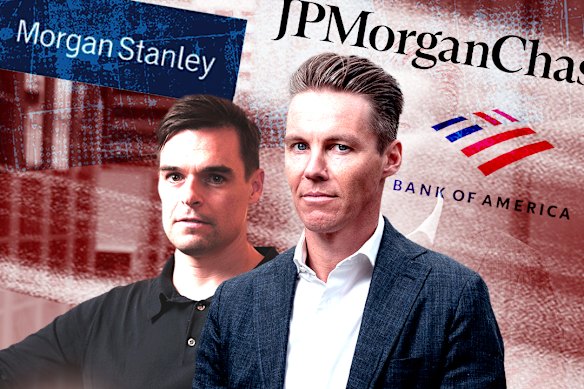
The ramifications are significant for its two chief architects – cousins who were set to be instant billionaires and had no real experience in the technology sector – and will sweep across Australia’s AI sector and the economy more broadly.
Had Firmus listed this month, millions of Australians would most likely have ended up owning a slice of it through their super, without ever being asked. They won’t now.
The comeback that wasn’t
The float was supposed to complete one of the more remarkable comebacks in Australian business. Oliver Curtis, Firmus’ 40-year-old co-chief executive and the husband of public relations entrepreneur Roxy Jacenko, is a former investment banker who served a year in jail for insider trading a decade ago. He has since called his actions “incredibly, gravely stupid”.
He co-founded Firmus in 2019 as a bitcoin mining business with his cousin Tim Rosenfield, who ran a luxury lingerie brand, and Jonathan Levee, who handles the engineering. Neither co-chief executive came from the technology industry.
They signed up big names all the same. Nvidia, the world’s most valuable chipmaker, is a shareholder and James Packer and former treasurer Joe Hockey hold stakes. “As a father, I’m incredibly proud of what Oli’s done,” Curtis’ father Nick, a mining entrepreneur and major shareholder, told The Australian last week.
Firmus earned about $US50 million ($73 million) in revenue last financial year. It asked to be valued at about 600 times that.
“Investors just weren’t prepared to pay a sky-high price up-front for capacity that’s still largely on the drawing board,” Josh Gilbert, who analyses Asia-Pacific markets for investing platform eToro, told this masthead.
The price had climbed quickly. Firmus sought a $1.2 billion valuation in late 2024 and raised money at $15 billion in August. Then it asked public investors for almost three times that.
The road to Friday was rocky, to put it lightly. This week Firmus confirmed that a $73 billion partnership with CDC, an established Australian data centre operator, was over. The Financial Review reported that a test of Firmus’ prized cooling system had flooded part of CDC’s Melbourne data centre earlier this year.
David Allen, who runs a fund at investment manager Plato that bets on shares falling, said the price assumed Firmus would “execute almost flawlessly” and grow its revenue by about 25,300 per cent in three years.
Fund managers who met the founders before the float told the Financial Review that their interest could drift quickly when an investor wasn’t a believer.
The country’s biggest super funds, including Aware Super, UniSuper and Australian Retirement Trust, stayed out. “Firmus is such an unknown quantity,” said Ben Squires, who invests the retirement savings of teachers and community workers at NGS Super.
Even then, investors already holding Firmus, including Nvidia and US investment giants Blackstone and Coatue, could have sold about $17 billion of existing shares from the first day of trading. That is more than twice the $7.9 billion new investors were being asked to put in.
‘Bankers gone to ground’
The banks running the float, JPMorgan, Bank of America, Morgan Stanley and Morgans, told investors on Monday that demand at $11 a share was “well in excess” of what was on offer. One Morgans adviser emailed clients that demand had been “enormous”.
By Wednesday, the banks were discussing cutting the price to about $9. On Thursday morning, they told fund managers that bids made that morning were “not held”, then went quiet. “Bankers gone to ground,” read one message doing the rounds of brokers and investors. By midday the offer documents had been pulled from view.
ASIC has dealt with this kind of message before, extracting a court-enforceable undertaking from Goldman Sachs in 2018 over how it described demand for a share sale. The regulator declined to comment on Firmus.
Who pays now
Whether Firmus can recover from here is an open question.
The Australian reported on Friday that Firmus is drawing up plans to list on America’s Nasdaq exchange next year. Until then, it will need private money, and the deepest pockets around it belong to Nvidia, Blackstone and Coatue. Their deal this year entitles them to extra shares if Firmus has not listed by November 30. Every one of those shrinks the founders’ slice.
The Australian reported on Friday that Firmus is drawing up plans to list on America’s Nasdaq exchange next year.Bloomberg
Curtis owns about 13 per cent of the company. He and his co-founders will remain very wealthy men, but the longer Firmus goes without a listing, the more it costs them.
“One IPO doesn’t define a company or an industry,” assistant minister Andrew Charlton said on Friday, and he is right that the AI boom is not over. But Gilbert said investors had become far choosier, and that being one of the few ways to back AI on the ASX was not enough.
Big-name customers like Meta and OpenAI will excite investors, Gilbert said, but whoever heads to the sharemarket next “will need to show how much of that demand is locked in under signed contracts, and how quickly it turns into cash”.
If Firmus does try again in New York, it will need to pour some foundations first.
The Market Recap newsletter is a wrap of the day’s trading. Get it each weekday afternoon.
 David Swan is the technology editor for The Age and The Sydney Morning Herald. He was previously technology editor for The Australian newspaper.Connect via X or email.
From our partners
Disclaimer : This story is auto aggregated by a computer programme and has not been created or edited by DOWNTHENEWS. Publisher: www.smh.com.au