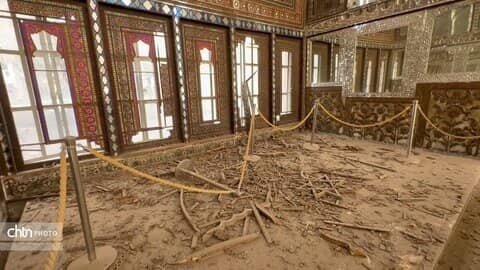
TEHRAN – A group of prominent British academics, museum curators, and fellows of the British Academy has expressed deep concern over reported damage to Iran’s UNESCO-registered world heritage sites amid war with the US and Israeli regime.
In a letter published by The Times, they cited damage to the Golestan Palace in Tehran and several sites surrounding Isfahan’s Naqsh-e Jahan Square, including the Imam Mosque aka Masjid-e Shah, Ali Qapu, and Chehel Sotoun Palace. It also reports the complete destruction of a provincial museum in Khorramabad. Beyond direct bombing, the academics warn that pollution from damage to oil depots and refineries risks causing irreversible harm to ancient sites such as Persepolis,
Pasargadae, and the rock-reliefs at Bisotun, Naqsh-e Rostam, and Bishapur. Zoroastrian sites in and around Yazd are also said to be at risk.
The signatories stressed that this represents a loss for global cultural heritage, not only for the people of Iran. The letter was signed by Professor Ladan Akbarnia of the Fitzwilliam Museum; Dr Lindsay Allen of King’s College London; Professor Ali Ansari and Dr Vesta Sarkhosh Curtis of the British Institute of Persian Studies; Professor Susan Babaie of the Courtauld Institute of Art; Dr Paul Collins of the British Museum; Dr John Curtis FBA; Professor Robert Hillenbrand FBA; Professor Almut Hinze FBA; and Professor Nicholas Sims Williams FBA.
The main scholar who initiated this move is John Curtis. A former Keeper of the Middle East Department at the British Museum and a leading scholar of Iranian archaeology, he has long been distinguished by his unwavering commitment to the preservation of Iran’s cultural heritage. His own research—spanning the Iron Age, the Elamite and Achaemenid periods, and the material culture of pre-Islamic Iran—has fundamentally shaped modern understanding of the country’s ancient civilizations. Beyond his scholarly output, Curtis has rendered exceptional service to Iranian heritage through decades of fieldwork, curatorial advocacy, and international collaboration, often at politically sensitive moments. It was his initiative that galvanized the recent collective action of British academics, curators, and fellows of the British Academy, leading to the urgent letter published in The Times. By mobilizing this high-profile warning over the bombing of sites such as Golestan Palace and the pollution threats to Persepolis, Curtis once again demonstrated his deep-seated belief that Iran’s millennia-old legacy is a matter of global, not merely national, heritage—an heritage that he has spent a lifetime studying, defending, and bringing to the world’s attention.
The letter, published in The Times correspondence section on March 27, underscores growing international concern over the protection of Iran’s millennia-old heritage in times of war.
AM
Disclaimer : This story is auto aggregated by a computer programme and has not been created or edited by DOWNTHENEWS. Publisher: tehrantimes.com