UK and Germany will face threats together, says Burnham in Berlin
-
Published
The UK and Germany will face threats together, Prime Minister Andy Burnham has said as he reaffirmed a series of defence and security partnerships.
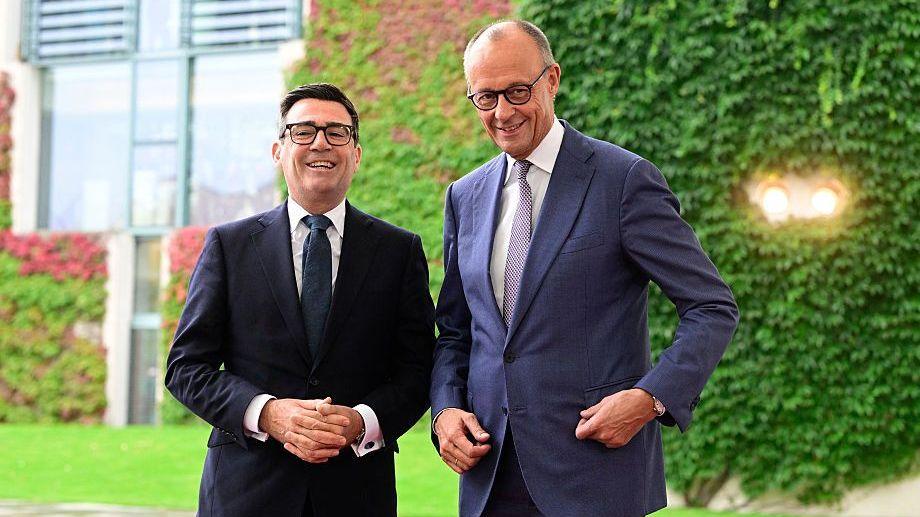
On his first official European trip, apart from visits to Ukraine, Burnham met German Chancellor Friedrich Merz, and was greeted with military honours in Berlin.
Speaking to reporters at the German capital’s Federal Chancellery, the prime minister said both countries were facing hybrid attacks “on a regular basis” and “it makes sense” to take them on together.
The pair formally ratified the 2025 Kensington Treaty, a partnership committing both countries to tackle hostile activity.
Burnham said the treaty would “improve our security here in Europe” but also help grow the economy and living standards.
“The Kensington Treaty [is] the first treaty between Germany and the UK since the Second World War – it really is a significant moment,” he said.
He added that the UK government would now “seek to progress” Germany joining Gcap, the Global Combat Air Programme led by Italy, Japan and the UK to develop a next-generation fighter aircraft.
He outlined partnerships “countering hybrid attacks” and “countering interference in our democratic processes”.
He mentioned collaboration on quantum technology and space, adding he was aiming to host the first joint meeting of the UK and German cabinets next year.
The Berlin talks come after intelligence services warned of rising threats, including last month when Germany accused Russia of launching a drone fitted with explosives at Leipzig/Halle Airport.
 Image source, Bloomberg/Getty Images
Meanwhile, French finance minister Roland Lescure has invited Britain to “come all the way” back to the European Union, in an interview with the BBC’s economics editor Faisal Islam.
Ahead of a UK-EU summit next month, Burnham said he was “very committed to securing deeper cooperation” and to “see if we can bring the UK closer to Europe”.
He told reporters a closer relationship with Europe was in the interests of growth and tackling irregular migration.
In recent weeks he has mentioned the prospect of eventually rejoining the bloc.
The German leader replied: “From our German side, I can assure you that we will do anything what we can do to bring the UK closer and closer back to Europe, to the European continent, to the European Union.”
-
‘Come all the way’ back to EU, French finance minister tells UK
-
Published13 hours ago
-
-
Plans for direct train to Berlin in new UK-Germany treaty
-
Published17 July 2025
-
The meeting comes as European leaders have been warning that the threat of hybrid attacks against Europe by Russia has intensified.
Hybrid attacks can include potentially destabilising activity such as cyber attacks, sabotage or misinformation.
Sir Mark Lyall Grant, former UK national security adviser, explained that hybrid warfare “falls somewhere between peace and war – it’s in that sort of grey zone, an area where Russia has been extremely active for some time”.
He told Radio 4’s Today that while Russia had posed a threat to the UK since Vladimir Putin became president in 2001, there had been an “intensification” in response to European support for Ukraine following Russia’s invasion.
“We know Russia has been mapping undersea cables in the North Sea; that’s something I’m sure Andy Burnham will be talking to Chancellor Merz about because it affects both the UK and Germany,” he added.
Last month, a senior Russian diplomat was summoned by the British government over an “egregious and reckless attack” on Leipzig airport, while the EU’s foreign affairs chief also summoned Russia’s envoy in Brussels.
 Image source, Getty Images
It is a major international freight hub used for providing support to Ukraine. Moscow has denied any involvement in the incident.
Meanwhile, questions have been raised this week about Germany’s reliability as an intelligence partner, following the bombshell arrest of a former spy chief on suspicion of espionage.
The talks also come during a period in which Merz’s own political future has come under intense scrutiny.
Burnham replaced Sir Keir Starmer as prime minister in July, after the former leader was forced out by his own MPs just two years after winning a landslide election victory.
Similarly, Merz has faced persistent rumours he could be replaced by his party due to his poor approval ratings and following setbacks in regional elections.
Although the chancellor appears to have overcome an immediate crisis in his leadership, questions remain over his future.
Additional reporting by Ottilie Mitchell.

Get in touch
Do you have any comments or questions about this story?
-
Merz vows to keep coalition together for Germany’s ‘democratic future’
-
Published21 September
-

Sign up for our Politics Essential newsletter to read top political analysis, gain insight from across the UK and stay up to speed with the big moments. It’ll be delivered straight to your inbox every weekday.
Disclaimer : This story is auto aggregated by a computer programme and has not been created or edited by DOWNTHENEWS. Publisher: BBC