
Updated ,first published
Belfast: Britain’s defence minister has quit in frustration over cuts to spending on national security in an extraordinary move that has thrown the government into crisis and added to pressure for a leadership challenge to replace Prime Minister Keir Starmer.
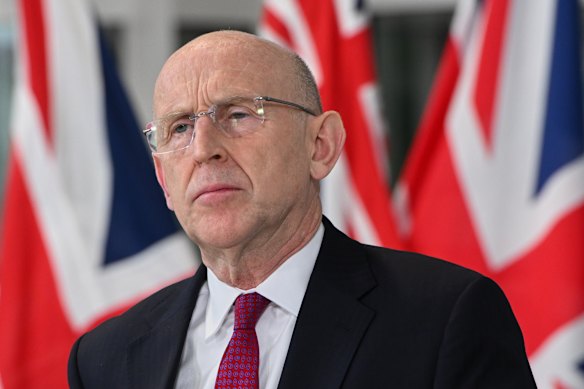
Defence Secretary John Healey announced his resignation hours before he was due to meet Australian counterpart Richard Marles in Portsmouth to outline their ambitions for the crucial AUKUS alliance on nuclear-powered submarines.
In a widening crisis over national security and Starmer’s authority, Armed Forces Minister Al Carns followed Healey by quitting the government, and they were joined by fellow Labour MP Pamela Nash, who resigned as the parliamentary private secretary in the defence portfolio.
The decisions confirmed a cabinet split over whether to increase defence spending and find savings in welfare programs to pay for the changes, while coming days before likely leadership challenger Andy Burnham hopes to win a seat in parliament and launch a formal bid for the top job.
Seen as one of the government’s steadiest cabinet ministers, Healey declared he had “no other option” than resigning after discovering on Monday that new spending on defence would not meet the standards he believed were necessary for the nation’s safety.
The decision stunned the government after Healey released a letter he sent to Starmer to complain about what he saw as dangerously weak spending in the Defence Investment Plan being negotiated among cabinet ministers.
“You have been unable, and the Treasury has been unwilling, to commit the resources that the nation needs to defend the country at this time of rising threats,” Healey wrote to Starmer.
“As I’ve outlined to you, there are credible ways of meeting the mid-term funding challenges, working multi-nationally and as other European nations are doing, to allow us to protect our ability to deliver the missions of our Labour government.
“You know what defence needs. Without a DIP that meets the moment in this way, I am being forced to make decisions that would reduce the readiness of our forces and increase the risk to personnel on operations, and could make the country less safe.”
The resignation comes one month after former health secretary Wes Streeting quit the cabinet and moved to the backbench over his frustrations with Starmer and the direction of the government, while declaring he was willing to stand for the leadership in a ballot among Labour Party members.
Burnham, the Greater Manchester Mayor, will have his fate decided by voters next week in a by-election for the seat of Makerfield, which he hopes to win so he can return to parliament in Westminster and begin a formal challenge to replace Starmer.
A survey of Labour Party members last month found that 59 per cent would choose Burnham and 37 per cent would back Starmer in a head-to-head contest.
Streeting, however, would struggle to topple the prime minister. YouGov found 65 per cent would choose Starmer and only 15 per cent would back Streeting in a similar head-to-head race.
Healey’s sudden resignation complicates an Australian diplomatic mission to the United Kingdom this week to shore up the defence alliance and accelerate work on the AUKUS project at a time of deep concerns that British shipbuilders are moving too slowly to start a new fleet of nuclear-powered submarines.
Marles, who is deputy prime minister and defence minister, joined Foreign Minister Penny Wong at a meeting in London on Wednesday with Healey and the UK Foreign Secretary, Yvette Cooper.
Healey sent a strong signal at the Wednesday meeting that he intended to remain in his job, saying he would be talking to Marles next week at a meeting about Ukraine and emphasising his personal commitment to the AUKUS program.
Asked by journalists on Wednesday about spending levels, Healey blamed the 14 years of Conservative government for doing too little on defence, and he vowed to make progress on building the new fleet of submarines, to be known as SSN-AUKUS and using a common design for UK and Australian vessels.
“You don’t turn that around, you don’t fix that overnight,” he said of the spending.
“But with submarines it’s a personal priority for me, it’s a personal priority for the new First Sea Lord to raise the levels, and pace, and effectiveness of our maintenance program, to raise the level of infrastructure that allows that maintenance to be better.”
Marles was due to meet Healey again in Portsmouth on Thursday, local time (early on Friday, AEST) but the resignation disrupted the Australian mission. Marles visited naval facilities in Portsmouth but cancelled plans for a press conference, just as some Australian journalists arrived for the event.
The loss of Healey and the wider upheaval in the British government adds fuel to the Australian debate over AUKUS when the United States is falling behind on its ambitions to build more submarines, while the UK also needs to speed up construction.
Defence expert Sophia Gaston said the changes did not cast doubt on AUKUS because its budget was protected in the UK’s defence investment plan.
Gaston, a senior fellow at the Centre for Statecraft and National Security at King’s College London, said Healey’s resignation would force Starmer to have difficult conversations about spending cuts to fund security outlays.
The spending plans already on the agenda “will not be sufficient” to address the deteriorating security environment, she said.
Get a note directly from our foreign correspondents on what’s making headlines around the world. Sign up for our weekly What in the World newsletter.
 David Crowe is Europe correspondent for The Sydney Morning Herald and The Age.Connect via X or email.
From our partners
Disclaimer : This story is auto aggregated by a computer programme and has not been created or edited by DOWNTHENEWS. Publisher: www.smh.com.au