

Getting into university in Sydney next year will be the toughest it’s ever been under a controversial new funding arrangement that critics say will severely limit places in the city, kneecap institutions and fail to increase access for poor students.
The new regime, called managed growth funding, effectively caps the number of domestic students admitted to each university and replaces the demand-driven funding introduced by the Gillard government that put student choice at the heart of university admissions. This means some students will be pushed out of universities in Sydney, leaving them to either study elsewhere or abandon tertiary education.
“Managed growth … hopes to divert enrolments to less popular universities. It puts system stability above student demand,” said higher-education expert Andrew Norton.
Born of the laudable aim of admitting more disadvantaged students to university, critics say that goal could have been achieved without the massive policy shift that means students – including the newly funded equity cohort – may be unable to study their preferred course at their preferred university because of tightened numbers at some institutions.
“If you’re a young person from a poor family, the bush or the regions, and you get the marks and you’ve got the skills, you will get a Commonwealth-supported place. This is all part of our work to open the doors of our universities wider,” education minister Jason Clare said.
An email from Clare to the nation’s vice-chancellors last year says that the government expects an additional 15,000 Commonwealth-supported places across the country in 2027.
Sceptics say that those extra places may not be available to students where they want to study.
“Restricting student choice between universities will only make it harder to match prospective students with a suitable university and course,” Norton said.
“While the government says it wants to increase the number of university students, the reality is that it is putting new obstacles to study in place.”
This is the situation that arose across Sydney’s major universities this year when the Albanese government soft-launched the policy. The results to date – universities scrambling and students reeling, locked out of their choice in courses despite marks that would have sufficed in the past.
At the University of NSW, the minimum ATAR for a Bachelor of Arts jumped from 80 to 83, while the ATAR for a Bachelor of Commerce leapt to 96.
The university said it was forced to decline 1000 prospective students it “would have liked to welcome”, with the smaller cohort causing anxiety for school-leavers and having financial implications for the university.
“The ambition to better fund Australian higher education is welcome, but it shouldn’t come at the cost of student choice,” a UNSW spokesperson said. “Students need to be supported in line with their own goals and ambitions. Telling a low-SES student they’ve got a place, but not in their preferred course or at their preferred university, isn’t a great outcome.”
It was a similar story at the University of Technology Sydney, which said it made fewer offers this year than previously, and Macquarie University.
“For the first time in my memory, having almost served for 14 years, we have declined to take [domestic Commonwealth-supported] students … because of the caps being placed on domestic student enrolments by the Federal Government,” Macquarie vice-chancellor Bruce Dowton told a parliamentary inquiry this year.
Macquarie has not, to date, seen changes in ATAR requirements from the policy, but Macquarie’s deputy vice-chancellor (people and operations) Professor Eric Knight warned of “unintended consequences that can arise from well-intentioned policy reforms”.
The University of Sydney has disbanded its long-running guaranteed-entry scheme.
“School-leavers who worked hard to achieve their HSC results faced increased uncertainty and competition during this year’s UAC offer rounds – there were fewer offers made, meaning higher acceptance rates and less choice,” vice-chancellor Mark Scott said.
“We are concerned that demand for university places in the Sydney metro areas has been under-estimated and that there is a risk new policy settings could drive an increase in ATARs, potentially limiting student choice and access.”
At the same time as introducing managed growth, the Albanese government has repeatedly said it wants 80 per cent of working Australians to have a tertiary qualification by 2050.
The University of Western Sydney’s vice-chancellor George Williams said that he welcomes managed growth.
“We are committed to giving all people – regardless of individual circumstances – access to university,” he said.
Within the university sector, theories about the massive policy shift abound. Some believe that this is an ill-conceived attempt to address Tasmania and regional Australia’s scandalously poor literacy and school completion rates by creating more regional university places that can easily be accessed by those students. Others think that influential university administrators from outside the Group of 8 found sympathy for their argument that the elite sandstone universities were taking too many students.
Regardless of the reason for the change, the impact on school-leavers is profound.
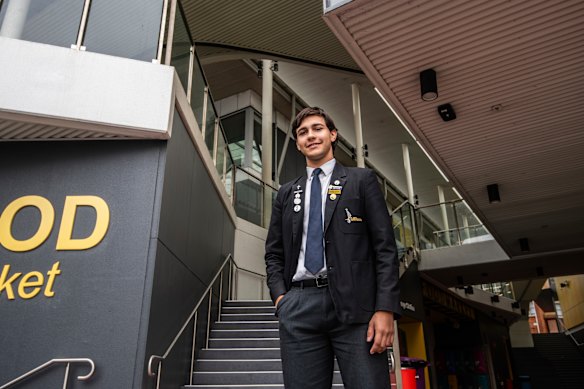
St Agnes College student James Schofield, 18, said that “nine out of 10” of his peers want to go to university and are trying to grasp the implications of the changes.
“We’re going to different information nights and things to try to keep up to date about it. I’ve definitely been trying to put my best foot forward,” said the 18-year-old, who hopes to study a Bachelor of Nutrition Science at the University of Technology, Sydney, or the Australian Catholic University next year.
The Rooty Hill school’s head of careers and partnerships, Nashwa Karafotias, said that leaving Sydney for university – a potential consequence of the changes that will lock lower-performing HSC students out of the city’s universities – was unrealistic for most of the school’s students.
“We’re in western Sydney, working with some of the most vulnerable students in NSW. Our kids find it really hard to leave the area because of financial burdens,” she said.
Be the first to know when major news happens. Sign up for breaking news alerts on email or turn on notifications in the app.
From our partners
Disclaimer : This story is auto aggregated by a computer programme and has not been created or edited by DOWNTHENEWS. Publisher: www.smh.com.au


