
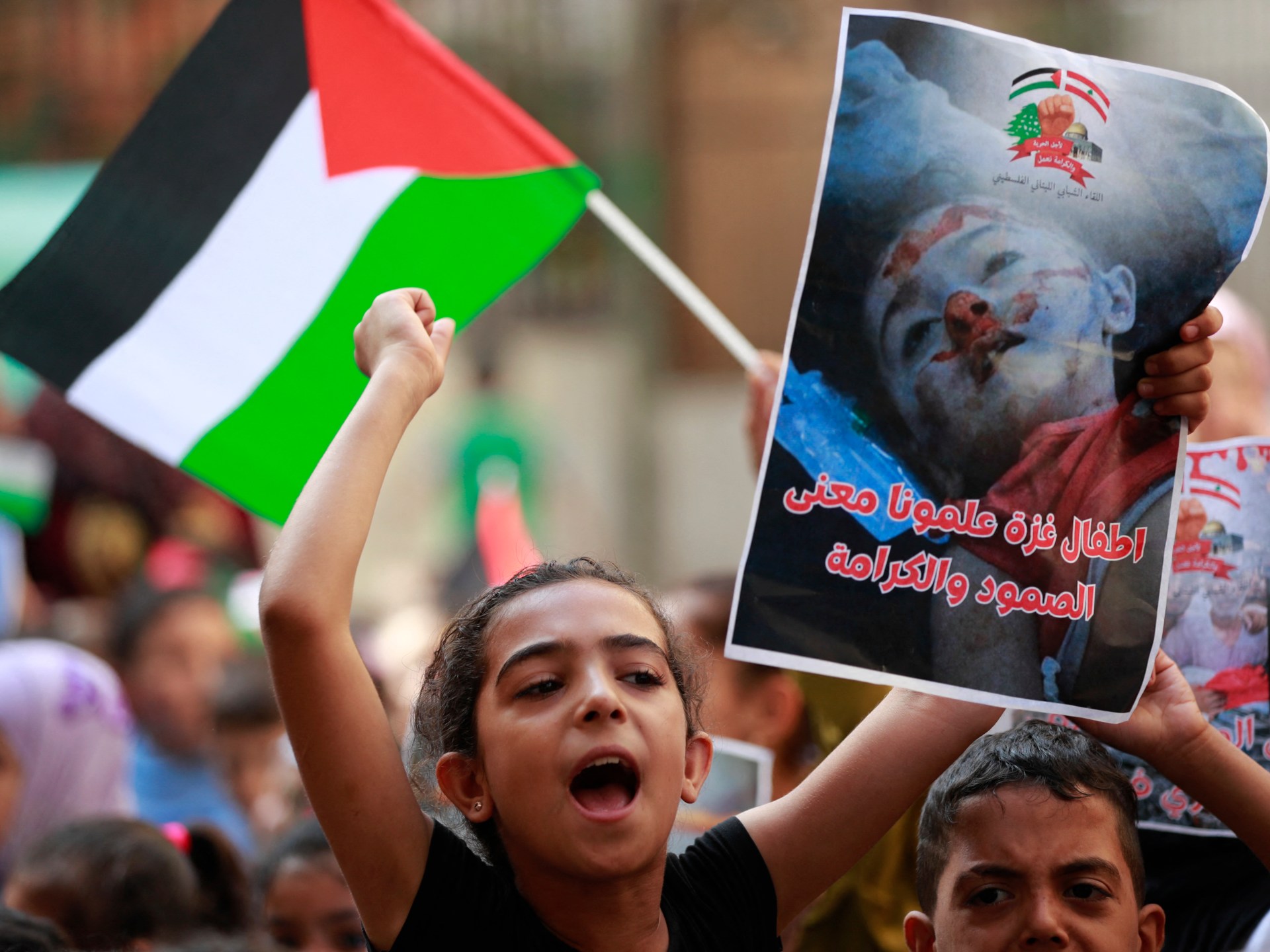
Beirut, Lebanon – Doumoua al-Baitan sat on the roof of a building in Beirut’s Palestinian refugee camp of Bourj el-Barajneh as the sun set. Like many Palestinian refugees in Lebanon, al-Baitan was born and raised in this camp.
For decades, Palestinians in Lebanon have been supported by the UN branch focused on Palestinian refugees, UNRWA. But funding cuts have impeded UNRWA’s ability to provide crucial aid, particularly since the Trump administration’s decision in February 2025 to maintain a US funding freeze imposed the previous year.
Recommended Stories
list of 3 itemsend of list
Between the funding cuts and funding shortfalls, UNRWA has had to close down or reduce hours of schools, healthcare centres, and clinics in Lebanon’s Palestinian refugee camps.
Palestinians told Al Jazeera that in addition to there being less work to go around and less medical support, children are being crammed into overcrowded classrooms, and the use and sale of illegal drugs has become more prevalent.
“My kids cannot retain what they are taught in class,” al-Baitan said, citing overcrowding. The divorced mother of four said she has started paying $200 per month – the same price as her monthly rent – for two of her children to attend after-school lessons.
Funding shortfalls
Since 1950, UNRWA has supported Palestinian refugees across the Middle East. Lebanon has 12 Palestinian refugee camps, where a large proportion of the country’s approximately 230,000 Palestinians live.
UNRWA’s role in the camps includes providing education, healthcare, relief and social services, camp infrastructure and improvement, microfinance, and emergency assistance. Palestinians first became refugees in Lebanon during the 1948 Nakba, when Zionist forces established the state of Israel after turning 750,000 Palestinians into refugees.
Advertisement
Today, the majority of Palestinians in Lebanon are de facto stateless and do not have Lebanese citizenship. As a result, they are effectively banned from a number of professions in Lebanon, including medicine, law, engineering, and pharmacy, which has meant the community is one of the most vulnerable in Lebanon. And that vulnerability has only increased as UNRWA faces a severe funding shortfall.
UNRWA spokesperson Fadi al-Tayyar told Al Jazeera in October that his agency needed around $70m to $80m more for 2026, forcing them to reduce service working hours by 20 percent since February.
Many schools have been forced to reduce the school week from five to four days for the 2026-27 academic year. More than 35,000 pupils are in 58 schools, with 15 additional classrooms in the northern Beddawi camp, in Tripoli.
Residents in Bourj el-Barajneh said that most of the schools in the camp had been shut down and that now students were being crammed into classrooms of 40 or more students at a time.
According to a monthly report released by the Jafra Foundation, a nonprofit that supports vulnerable communities in Lebanon including Palestinian refugees, the funding shortfall “threatens the education, healthcare, water, and sanitation services provided by UNRWA and exacerbates the pressures on millions of Palestinian refugees in its five areas of operation: the Gaza Strip, the West Bank (including East Jerusalem), Jordan, Lebanon, and Syria”.
Economic troubles
UNRWA’s June 2026 emergency report found that out of 26 primary healthcare centres and clinics, only 15 were operational. Eleven had shut down.
While the precarity has had an impact on the Palestinian community in Lebanon at large, some refugees also suffer from compounding difficulties. There are between 3,000 and 5,000 Palestinian refugees who are undocumented.
There are also an estimated 19,000 Palestinian refugees from Syria living in Lebanon, many of whom fled Lebanon’s eastern neighbour during the country’s 13-year war. A policy change in Lebanon in May 2024, however, halted residency renewals for many Palestinians from Syria, leading to increased exposure to detention, more difficulty in finding legal employment, and registering for education or civil issues.
Locals and experts also said the funding shortcomings have led to a proliferation of issues related to drugs and violence in the camps.
“There is a very tired economic situation and there is no work,” Fadi Abu Halawa, the security officer at the Jafra Foundation in Beirut, told Al Jazeera. He added that Jafra’s monthly report showed an increase in crime and drug use and distribution in the camps.
Advertisement
“Of course, all of this is 100 percent due to the economy,” he said.
Southern camps
People in the camps have responded to the funding cuts, lack of work, and subpar services by organising sit-ins. Shatila camp, one of the largest in Beirut, has organised one for Friday.
“The recent distribution of bread and flour by UNRWA has sparked widespread dissatisfaction among Palestinian refugees in the camps,” Jafra’s October report says. “They considered that allocating a 5-kilogram bag of flour to each family does not meet the needs of households, especially large ones, and does not compensate for the reduction in services and aid on which they depend.”
Israel’s war on Lebanon has also had an impact on the camps. Five of Lebanon’s camps are located in southern Lebanon and have faced displacement and attacks. Israel killed 12 people in attacks across Lebanon in February, including two in Ein el-Hilweh, Lebanon’s biggest Palestinian camp, located in the southern city of Sidon. Three months before that, it had killed at least 13 people, including 11 children, who were playing football in the dense camp.
The Jafra report from October says the camps “have been witnessing a state of security instability with the recent Israeli escalation in military operations in southern Lebanon, amid fears that these operations are approaching the camps, which may lead to a new wave of displacement of refugee families”.
Disclaimer : This story is auto aggregated by a computer programme and has not been created or edited by DOWNTHENEWS. Publisher: aljazeera.com




