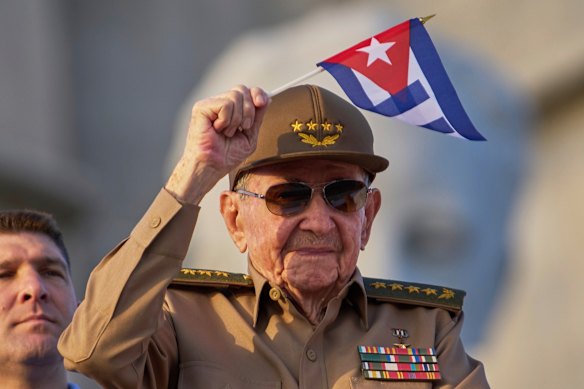

Washington/Miami/Havana: The United States has brought murder charges against former Cuban president Raúl Castro, in the latest escalation of the Trump administration’s campaign against the country’s communist government.
The indictment, issued by a grand jury in Miami last month and unsealed on Wednesday (US time), charges Castro and others with four counts of murder, conspiracy to kill US nationals and the destruction of aircraft.
It relates to a 1996 incident in which two American civilian aircraft operated by a group of Cuban exiles known as the Brothers to the Rescue were shot down in international waters by Cuban military jets. Four men were killed.
Acting US Attorney-General Todd Blanche announced the charges at a news conference in Miami attended by dignitaries, Cuban exiles and families of the victims, who cheered and applauded the government’s actions.
“For the first time in nearly 70 years, senior leadership of the Cuban regime has been charged in this country … for acts of violence resulting in the deaths of American citizens,” he said. “Nations and their leaders cannot be permitted to target Americans, kill them, and not face accountability.
“President Trump has committed to restoring a very simple but important principle: if you kill Americans, we will pursue you, no matter who you are and no matter what title you hold – and in this case, no matter how much time has passed.”
Five other people are named as co-defendants in the indictment.
Castro, 94, last appeared in public in Cuba earlier this month, and there is no evidence that he has since left the island or that the government would allow him to be extradited.
It comes as Trump pushes for regime change in Cuba, where Castro’s communists have been in charge since his late brother, Fidel Castro, led a revolution in 1959.
Cuba will be “next”, Trump has said multiple times, following the military operation to abduct then-Venezuelan leader Nicolás Maduro in early January and the war in Iran that began at the end of February.
Maduro was taken to New York and jailed to face charges related to drug trafficking, which were first levelled against him under the first Trump administration in 2020.
Earlier on Wednesday, Trump called Cuba a “rogue state harbouring hostile foreign military” and framed his actions regarding the Caribbean island as part of a broader effort to expand US influence in the western hemisphere.
“From the shores of Havana to the banks of the Panama Canal, we will drive out the forces of lawlessness and crime and foreign encroachment,” Trump said at a Coast Guard Academy event in Connecticut.
On the same day the indictment was unsealed, Secretary of State Marco Rubio – a Cuban American born in Miami – delivered a video message in Spanish addressed directly to the Cuban people, offering them “a new Cuba” with freedom and opportunity.
The US was “ready to open a new chapter” in the two countries’ relationship, Rubio said, and could provide $US100 million in aid. The only thing standing in the way, he said, was “those who control your country”.
After taking power, Fidel Castro struck an alliance with the Soviet Union and seized US-owned businesses and properties. The US has since maintained an economic embargo on the nation of about 10 million people.
The two sides have talked intermittently over the years. Diplomatic relations briefly improved during former Democratic president Barack Obama’s second term, but Trump has taken a harder line.
‘Superficial and misinformed’
The Trump administration has imposed a naval blockade on Cuba and imposed sanctions on other countries selling fuel to Havana, leading to crippling fuel, food and electricity shortages.
Cuban President Miguel Diaz-Canel said on Monday that the island does not represent a threat.
Foreign Minister Bruno Rodriguez said a White House statement critical of the country’s government was “superficial and misinformed” and accused Rubio of reading a “mendacious script” blaming the Cuban government for the damage inflicted by decades-long US policies.
Rodriguez said Cuba had not rejected the aid package but called it cynical. Rubio insisted it could only be distributed by the Catholic Church or trusted charities.
Cuba and Rodriguez had yet to comment directly on the criminal case against Raúl Castro.
Born in 1931, Raúl Castro was a key figure alongside his older brother in the guerrilla war that toppled the US-backed dictator Fulgencio Batista.
He helped defeat the US-organised Bay of Pigs invasion in 1961, and served as defence minister for decades. He succeeded his brother as president in 2008 and stepped down in 2018, but remains a powerful behind-the-scenes figure in Cuban politics. He was the defence minister at the time of the 1996 incident.
The two small planes that were shot down were being flown by Brothers to the Rescue, a group of Miami-based Cuban exile pilots who said their mission was to search for Cuban rafters fleeing the island. All four men aboard were killed.
The Cuban government has argued the strike was legitimate. Fidel Castro said Cuba’s military had acted on “standing orders” to down planes intruding on Cuban airspace and that Raúl Castro did not give a specific order to fire.
The US condemned the attack and imposed sanctions, but did not pursue criminal charges against either Castro brother. The Justice Department charged three Cuban military officers in 2003, but they were never extradited.
The International Civil Aviation Organisation later concluded that the incident took place over international waters.
With Reuters
Get a note directly from our foreign correspondents on what’s making headlines around the world. Sign up for our weekly What in the World newsletter.
 Michael Koziol is the North America correspondent for The Age and Sydney Morning Herald. He is a former Sydney editor, Sun-Herald deputy editor and a federal political reporter in Canberra.Connect via X or email.
From our partners
Disclaimer : This story is auto aggregated by a computer programme and has not been created or edited by DOWNTHENEWS. Publisher: www.smh.com.au