
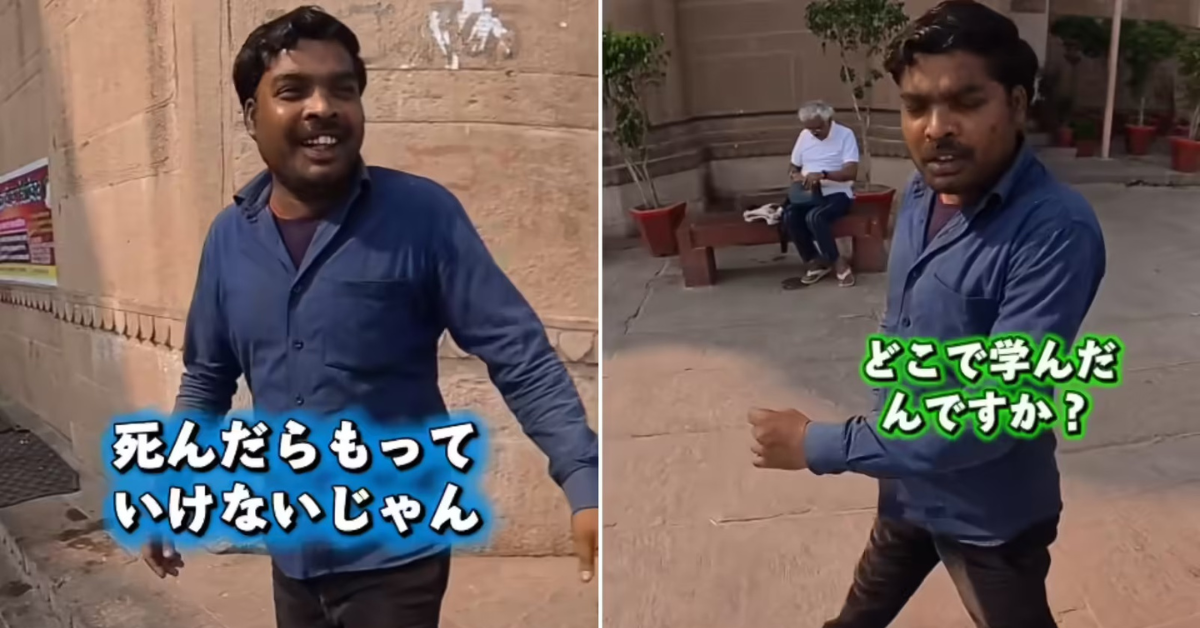
At the steps of Varanasi Ghats, where the rhythms of ritual and tourism overlap, a local guide known as Mr Deep has become the centre of an unexpected global conversation.
A moment that travelled far
In a recent viral Instagram video, he is seen guiding a group of Japanese tourists in fluent Japanese. The exchange is unforced and easy, as he explains the city, responds to questions, and jokes with the group in a language far removed from his own.
The tourists listen closely and respond with the familiarity of people who feel understood.
The most striking moment comes toward the end of the clip. One of the tourists extends money as a gesture of gratitude.
Deep smiles and declines, replying in Japanese, “Money really isn’t that important. People are important.” The interaction is brief, but it lingers because it captures a kind of hospitality that is rarely articulated so simply.
The video has since surpassed a million views, and the online response has been unusually consistent in tone. Viewers are not only impressed by his language skills but also moved by the sincerity of the exchange. One user wrote, “He wouldn’t even accept a tip. He really was just too kind-hearted.”
Another commented, “Spent the day going around Varanasi and drinking beers with this guy. It was a wonderful time.” A third observed, “It’s so interesting to see his Japanese with an Indian accent,” pointing to the layered cultural exchange embedded in the interaction.
The man behind the fluency
As the clip circulated, curiosity about Deep grew. In the video, when asked how he learned Japanese, he replies that he began studying it at age 15.
There is no indication of formal training abroad, and his fluency appears to be the result of years of self-learning and on-ground practice shaped by repeated interactions with visitors.
Japanese is widely regarded as a difficult language to master, with its multiple scripts and complex system of honorifics. What stands out in Deep’s speech is not only accuracy but also cultural ease.
He understands when to be formal, when to be conversational, and how to maintain the politeness that is central to Japanese communication. This kind of fluency reflects not just linguistic knowledge but cultural intelligence developed over time.
His demeanour in the video reinforces that impression. He does not perform for the camera or exaggerate his abilities.
His refusal to accept the tip feels instinctive rather than symbolic, and for many viewers, this authenticity is what sets the moment apart from the countless travel clips that circulate online.
Challenging stereotypes in tourism
At the same time, the video is quietly challenging long-held assumptions about India’s informal tourism sector.
In cities like Varanasi, local guides are often the first point of contact for international visitors, yet their work is frequently viewed through a narrow lens shaped by concerns about overcharging or aggressive solicitation.
Deep’s interaction offers a different perspective. It shows a guide who has invested in learning a foreign language, who understands his audience, and who prioritises comfort and connection over transaction.
His work requires adaptability, patience, and an ability to interpret not just facts about a place but the expectations of people experiencing it for the first time.
Language as a bridge, not just a skill
Across India, many guides operate in similar conditions. They learn languages like Japanese, French, or Spanish through informal means such as online videos, second-hand books, and conversations with travellers.
This learning is rarely certified or formally recognised, but it plays a crucial role in shaping how visitors experience the country.
In this context, language becomes both a livelihood and a bridge. It allows guides to move beyond basic instruction and create more meaningful interactions.
When visitors are addressed in their own language, unfamiliar environments become easier to navigate, and cultural gaps begin to close.
Reclaiming hospitality in practice
The idea of Atithi Devo Bhava, often used in tourism campaigns, finds a more grounded expression in such moments.
Deep’s statement that people matter more than money resonates because it is backed by action, reflecting a version of hospitality that is rooted in dignity and mutual respect rather than obligation.
Varanasi, often described as one of the world’s oldest continuously inhabited cities, draws travellers seeking spirituality, history, and cultural depth. Guides like Deep shape these experiences in ways that are not always visible.
They translate rituals, contextualise traditions, and help visitors engage with the city beyond its surface.
A small moment, a larger shift
The viral video has not changed the realities of the profession overnight, and local guides continue to work within an informal system that offers limited security or recognition. However, it has shifted attention, even if briefly, toward the skill and effort that underpin this work.
What makes the moment enduring is not just its virality, but what it reveals. It shows that professionalism in tourism is not always defined by formal structures or certifications. It can also be found in self-taught fluency, cultural sensitivity, and the ability to make a stranger feel at ease in an unfamiliar place.
At the ghats, where countless such interactions unfold every day, Deep’s story stands out because it was seen. It serves as a reminder that behind every guided walk is a person who has learned, adapted, and worked quietly to bridge worlds.
Disclaimer : This story is auto aggregated by a computer programme and has not been created or edited by DOWNTHENEWS. Publisher: thebetterindia.com






