US Marines are working to repair the Venezuelan port of La Guaira, a senior administration official said Monday, as Washington boosted its financial commitment for the earthquake-hit country to $300m.
A “specializ=sed team of Marines” are “working around the clock to repair that port and allow the delivery of critical supplies by sea,” the US official told journalists on condition of anonymity, adding that the USS Fort Lauderdale – an amphibious transport dock warship – had also docked there.
La Guaira, on Venezuelan’s northern coast, is one of the country’s two main ports.
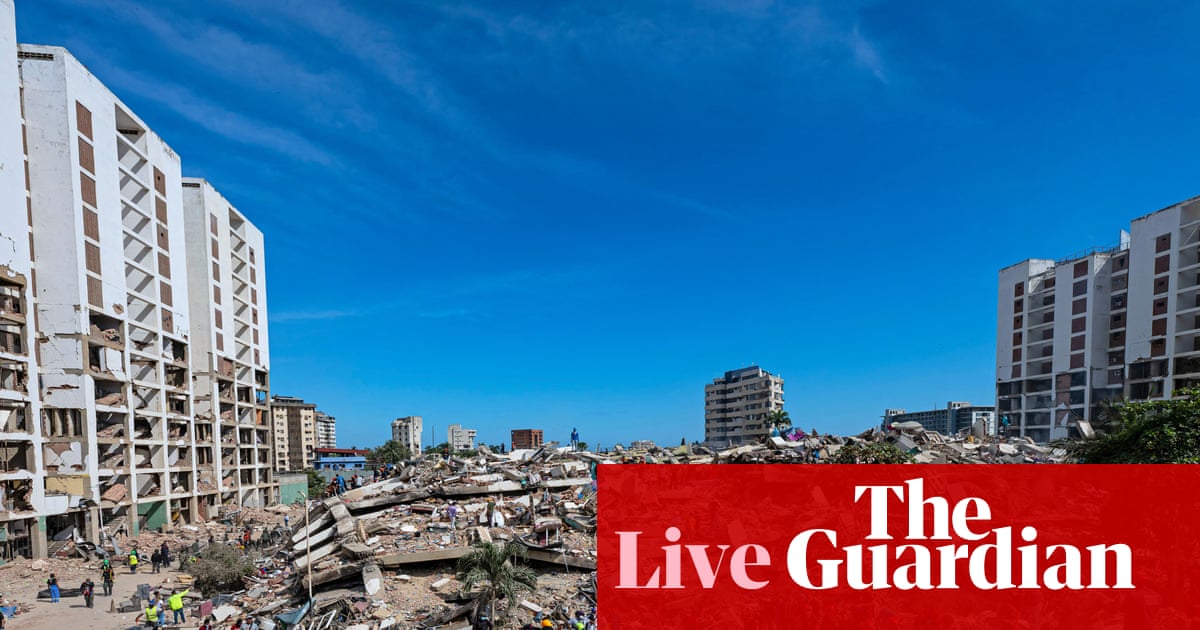
A residential complex once touted as part of former strongman leader Hugo Chavez’s flagship housing program has been left uninhabitable in Venezuela’s earthquake disaster.
Built as part of efforts to modernise Venezuela, the buildings now symbolise the country’s dire situation after twin quakes on Wednesday left nearly 1,500 people confirmed dead and tens of thousands missing.
“Most of the buildings at the back of the complex have completely collapsed,” Jenny Contreras, 28, said.
Contreras, her husband and their four-year-old son have slept on a mattress in the street since the quakes tore into 192 buildings in the Urbanismo Hugo Chavez complex in the Catia La Mar neighbourhood of La Guaira.
The 3,400 apartments have been evacuated and Contreras said she was not even able to return to recover belongings.
Large cracks rippled through the buildings, revealing interior construction materials, AFP reporters said. Some were teetering on the verge of collapse and others had already fallen.
Even for buildings that are still standing, the future is bleak.
“The entire development will be condemned. The whole development is going to disappear in the future because all of it is in very bad condition,” Contreras said.
The United States has pledged more than $300m in funding to aid earthquake-hit Venezuela, the state department said today, up from a previous commitment of $150m.
“These funds will provide emergency medical care, food assistance, water and sanitation, shelter, protection, and logistics,” the department said in a statement.
The money is being directed through partner organisations including Samaritan’s Purse, Catholic Relief Services, the International Organization for Migration, the World Food Programme and the Red Cross, the statement said.
Washington has also deployed four urban search-and-rescue teams to Venezuela that are made up of more than 300 first responders and almost two dozen search dogs, the statement added.
In a separate post on X, Delcy Rodríguez, who has been criticised for the sluggish official response to the earthquakes, praised the international contribution to the ongoing rescue and relief efforts.
She said:
We visited the García Carneiro Stadium, where response teams from the international community are located, having arrived to provide support. 30 countries, 3,681 rescuers, 1,086 tons of supplies, 27 vehicles, and 118 canines that bolster the search and rescue efforts. Thank you!
Venezuela’s acting president Delcy Rodríguez has posted footage of the rescuing of Aaron Levi Cantillo Vargas, 21, who she says was trapped under rubble in the town of Caraballeda for 106 hours before being pulled out to safety earlier today (see post at 13.58 for more details).
Dilan Yeşilgöz-Zegerius, the Netherland’s defence minister and deputy prime minister, said last night that the patrol vessel HNLMS Groningen was heading from the Caribbean to Venezuela to provide assistance to Venezuela following the earthquakes.
In a post on X, she said the ship, which will deliver relief supplies, can provide and produce drinking water to affected areas in the country.
The Reuters news agency is reporting that an explosion at a rig operated by state-run oil company PDVSA in Venezuela’s Apure state left at least eight workers injured yesterday evening. They were transported to Colombia for medical assistance, according to the sources, who spoke under the condition of anonymity.
A 4.6-magnitude aftershock centred at a depth of 10km (six miles) hit north of the Venezuelan capital Caracas early on Monday, according to the US Geological Survey.
No damage was immediately reported from the aftershock.
Wednesday’s twin earthquakes have left close to 1,500 people confirmed dead, the president of the National Assembly, Jorge Rodriguez, said on social media.
In an update to X, El Salvador’s president has said that after hours of intensive work rescuers have freed Aaron Levi Cantillo Vargas, 21, who was trapped under a building in Caraballeda, La Guaira, calling the operation “a miracle”.
“This rescue was made possible thanks to the coordinated effort of the rescue teams from Venezuela, Mexico, and El Salvador, who worked tirelessly to reach Aaron,” Nayib Bukele wrote in a social media post, adding that the 21-year-old is now receiving specialised medical attention.
China says it will send 100 million yuan ($14.7m; £11.1m) in disaster relief aid to Venezuela.
The Chinese government will provide Venezuela with “emergency free relief supplies… to support earthquake relief and post-disaster reconstruction”, foreign ministry spokesperson Guo Jiakun told reporters this morning.
The supplies will be delivered “as soon as possible”, while Beijing also provides Caracas with satellite images of affected areas to assist in rescue efforts, the spokesperson added.
Eight Chinese nationals have been killed in the earthquakes, while one remains missing, Chinese state media reported on Monday.
At least 24 countries have sent 521 tons of supplies, 86 units with dogs trained to locate people trapped beneath the rubble and more than 2,700 search-and-rescue personnel, Venezuela’s acting president, Delcy Rodríguez, said on Sunday.
My colleague Clavel Rangel has filed this story from Caracas:
Displaced families from across Caracas have been arriving at Parque del Este, a beautiful 200-acre park in the city’s east that was designed by the legendary Brazilian landscape architect Roberto Burle Marx.
Some of the earthquake survivors, like 49-year-old Leidy Cáceres, carry fresh memories of an older tragedy: the 1999 Vargas disaster.
Leidy survived the catastrophic mudslides that devastated Venezuela’s Caribbean coast, and now she has once again been displaced, along with her children and grandchildren, after the twin earthquakes that struck the country on 24 June.
“I was displaced back then, too. For me, this feels like living through the same thing all over again. I used to live in the El Limón neighborhood, on the road down to Vargas. We lost everything at that time. I was 10 years old.”
Leidy lives – or used to live – in the densely populated neighbourhood of Petare. She no longer knows whether her family will be able to return home.
A neighbour donated a tent, which she has been using to spend the nights this Friday with her daughter, who is two months pregnant, and her five grandchildren.
She said:
We left because we were afraid the aftershocks would bring our house
down. No one here has told us when we might be able to return. In
fact, nobody has given us any information.It’s ordinary people, our neighbours, who have been helping us. No one from the government has come to ask about the extent of the damage.
Leidy’s family is among the few fortunate enough to have a tent. Most people are sleeping on bedsheets spread across the park’s grass.
In this powerful story, my colleagues Clavel Rangel and Tom Phillips have some details about the anger felt by many Venezuelans at the inadequate governmental response to the earthquakes. Here is an extract:
Venezuela’s communications ministry has also sought to project an image of unity and diligence in the face of the tragedy, posting social media videos of government rescue teams using sledgehammers and stretchers to pluck dust-caked survivors from the rubble.
But on the streets, there is growing anger at what many perceive as the sluggish response of a government unprepared for a crisis of this scale, and the way many feel they were abandoned to their own fate in the hours after disaster struck.
Rodríguez was heckled by frustrated locals while touring one badly hit part of the capital. “The government isn’t doing anything for the people!” shouted one critic.
Outside the mortuary, the relentless work of volunteers offering water, coffee and trauma counselling contrasted with the lethargic official reaction, which experts blame on years of underinvestment in emergency services, as well as the sheer scale of the natural disaster.
Similar scenes could be seen all across the traumatised city, as tents, mattresses and food were delivered to hundreds of families sleeping out on the streets because they were too frightened to return home, many with young children. If there is one thing not lacking in Caracas, it is the food provided by volunteers.
The wife and two children of Argentine footballer Lucas Trejo have died after the powerful twin earthquakes struck Venezuela last week, his team said on Sunday.
Trejo, who plays for Club Sport Maritimo La Guaira, a second-division team in Venezuela, had searched for his wife Yanina and children Aarón and Ainhoa in the rubble for three days before rescue workers recovered their bodies, CNN reported.
“Club Sport Maritimo La Guaira deeply mourns the irreparable loss of our player’s wife and children,” the team said in a post on Instagram.
Trejo, 38, was at a team training camp in Caracas, the capital of Venezuela, when the earthquakes of magnitude 7.2 and 7.5 struck on Wednesday evening, according to CNN.
He immediately returned to his home in La Guaira where he encountered “a horrific scene,” Trejo’s brother-in-law, Ricardo Ardiles, told CNN. “He found absolutely nothing of what the building itself had been.”
El Salvador’s president, Nayib Bukele, has said rescue teams from El Savador, Venezuela and Mexico are working to pull out Aaron Levi Cantillo Vargas, 21, from a building he remains trapped under in Caraballeda, La Guaira state.
“We have already managed to locate him, and one of our doctors has been able to administer fluids to keep him hydrated,” he wrote in a post on X.
“Unfortunately, between our rescuers and Aaron lies the body of a deceased person, which is complicating the efforts to reach him.”
Venezuela’s coastal state of La Guaira was hardest hit by the twin earthquakes on Wednesday. Here are some of the latest images sent to us over the newswires as recovery efforts there continue:
All schools in Venezuela will remain closed until at least 6 June due to the extensive damage caused by the earthquakes that struck last week, the country’s education ministry has said.
The government has urged families to follow official channels to keep informed about the latest developments.
Schools have been shut since the two earthquakes hit within a minute of each other shortly after 6pm local time on Wednesday.
The education ministry subsequently said that some schools would be converted into emergency relief centres and shelters for affected families.
There have been glimmers of hope in an ongoing tragedy that has shaken a country already mired in an economic crisis caused by years of crippling US-led sanctions, hyperinflation, government corruption and mismanagement.
A man and his teenage son were found alive under the rubble in Venezuela on Sunday, in a town about 40km north of the capital Caracas, AFP journalists reported. The discovery of survivors in Caraballeda was made by French and American rescue teams.
Thirty-three people were rescued from the rubble in Venezuela on Saturday, the country’s president said.
The US state department hailed the rescue of an infant by American rescue crews over the weekend, posting a video to X showing rescuers removing the wailing child from the rubble.
A Colombian rescue team saved an 11-year-old boy, Moises, who had been trapped about 3 metres (10 feet) deep in rubble, after identifying his location with a scanner, Reuters TV reported. He was removed on a stretcher with a broken arm. His mother and sister were killed.
On Friday, after 32 hours stuck under debris, a mother and her 18-day-old baby were rescued alive, as you can see below:
The president of Venezuela’s National Assembly has warned time is running out to rescue survivors trapped under the rubble.
The death toll from the earthquakes has risen to at least 1,450 people, with 3,150 injured and 12,721 others displaced, Jorge Rodríguez said yesterday in a televised address.
“We are in critical hours, in crucial hours to continue rescuing lives and to build camps where those people who have lost their homes, or who cannot return, for whatever reason, to their residences can stay,” Rodríguez said.
More search and rescue teams are arriving in Venezuela five days after the powerful 7.2 and 7.5 magnitude quakes struck within a minute of each other on Wednesday evening, flattening buildings in the north of the country.
The second quake was one of the strongest tremors to hit Venezuela in a century. At least 68,900 people have been reported unaccounted for by their families.
Experts say the first 72 hours after natural disasters define the narrow window for rescuing the living. After that the search usually becomes one of recovering bodies.
Venezuela’s acting president, Delcy Rodríguez, says power has been restored to La Guaira, a port city near the country’s main international airport badly affected by the earthquakes.
But there is a severe shortage of heavy machinery needed to rescue survivors and state manpower has been lacking, meaning the government is reliant on international aid for assistance.
Disclaimer : This story is auto aggregated by a computer programme and has not been created or edited by DOWNTHENEWS. Publisher: theguardian.com