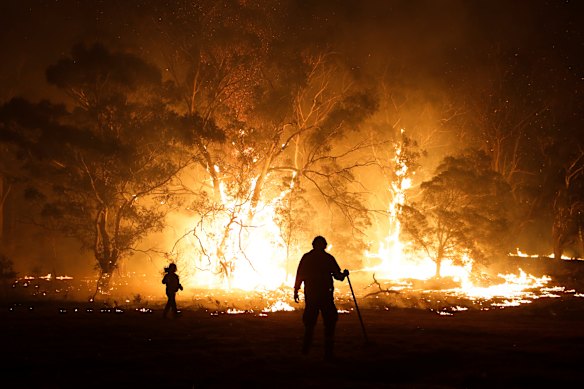

A “very strong” El Nino global weather event has been declared by the Bureau of Meteorology and forecasts show it could be the most severe in decades, elevating the risk of drought, heatwaves and bushfires this summer.
El Ninos are triggered by warming of the ocean around the equator and a weakening of trade winds that blow around in the Pacific Ocean, which reduces the rain on Australia’s eastern seaboard.
The Bureau of Meteorology is late among international weather agencies in officially declaring the onset of El Nino. The US National Oceanic and Atmospheric Administration declared last week a 63 per cent chance that the current phenomenon would “would rank among the largest events in the historical record going back to 1950”.
Japan also declared an El Nino last week.
The previous El Nino event, which ran from spring 2023 to early 2024, included Australia’s driest three months on record: August, September and October 2023.
It is too early to say how the current El Nino will play out. A rainband has swept across southern Australia but with El Nino under way, the three-month weather outlook is for hotter temperatures and below median rainfall.
The bureau said that a warmer Pacific Ocean usually caused global temperatures to rise and noted that southern Australia had already experienced above-average temperatures this year.
Additionally, global warming had generated a long-term warming trend, the bureau said, noting that since 2000 Australia had copped 14 of its 15 warmest years since records began in 1910.
The strength of an El Nino is gauged by sea surface temperatures in the tropical Pacific, but a strong event does not necessarily result in extreme weather in Australia, while the opposite is true of “weak” El Ninos that can spark severe drought or bushfires.
“Most models suggest this event is likely to be strong to very strong,” the bureau noted in a statement. “The strength of the event doesn’t always match the strength of its impact in Australia. A weaker event can have major effects, while a stronger one may not.”
El Ninos have a global reach and are associated with severe storms and flooding in Americas and both droughts and floods in North Africa.
In Australia, climate scientists use the term El Nino-Southern Oscillation rather than El Nino weather cycles, indicating a need for the right ocean and atmospheric conditions to arise simultaneously to drive the weather system that often delivers heatwaves, droughts, and raises the risk of severe bushfires.
This combination of hot seas and weak trade winds is known as “atmospheric coupling”.
La Nina weather systems are effectively the opposite of an El Nino event and bring moist air along the coast of northern Australia, driving unusually wet weather down the eastern seaboard.
Get to the heart of what’s happening with climate change and the environment. Sign up for our fortnightly Environment newsletter.
 Mike Foley is the climate and energy correspondent for The Age and The Sydney Morning Herald.Connect via email.
From our partners
Disclaimer : This story is auto aggregated by a computer programme and has not been created or edited by DOWNTHENEWS. Publisher: www.smh.com.au