

Victoria will receive $350 million to improve community infrastructure in growing suburbs and regional hubs, making it the first state to qualify for the federal government’s bonus aimed at improving services.
The funding commitment to improve liveability comes as former New York mayor Bill de Blasio warns that new developments across Melbourne need to have 25 per cent mandated affordable housing to help tackle the city’s housing crisis.
De Blasio says in a speech to be delivered at this week’s Melbourne Assembly civic forum at Federation Square that affordable housing supply around the world has failed to keep up with population, employment changes and pricing.
“A city without enough affordable housing will simply fail,” he says.
“The private sector will never produce enough housing for working-class families on its own.
“Only with an aggressive public sector role can enough affordable housing be built and preserved.”
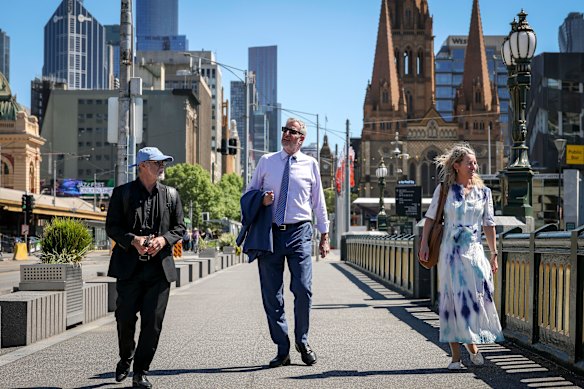
De Blasio will deliver his speech in the company of Prime Minister Anthony Albanese, who in a separate address to the assembly will reveal that Victoria is the first state to qualify for a financial bonus under the National Housing Accord.
Albanese is to say that under the New Homes Bonus scheme, Victoria will receive $350 million in federal funding to be invested into community infrastructure in growth suburbs and regional areas.
“This program is open to every state and territory – and I encourage them to follow Victoria’s lead,” the PM says in his speech.
The bonus is based on new modelling by the National Housing Supply and Affordability Council. The modelling shows that despite Victoria currently lagging by about 6000 homes in its annual quota for new dwellings built, an acceleration in construction is expected to deliver a five-year total of 287,000 new homes by July 1, 2029 – nearly 32,000 more than the state’s minimum target under the accord.
Albanese will foreshadow further measures by the federal and Victorian governments to help more first home buyers enter the housing market.
De Blasio says market forces should not be left to determine the type and number of homes being built.
He introduced mandatory inclusion zoning policies during his time leading New York City, enabling private developers to construct higher or denser buildings than would normally be allowed in exchange for a commitment that about 25 per cent of new units would be affordable housing.
“This can be used to great effect in a high-value city like Melbourne,” de Blasio says.
The City of Melbourne has advocated such zoning in the past, but Lord Mayor Nick Reece announced plans to abandon these targets, arguing current economic conditions would cause the policy to constrain housing supply.
The state government has drawn criticism for using a limited version of inclusionary zoning where it can fast-track residential projects – overriding the ability of communities or councils to contest them at VCAT – on the condition that private developers include 10 per cent affordable housing in new projects.
However, developers can bypass the requirement to build affordable housing by instead paying a fee of 3 per cent of the project’s value into a government housing fund.
“Affordable housing” in Victoria refers to private rental stock offered at a minimum 10 per cent discount to the market rate for moderate-income earners for a set number of years only.
Planning Minister Sonya Kilkenny and opposition planning spokesman David Southwick both declined to comment on whether Victoria should take up the 25 per cent affordable housing target.
Kilkenny instead said the government’s Development Facilitation Program had so far delivered 16,000 new homes of which 18 per cent were affordable homes.
“The best way to make homes more affordable is to build more of them, and Victoria continues to build more homes than any other state,” Kilkenny said.
Southwick said the Liberal Party wanted to lower property taxes.
“Our team’s housing plan is about lowering costs, delivering greater choice and restoring confidence to our construction sector,” he said.
The Planning Institute of Australia backs mandatory affordable housing targets, with Victorian president Patrick Fensham also raising concerns about the current system. Fensham said it was not clear how many homes the Development Facilitation Program subsidises, who is eligible for them and how long the homes are eligible for a subsidy.
“It’s a matter of being transparent,” he said.
The Planning Institute has called for 80,000 social housing homes by 2051 – equal to about 3000 to 4000 a year – to tackle Victoria’s a shortfall.
Fensham said a mandatory social and housing contribution should be applied to all development, but warned it is difficult to apply terms such as “affordable housing” in an Australian context where it is not the same as social housing – reserved for low-income renters on the government waiting list and managed by the state (public housing) or non-profits (community housing).
“London and New York are way ahead of us because mandating affordable housing just seems to be a standard requirement there,” Fensham said. “We’ve been slow to move into a recognition that the development process and the planning system should have a role in making the contributions towards social affordable housing.”
Mandatory housing targets are opposed by many developers.
Linda Allison, chief executive of the Urban Development Institute of Australia, said a one size fits all approach does not work for housing projects.
“A mandatory target will drive up the overall cost of housing, which will ultimately be paid for by home buyers,” she said.
Allison said paying a levy through the Development Facilitation Program was preferable for developers as it provided the certainty of a fixed cost not subject to future price variability.
“The best way to help industry deliver more homes is to create a tax environment that encourages investment and to reduce red tape which causes significant time delays,” she said.
“The uncomfortable reality is that affordable and social housing needs government funding to make it stack up, and government funding comes from taxpayers. Most people feel like they are already paying enough tax.”
The Melbourne Assembly will on Tuesday hear from keynote speaker de Blasio and from the prime minister. Panel discussions on two key pillars of the forum, shaping our city and education and innovation, will be held.
From our partners
Disclaimer : This story is auto aggregated by a computer programme and has not been created or edited by DOWNTHENEWS. Publisher: www.smh.com.au



