Victoria has recorded a surplus for the first time since the pandemic but the state’s financial recovery remains uncertain with debt forecast to near $200bn in coming years amid global uncertainty.
The 2026-27 Victorian budget, handed down on Tuesday, shows the state recorded a $727m operating surplus in 2025-26, a slight improvement on December’s pre-budget update of $710m and the $611m forecast last May.
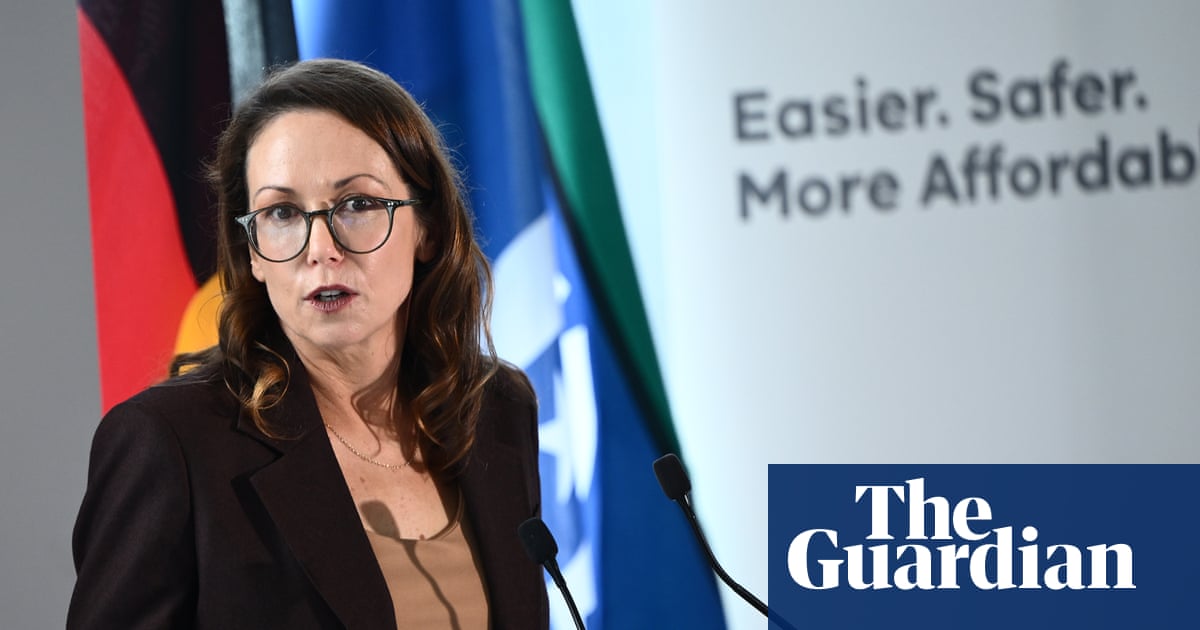
The treasurer, Jaclyn Symes, said it marked Victoria’s first surplus in seven years and the only one recorded by any state government “on the eastern seaboard” in 2025-26.
“We join Western Australia and South Australia as the only jurisdictions in surplus. But of course, South Australia’s is smaller than ours, and Western Australia can rely on things that other states can only dream of in terms of royalties and the sweetheart GST deal,” she told reporters on Tuesday.
“The fact that we’re delivering surpluses across the board in that respect is impressive, given our structural disadvantage compared to the other states when it comes to revenue.”
The budget has also projected a $1.05bn surplus in 2026-27 – down by $895m on December’s forecast – then surpluses of $1.86bn in 2027-28, $1.94bn in 2028-29 and $1.97bn in 29-30.
Symes said the successive surpluses were due to the state’s strong economic growth and government’s “disciplined decisions” amid a “tight fiscal environment”.
Like other states, Victoria’s headline operating surplus does not include infrastructure and other capital spending.
When factored in, Victoria is forecast to have a cash deficit of $7.7bn in 2026-27 – $400m worse than forecast in the December budget update – decreasing to $7.12bn in 2027-28 before widening to $7.58b in 20238-29 and $8.07bn in 2029-30.
Debt is also forecast to grow from $165.3bn in June 2026 to $199.3bn in 2029-30 but stabilises as a proportion of the economy to 24.4% of gross state product (GSP). By then, interest payments on state debt are forecast to total $11.82bn – or $32m a day.
Another key expense for the government is its public sector wage bill, sitting at $41.13bn in 2026-27 or 35% of total revenue. It follows the government signing off on a plan in December to slash 1,000 public sector jobs, including 300 executives, and merge several entities.
The government will rake in $41.52bn in tax revenue this year, growing to $43.18bn in 2026-27 and then by an average of 5.1% over the forward estimates.
But the revenue it collects from stamp duty is forecast to take a hit over the coming financial year due to a “decline in property market activity amid higher interest rates” before recovering in 2027-28.
The budget also forecasts poker machine revenue will decrease due to the introduction of mandatory carded play, though it will be offset by growth in lottery revenue, thanks in part due to a new deal with the Lottery Corporation announced on Tuesday. The operator of Powerball and Oz Lotto told the ASX it received an unprecedented 40-year extension to its Victorian licence, allowing them to keep operating until 2068.
The budget rests on several key assumptions, including that the state’s economy will continue to grow – by 1.5% in 2026-27, 2% in 2027-28 and then 2.5% in the last two years of the forward estimates, with inflation peaking at 3.5% this financial year and the next, before tapering to 2.5% in 2029-30.
It also assumes the Reserve Bank of Australia will increase the cash rate to 4.35% by mid-2026, then remain at that level throughout 2026-27 before gradually declining to 3.5% by late 2028.
Symes defended the assumptions, telling reporters they weren’t “more rosy than anybody else’s” and that treasury was “quite conservative”.
The budget warns Victoria’s economic outlook and forecasts are subject to “elevated” uncertainty amid a “highly uncertain geopolitical backdrop”.
Named “Easier. Safer. More Affordable”, the budget funds $13.8bn in new initiatives since December’s budget update, including $750m to provide a 20% refund on car registrations and $432m to extend free public transport until the end of May and then offer half-price fares for the rest of 2026. It also includes $2.4bn in funding over five years for Thriving Kids, a replacement program for NDIS recipients with autism who will be removed from the national scheme.
There were just $607.5m in new savings measures over four years, described in the budget papers as “back of house efficiencies” in the public service.
Disclaimer : This story is auto aggregated by a computer programme and has not been created or edited by DOWNTHENEWS. Publisher: theguardian.com