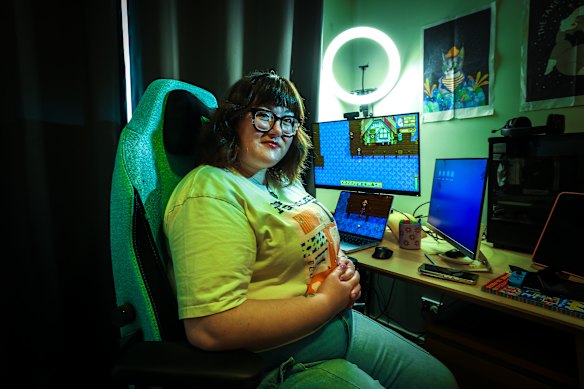

Since she was in her teens, video games have been much more than a pastime for Cassandra Gray. They were portals through which she could connect with new friends, a way to shut her brain off after a long day, and an antidote to any anxious thoughts.
This became even more evident during the COVID-19 pandemic, when the world shut down and online gaming transformed into her social lifeline.
That all changed in 2021. Gray developed peripheral and optic neuropathy, a chronic illness that eventually caused her eyesight to deteriorate. Over time, the games that once offered her refuge were suddenly impossible to play. Her social lifeline was cut.
“When you hear about someone losing their eyesight, you wouldn’t think the ability to play games would be the highest thing on their list,” Gray, who is also a game developer, says. “But because I was already sick, it was like, ‘What do I do with my time now?’ It was quite depressing.”
Gray, from Melbourne, is far from alone in that respect. About 21 per cent of adult gamers report having a disability, and an estimated 250 million gamers worldwide identify as visually impaired. Yet game design still favours able-bodied players.
Gray, 35, had to stop playing some of her favourite narrative-focused games because they contained too much text, most of which was too small or did not remain on screen long enough for her to read. Others had too many icons, or contained distracting flashing lights.
“You don’t have to do a lot to make a game more accessible for many people,” Gray says. “If 21 per cent of gamers have some kind of disability, that’s 21 per cent of the gaming population potentially locked out of certain games … Accessibility is important for my own personal reasons, but it’s also just common sense.”
Dr Steven Conway, course director for games and interactivity at Swinburne University of Technology, agrees. More people play video games than ever before, he says, yet the games don’t necessarily reflect that diversity. To try to change this, he and four fellow Swinburne researchers launched co-design workshops to develop solutions to gaming’s accessibility problem.
How can video games be made more accessible?
By hosting workshops with young gamers and industry professionals, Conway and his fellow researchers came up with these suggestions:
Quick wins
- Include accessibility toggles in a dedicated, clearly organised game options menu so that players can easily customise their experience to their own needs.
- Use accessibility and inclusion surveys to identify barriers.
- Prioritise clear, icon-based user interfaces.
Hard wins
- Ensure game art follows inclusive design principles so that it’s visually accessible, clear and adaptable.
- Introduce cross-platform player profiles that log a person’s accessibility preferences, which automatically apply games upon launch.
- Create visually accessible game art.
Some developers already prioritise accessibility, and the Australian Game Developer Awards dedicates a category to those who excel in this area. There’s even an award show centred on accessibility, with last year’s event celebrating games such as Star Wars Outlaws. Large-scale initiatives such as Can I Play That?, a platform made for and by disabled gamers, have become industry mainstays.
However, Conway says accessibility improvements have been inconsistent across the industry, creating a need for more universal guidelines.
This could be as simple as incorporating accessibility toggles into a game’s options menu, allowing players to easily customise their gaming experience, or reducing the number of icons appearing simultaneously on-screen.
“We should provide equity to as many people as possible, and understand there’s a difference between access and the integrity of the activity,” Conway says. “People tend to go, ‘Oh, you’re just making games easier’, but that’s not at all the impulse … Accessibility doesn’t undermine the challenge or integrity of the art form.”
The co-design workshops, which also explored representation and hostility in online gaming, found that video games could benefit from an accessibility rating scale, similar to age classifications in film and TV. This could immediately indicate how accessible a game is, Conway says, helping players decide which games are best for them, and also encouraging developers to consider accessibility from the get-go.
While Australian games are renowned for their diversity in terms of representation, Conway says they’re generally only on a par with those from other countries when it comes to accessibility. Unlike the makers of AAA games (blockbusters), indie companies may not have the resources for the rigorous play-testing required to check game accessibility. It would also be difficult to enforce these guidelines across every game genre or style.
Conway says their guidelines therefore aren’t intended as “mandates”.
“I wouldn’t want our checklist to be the barrier for a three-person studio from releasing their game because they simply can’t check everything off,” he says. “I would love for it to be a flexible checklist that’s reconfigurable based upon the studio’s needs and situation.”
Gray, who has resorted to screen magnifiers to help her play certain games, says these changes could be revolutionary for many players. As a game developer, she acknowledges how difficult it can be to enforce any prerequisite.
Guidelines, however, are a good starting point. With them, Gray says, accessibility will at least be part the conversation more often. “There are very basic things you can include that make a huge difference,” she says.
Find out the next TV, streaming series and movies to add to your must-sees. Get The Watchlist delivered every Thursday.
 Nell Geraets is a Culture reporter at The Age and The Sydney Morning Herald.Connect via X or email.
From our partners
Disclaimer : This story is auto aggregated by a computer programme and has not been created or edited by DOWNTHENEWS. Publisher: www.smh.com.au