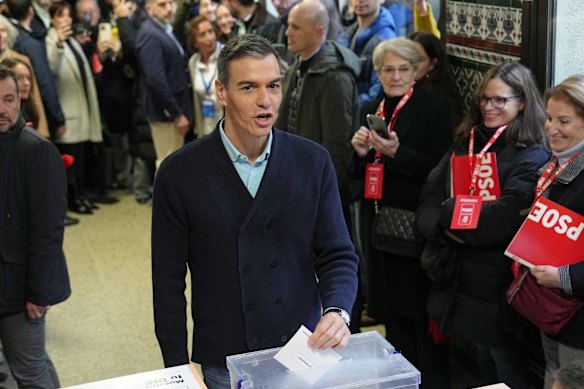

Madrid: Spanish voters have cast their ballots in record numbers in an election that has forced Prime Minister Pedro Sánchez to fight for his survival against conservative rivals who have blasted his government over housing, migration and rising living costs.
Voter turnout reached almost 68 per by 6pm on Sunday – 4am on Monday AEDT – as millions of Spaniards queued at local polling stations in what has been described as the most consequential election since the restoration of democracy in 1977.
A surge in support for centre-right leader Alberto Núñez Feijóo and his People’s Party (PP) has lifted him to front-runner status in the opinion polls, after he urged the public to vote for a “necessary change” after eight years of socialist rule in Madrid.
Sánchez, however, has become a leading progressive figure in Europe over eight years in office by defying challengers and emerging triumphant from four elections, even when forced to negotiate with minor parties to secure his survival.
Sánchez cast his ballot on Sunday morning with a call for an “historic mobilisation” in support of his Spanish Socialist Workers’ Party (PSOE) and his policy pledges to invest in housing, health and education.
Feijóo countered by urging people not to vote out of “fear” and instead keep in mind their memories of the recent past, hoping they would punish the incumbents during a time of increasing hardship.
While Sánchez and Feijóo are regarded as the competing contenders for the prime minister’s office, polling suggests either of them would have to rule with the support of minor parties.
The hard-right Vox party gained about 18 per cent in a series of opinion polls in recent weeks after its leader, Santiago Abascal, stepped up his calls for tougher border controls and a “remigration” policy to force migrants to leave Spain if they broke the law or did not have approval to enter.
On the left, former Barcelona mayor Ada Colau is leading the Frente Amplio – or Broad Front – and has enough support to become a contender in any negotiations if Sánchez falls just short of a majority.
Recent polling by national newspaper El Pais showed that Feijóo and his party had 31.4 per cent of the vote, while Sánchez and the PSOE had 29.1 per cent. Abascal and Vox had 17.9 per cent, while Colau and the Broad Front had 6.8 per cent.
The election campaign has been dominated by public anger over housing shortages after elderly tenant María del Carmen Abascal was evicted from her home in September, triggering widespread protests. She died two weeks later.
Anxiety over migration has also shaped the debate after more than 72,000 migrants crossed from Morocco into the Spanish enclave of Ceuta in August. Migrants have also arrived in record numbers at the Canary Islands after voyages in small boats from West Africa.
Spanish election authorities said 68 per cent of eligible voters had cast their ballots by 6pm, almost 15 percentage points higher than the total turnout at the previous election in 2023.
Polls closed across Spain at 8pm on Sunday (6am on Monday, AEDT) and opinion polling is expected to be released soon afterwards, followed by official results in the subsequent hours.
Voters in suburban Madrid told this masthead of their disappointment in the government over the past eight years and their doubts about whether to throw their support behind Feijóo or other contenders on the right.
“There is a big polarisation,” said Daniel de Pedro, 38, a marketing account director.
“In other times here in Spain, maybe there were more people in the political centre. Now there are many people who are absolutely on the right or absolutely on the left.”
De Pedro spoke after casting his ballot in the district of Tetuán, where migrants comprise about 20 per cent of the population and some neighbourhoods are known for relatively modest living standards.
The housing crisis was “crazy” for ordinary workers, said Maria Aguilar, 37, a hospitality worker also in Tetuán.
Aguilar said she began paying €945 euros per month (about $1500) for a three-bedroom apartment in the district five years ago but that the landlord had increased this to €1500 in recent months. The 59 per cent increase over five years forced her and her sister to leave.
“There is less trust in politics here now,” she said.
“Generation after generation, fewer people trust the politicians on what they’re going to do.”
While rents have soared, salaries have fallen behind inflation. The economy is tipped to grow 2.6 per cent this year, but is forecast to slow next year and afterwards. Inflation is forecast to be 3.9 per cent this year.
The government has spent heavily over the past eight years, but has amassed significant public debt, which is now equivalent to 99 per cent of GDP. This year’s deficit is 2.6 per cent of GDP.
In the neighbourhood of Chamartin, where incomes are higher, several residents told this masthead it was time for a conservative government.
“We are receiving a lot of migrants and the government seems to not doing anything regarding this question,” said Joachim, 28, who asked that his surname not be published.
“I like the idea of a mixed government between the PP and Vox, because one of them has a lot of experience in governing, and the other one has clear policies that we have to do more.”
The PP and Vox currently govern in coalition in four Spanish regions: Extremadura, Castile and León, Aragón and Andalusia.
Feijóo and Abascal have not ruled out forming an alliance at the national level, giving rise to widespread speculation about a conservative coalition holding enough numbers in parliament to topple Sánchez.
Government is decided by a majority among the 350 members of the Congress of Deputies, the Spanish lower house.
Feijóo and the PP gained 89 seats at the last election, while Abascal and Vox gained 52 seats, falling short of a majority.
Sánchez and the PSOE gained 120 seats but were able to hold power with support from a left-wing group, Sumar. That group has lost ground, however, as the Broad Front has gained in the polls ahead of the 2026 election.
Get a note directly from our foreign correspondents on what’s making headlines around the world. Sign up for our weekly What in the World newsletter.
 David Crowe is Europe correspondent for The Sydney Morning Herald and The Age.Connect via X or email.
From our partners
Disclaimer : This story is auto aggregated by a computer programme and has not been created or edited by DOWNTHENEWS. Publisher: www.smh.com.au