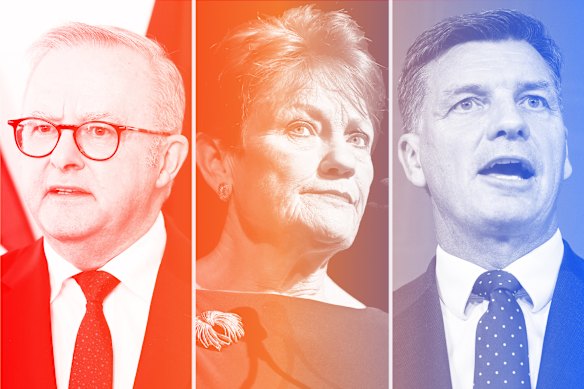

Voter support for One Nation has fallen from its high point in June, with the party’s primary vote down by 2 percentage points in the past month and 4 points since the middle of the year, while leader Pauline Hanson’s likeability and performance ratings have also taken a dive.
But the government is being blamed for the cost-of-living crunch: 46 per cent of people are sheeting home primary responsibility to federal Labor, a rise of 6 percentage points since March.
This is 1.7 times as many voters faulting Labor for economic pain as the 26 per cent who now blame global factors including the wars in Iran and Ukraine. Those blaming global factors rose 9 percentage points since March, while just 4 per cent blamed the Reserve Bank, despite the bank’s decision at the end of September to raise the cash rate for the fourth time this year.
Resolve Political Monitor pollster Jim Reed said that although housing costs were hurting less,“high fuel prices, rate increase and credit card fees are all stoking renewed cost-of-living concerns. Voters appreciate there are global pressures in some of this, but government is seen to be hindering rather than helping”.
Support for the major parties in the latest Resolve poll was relatively steady. Labor’s primary vote edged up 1 point to 29 per cent and support for the Coalition dipped 1 point to 23 per cent – though the Coalition was still trailing One Nation, which was on 25 per cent.
In the first full poll since David Shoebridge became federal leader, the Greens were up 1 percentage point to 12 per cent over the past month, though a majority of the 2250 voters Resolve Political Monitor surveyed from Tuesday to Saturday of last week were not even aware the party had a new leader.
All of these movements were within the poll’s margin of error of plus or minus 2.1 per cent.
Just 36 per cent of Greens voters were aware the party had chosen Shoebridge after former leader Larissa Waters stepped down for health reasons, compared with 42 per cent of Labor voters and 44 per cent of One Nation and Coalition voters. The figure was 40 per cent for all voters.
The poll recorded a significant movement in people’s expectations of who will win the next election. The percentage of voters expecting One Nation to win fell by 8 percentage points to 20 per cent. The number of people expecting Labor to win fell by 1 point to 32 per cent, while 20 per cent said they expected the Coalition to win, up 2 percentage points in a month.
Amid growing concern within Labor that Anthony Albanese has become a drag on the party’s primary vote, the prime minister increased his lead as preferred leader by 3 points to 32 per cent – comfortably ahead of his political opponents. Opposition Leader Angus Taylor edged up 1 point to 22 per cent and Hanson gained 1 point to 26 per cent.
Hanson outscored Albanese and Taylor on the leaders’ performance ratings, with 45 per cent rating her performance as good or very good, down 2 points, while 41 per cent rated her performance as poor or very poor, up 4 percentage points in a month. The net movement of a 6 percentage point drop is statistically significant and outside the margin of error.
Similarly, Hanson’s net likeability rating fell from 7 points to zero, while Taylor’s rating fell 2 points to 8 per cent and Albanese’s improved by 1 point to minus 15 per cent.
Hanson’s slide could be down to a week out of the headlines, Reed suggested, noting that One Nation thrived on controversy and attention “and we simply haven’t seen them as much lately”.
“If we think about the political spectrum in terms of the two centrist parties now being flanked by the Greens and One Nation, it’s remarkable how similar the extremes are. Both grew from wealthy donors, both have evolved from single-issue parties into broader ideological movements, both care about identity.
“The major difference seems to be that One Nation thrives on media attention because people see themselves and like what they see, whereas scrutiny either damages the Greens or only appeals to their base.”
Just over a third of surveyed voters, 36 per cent, rated Albanese’s performance as good or very good, up 1 point on last month, while 54 per cent said the prime minister’s performance was poor or very poor, also a 1 point rise on last month. The proportion of undecided voters was just 9 per cent, suggesting views of the prime minister’s performance are firmly set.
Taylor’s performance rating improved by 2 percentage points to 41 per cent, but the percentage of people who rated his performance as either poor or very poor rose 4 points to 34 per cent, with 25 per cent of people undecided.
Ahead of parliament returning on Monday, both Hanson and Taylor spoke at the Conservative Political Action Conference in Brisbane to set out their competing visions.
Hanson criticised Taylor during a speech on Saturday for being a “smarmy management consultant” but said her party would work with the Coalition to boot Labor from office at the next election. On Sunday, she claimed to News24 (formerly Sky News) that one attendee had told her he was quitting the Liberal Party after Taylor’s speech.
In his speech at CPAC, Taylor acknowledged what he saw as mistakes made under the Morrison government including COVID-era spending, signing up to net zero and “allowing immigration numbers to creep up, especially student and bridging visas”.
The change in Greens leader made no difference to 70 per cent of voters, while 13 per cent said they were more likely to vote for the environmental party and 17 per cent said they were less likely.
Larissa Waters’ net likeability score was plus 5 percentage points, well ahead of Shoebridge on minus 3 points, but Shoebridge was better known than Waters. The new leader was familiar to 55 per cent of voters and unfamiliar to 45 per cent, whereas 50 per cent of people were unfamiliar with Waters even after she had spent nearly 18 months as leader.
Cut through the noise of federal politics with news, views and expert analysis. Subscribers can sign up to our weekly Inside Politics newsletter.
 James Massola is Chief Political Commentator. He has previously been National Affairs
Editor and South-East Asia Correspondent, and has won Quill and Kennedy awards and is the 2026 Press Gallery Journalist of the Year. Connect securely on Signal @jamesmassola.01Connect via X or email.
From our partners
Disclaimer : This story is auto aggregated by a computer programme and has not been created or edited by DOWNTHENEWS. Publisher: www.smh.com.au