
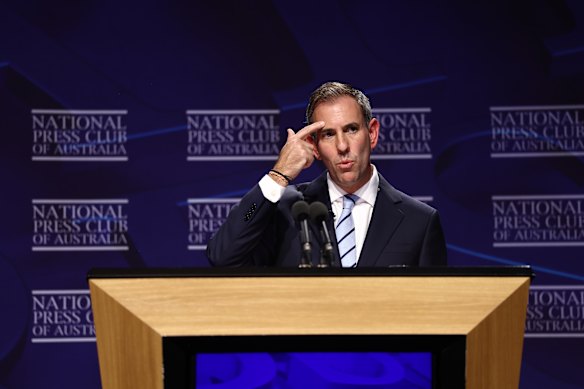

Jim Chalmers’ fifth federal budget handed down last week was the worst-received economic statement since the Resolve Political Monitor began tracking voter perceptions of the budget back in May 2021.
Just 24 per cent of people polled following last Tuesday’s budget agreed with the proposition that the policies announced this year would be “good” or “very good” for them and their household, while 35 per cent of people said it would be “poor” or “very poor”, and 41 per cent of voters said they were unsure or neutral over the document.
That contrasts unfavourably with the five previous budgets tracked by Resolve, with Josh Frydenberg’s March 2022 budget and Chalmers’ May 2024 budget both registering overall ratings of 40 per cent in favour.
About 35 per cent of voters said the May 2021 budget was “good” or “very good” for them and their households, while the budgets of October 2022 and March 2025 both registered scores of 28 per cent.
Labor clearly signalled ahead of the budget that it would take tough decisions and make changes, such as to the tax system, that would stir controversy and leave some people worse off – and that warning was not an exaggeration. However, with 94 seats in the House of Representatives, the prime minister decided it was time to spend some of his political capital and take risks the government had previously been reluctant to touch.
It was a similar story across a swath of other categories, with the 2026 budget registering the lowest overall good score recorded in the last five years of Resolve polls for its impact on the country as a whole (30 per cent), the health of the economy (31 per cent), job creation and wages (31 per cent), women (24 per cent), older Australians (25 per cent) and more.
The Resolve poll conducted for this masthead after the budget, from May 13 to 16, surveyed 1800 voters and has a margin of error of plus or minus 2.3 per cent.
Those major policy changes included paring back capital gains tax breaks and scrapping negative gearing on existing properties, which Labor argues will reduce incentives for property investors and make it easier for first home buyers to get into the market.
Pitched as the budget that would finally tackle intergenerational inequality, it was most popular with people aged 18 to 34 – two out of five voters in this mostly Generation Z age bracket ranked it good overall.
However, only a quarter of voters aged 35 to 54 – a mix of Millennials and Generation X in their peak mortgage-paying and child-raising years – rated the budget as good, while just 11 per cent of those aged over 55 rated the budget as good for them and their households.
Across tax brackets, high-income earners were the most likely to rate the budget as good for them and their households, with 31 per cent giving the budget a tick, but just 22 per cent of middle-income earners and 18 per cent of low-income earners rated the budget as good.
More than two-thirds of voters said they would like the federal government extend the 50 per cent cut to the fuel excise, which was put in place after fuel prices surged because of war in the Middle East, and which is due to expire on June 30.
Similarly, there was strong support for individual budget measures, including 58 per cent support for $2 billion more being spent on infrastructure for new housing, 60 per cent of people backing the $1000 standard tax deduction, and 58 per cent of people backing the $10 billion package designed to boost Australia’s fuel surpluses.
The Resolve poll also found the federal government’s primary vote had slumped 3 percentage points to just 29 per cent, with the Coalition on 23 per cent and One Nation on 24 per cent.
Opposition Leader Angus Taylor, who ramped up claims on Monday that the budget introduced a death tax by stealth, moved ahead of Prime Minister Anthony Albanese as preferred prime minister and leads 33-30, with 37 per cent of people undecided.
Albanese played down the hit he and Labor had taken in the polls after the budget, arguing that “what we’re doing here is getting it right [the tax system] for 75,000 young people to get in their own home”.
Cut through the noise of federal politics with news, views and expert analysis. Subscribers can sign up to our weekly Inside Politics newsletter.
 James Massola is chief political commentator. He was previously national affairs editor and South-East Asia correspondent. He has won Quill and Kennedy awards and been a Walkley finalist. Connect securely on Signal @jamesmassola.01Connect via X or email.
From our partners
Disclaimer : This story is auto aggregated by a computer programme and has not been created or edited by DOWNTHENEWS. Publisher: www.smh.com.au


