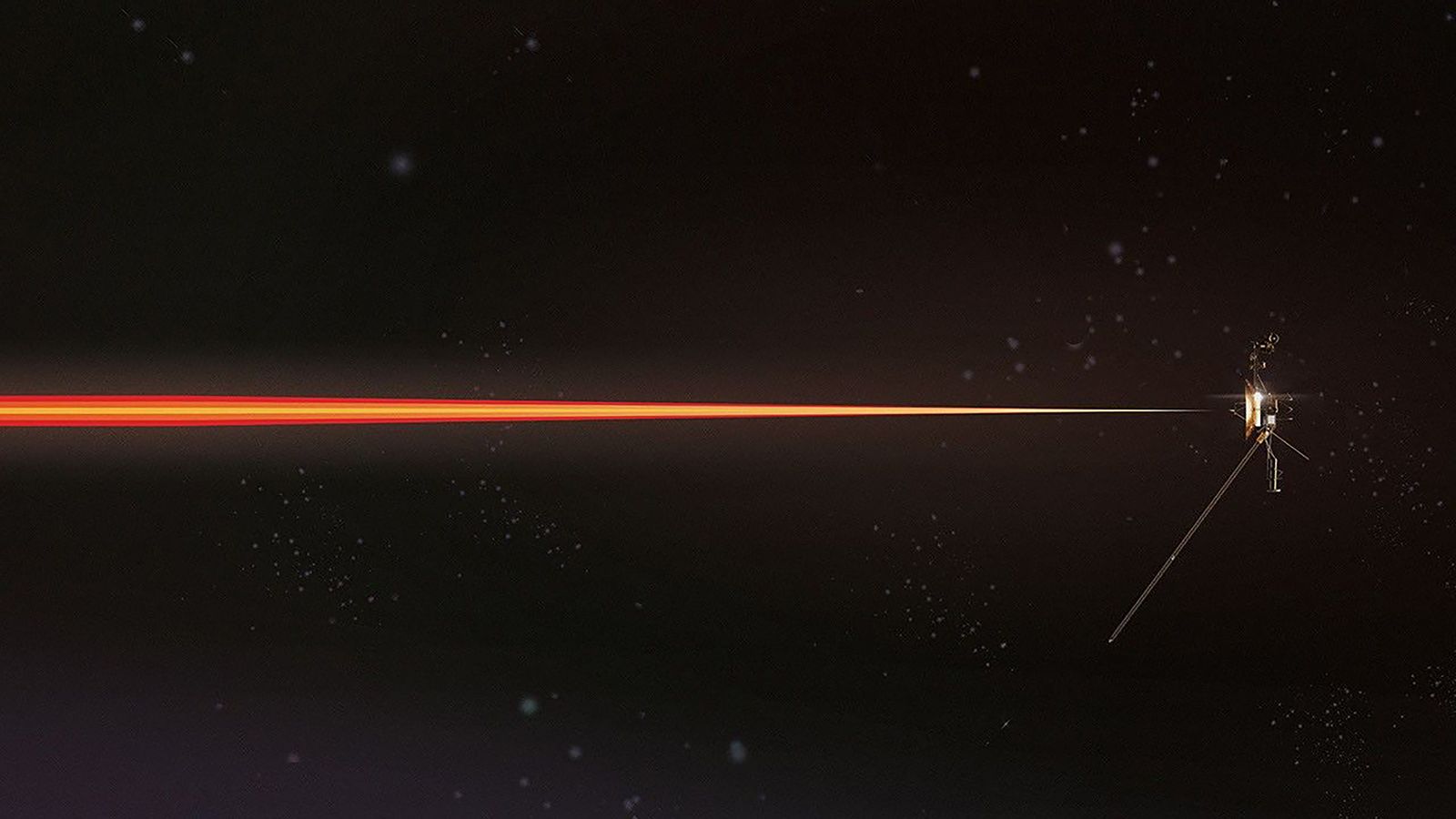
The Voyager 1 spacecraft launched from Earth in September 1977.
It’s not just old; it’s also really far away. In fact, it’s so far that it takes light one whole day to travel from the spacecraft to Earth and vice versa. That puts its distance at one light-day.
The expanse separating it from Earth raises so many interesting physics questions about Voyager 1’s epic, well, voyage. Let’s get to the questions—and the answers.
How Do We Measure Distance in Space?
In science, we like to measure things, including distance. Surely, you’re familiar with meters. If you put a mass on a string and let it swing back and forth (like the pendulum of a clock), it will take about 1 second to go from side to side if the string is 1 meter long.
But if you want to measure larger distances like the proximity of stuff in space, this unit quickly becomes silly because objects are so far apart. While kilometers can be helpful for measuring the distance between things like Earth and the International Space Station or the moon, even they become hard to comprehend at larger scales.
Enter the Astronomical Unit, or AU, which is the average distance from the sun to the Earth, or about 1.5 x 10¹¹ meters. Humans found this distance by observing the transit of Venus. This transit is like a solar eclipse, except instead of the moon passing in front of the sun, it’s the planet Venus. Looking at Venus’ movement from different locations on Earth, the planet creates a shadow at different times. If you know the radius of the Earth, you can find this distance from the Earth to sun.
But what if you want to measure the distance to a star outside the solar system? AUs start to become a little unwieldy. Enter the parsec. No matter what Han Solo says in Star Wars, the parsec is a unit of distance and not the best time for the Kessel Run.
And it’s a long distance: for comparison, 1 parsec is about 200,000 AUs. The parsec is a way to measure distance using parallax. You can get the mechanics of parallax by holding your thumb out with an extended arm in front of your face. Close one eye and line up your thumb with an object across the room. Now close that eye and open your other eye. You will notice that the thumb seems to shift its position. The size of the angular shift depends on both the distance between observation locations—the distance between your eyes—and the distance to the object. The farther the object, the less parallax shift you will observe.
OK, So What’s a Light-Day?
As Earth orbits the sun, we have different observation locations while looking at stars. Imagine an observation shift of 1 AU (you would get a 2 AU shift going from December to June). If a star has a parallax shift of 1 arc-second, we say it has a distance of 1 parsec.
At one point, astronomer Friedrich Bessel was using parallax to measure the distance to a star. He said that it was so far away that it would take light 10.3 years to reach the Earth. Boom, there’s your unit of distance, the light-year. It’s the distance light travels in one year, or 9.9 x 10¹⁵ meters, or over 6 million AU. But we can use any unit of time to measure distance with light. One light-day is the distance that light travels in 24 hours, or 2.6 x 10¹³ meters. That’s really far. In fact, no human-made object has gone farther. Let’s say that Voyager traveled at a constant speed and in a straight line (it didn’t). That would give it an average speed of 164 kilometers per second or about 36,000 mph.
What Forces Affect Voyager 1?
Voyager has felt a lot of different forces out in space. The first is the rockets that got it there. But let’s talk about the other ones it has encountered.
First, there’s gravitational force. There is an attractive gravitational force between any two objects with mass. The force depends on the masses of the two objects and the distance between them. The force is there on any number of scales: Since your body has a mass (maybe around 70 kilograms) and your phone has a mass (about 200 grams), there is an attractive force. If the phone is about 50 centimeters from your body, the gravitational force the phone exerts on you is about 4 x 10⁻⁹ newtons. In other words, it’s exceedingly tiny. (Depending on how much you love your phone, though, the attraction may feel stronger.)
For Voyager, there’s also a gravitational interaction with masses—like the outer planets it was originally launched to observe, as well as Earth. However, the really big gravitational influence is from the sun, since it has such a large mass (2 x 1030 kilograms). Using the mass of Voyager 1 at 722 kilograms, there is an attractive force of 1.4 x 10⁻⁴ newtons. That’s equivalent to the weight of 78 grains of salt on the surface of the Earth.
The only other object that would have a substantial relationship to Voyager 1 is the planet Jupiter, with a mass of 1.9 x 1027 kilograms. But it’s only when Voyager was fairly close to the planet way back in 1979 that this gravitational force would even partially compare to the interaction with the sun.
There are other, more exotic interactions with the spacecraft, but these forces are also tiny. Solar winds—charged particles emitted from the surface of the sun—have blown past Voyager. Although they travel very fast, the mass of these particles is extremely small. The further you get from the sun, the more their intensity decreases as well.
The venerable craft is also likely to feel the impacts of magnetic fields and other weird things as it moves from a region where the primary interactions are with the sun—the heliosphere—to interactions with other stars and stuff—the interstellar medium.
Will Voyager Go On Forever?
Newton’s second law of motion says that forces on an object change its motion. As an equation, we can write this as net force = mass times acceleration. The acceleration is defined as the time rate of change of the velocity.
Let’s take the average speed we calculated above of 164 kilometers per second for simplicity’s sake. Does this velocity change? Yes. Remember, we calculated the gravitational force from the sun with a value of 1.4 x 10⁻⁴ newtons. To further simplify things, let’s assume that’s the only force acting on Voyager. Using that and the mass of the spacecraft, we get an acceleration of around 2 x 10⁻⁷ newtons. Since the gravitational force is mostly in the opposite direction as the motion of the spacecraft, though, this translates to a very slight deceleration. In one day of travel, Voyager 1 will only slow down by 0.012 meters per second.
Not much on a daily basis, but the craft does indeed slow down. Will this eventually make it stop? Actually, no. Remember, Voyager is moving away from the sun. That means that while it slows down a bit every day, it’s also getting farther from the sun and its gravitational force—the very thing slowing it down in the first place.
It’s possible for an object to always slow down but never stop, and it will “escape” from the sun. Perhaps it’s not surprising that we call this the escape velocity. For the location of the Voyager, it needs to have a speed of at least 3.2 kilometers per second. If Voyager were slower, it would essentially “fall” back to the sun, just like an apple tossed in the air falls back to the Earth.
Of course, there are always things out there that could unexpectedly impact Voyager 1. Even a very tiny amount of interstellar dust will eventually slow it down further and perhaps even stop it. Or who knows, maybe it will become self-aware and turn into the V’Ger from Star Trek: The Motion Picture. Only time will tell.
Disclaimer : This story is auto aggregated by a computer programme and has not been created or edited by DOWNTHENEWS. Publisher: wired.com