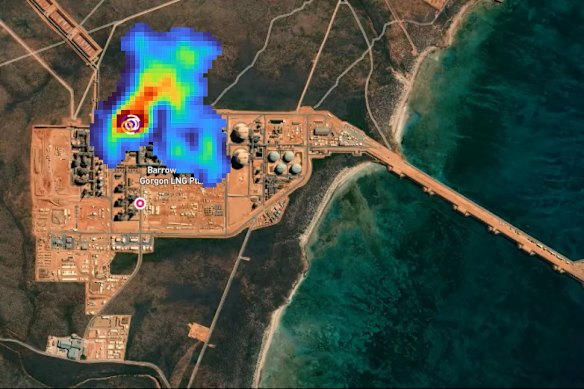
The massive plumes of methane emitted from Chevron’s Gorgon LNG facility on Barrow Island was not a leak and instead were vented deliberately, the environmental regulator has confirmed.
Non-profit Carbon Mapper’s Tanager-1 satellite captured methane plumes from the facility in five consecutive passes of Barrow Island from November 2025.
The largest release included a massive 7.8 tonne-per-hour plume in August which prompted the United Nations Environmental Programme to report it to the Department of Water and Environmental Protection.
A leak that size is deemed a “super emitter” event under the US Environmental Protection Agency definition where the threshold is 100 kilograms-per-hour of methane.
The massive plumes were initially characterised as a leak, but during an upper house committee meeting on Wednesday, Environment Minister Matthew Swinbourne said it was a purposeful vent.
He said a department investigation launched after the August plumes and finalised last week concluded Chevron was deliberately venting the gas because of its struggling carbon capture and storage system.
“The department’s assessment is that the methane detected was associated with the venting of reservoir carbon dioxide from the facility’s acid gas removal units, resulting from operational constraints affecting the facility’s carbon capture and storage system,” Swinbourne told the committee.
The revelation confirmed whistleblower claims tabled in the upper house on Tuesday night by Greens fossil fuels spokeswoman Sophie McNeill that Chevron had been deliberately releasing methane into the atmosphere because of problems with the carbon capture and storage facility.
McNeill accused the state government of “covering up” the methane “leak”, which was flatly rejected by Swinbourne in a heated exchange during the committee hearing.
Swinbourne said both he and the department were waiting for the investigation to conclude before coming to any conclusions.
“We never drew a conclusion that it was a leak. There was an investigation process that was underway to determine the source of that methane,” he said.
In response, McNeill claimed investigators were told by Chevron during a visit on November 5 and 6 that it was deliberate venting, which she said amounted to a cover-up.
“How is this not a cover-up when the department has known since the fifth and sixth of November they were told by everyone when they went to Gorgon that this is deliberate venting?” she said.
“We don’t have the luxury that you have of jumping to conclusions,” Swinbourne said in response.
“We can’t just get into the chamber at the end of the night and make all these accusations and draw all these conclusions.
“There is no cover-up, member. That is your framing of this because it suits your narrative.”
McNeill said the fact it was a commercial decision was horrifying.
“It’s horrifying. It’s worse that it’s not a leak. I wish it was a leak, Minister. This is horrifying. They are deliberately choosing to do this. This is a production decision. It is absolutely gut-wrenching,” she said.
A department bureaucrat revealed during the hearing that despite having the technology to monitor methane emissions, that was not deployed during the investigation.
Swinbourne also revealed he had written to the Environmental Protection Authority to consider whether additional conditions including greater monitoring and reporting requirements on Chevron.
Chevron’s carbon capture and storage system was the largest of its kind when it was first built.
The oil and gas sector held hopes it would greatly reduce carbon emissions for the industry.
The system separates carbon dioxide contained in natural gas reservoirs and pumping it back into the ground.
As part of its approval to operate Gorgon, Chevron is required to inject at least 80 per cent of reservoir carbon dioxide back into the ground.
However, the technology has been beset with issues since operations began in 2016.
It has come nowhere near meeting its 80 per cent condition, which has forced Chevron to find carbon offsets elsewhere.
Chevron’s carbon capture system also prompted a testy exchange between McNeill and Swinbourne.
McNeill said the system didn’t work to which Swinbourne replied: “What I will say is it does work. It is capturing significant amount of carbon. It is not, however, meeting what the ambition was when the ministerial conditions were settled originally,” he said.
“They must still offset those emissions.”
McNeill responded: “I don’t believe in offsets.”
Swinbourne then said: “Well, then that’s a problem for you.”
To which McNeill responded: “No, it’s not. It’s actually a problem for the climate, minister.”
Chevron was approached for comment.
 Hamish Hastie is WAtoday’s state political reporter and the winner of five WA Media Awards, including the 2023 Beck Prize for best political journalism.Connect via X or email.
 Holly Thompson is a journalist with WAtoday, specialising in education and the environment.Connect via X or email.
From our partners
Disclaimer : This story is auto aggregated by a computer programme and has not been created or edited by DOWNTHENEWS. Publisher: www.smh.com.au