In the last 24 hours, President Trump twice threatened to restart the war against Iran and yet the price of Brent crude ticked lower to $79 per barrel from $81. Investors appear to be paying more attention to what mediators in Switzerland are saying about the ongoing peace talks between the two sides: “Encouraging progress” according to the BBC; “major progress” per Bloomberg.
A review of this morning’s notes from Wall Street analysts shows they are focused more on what Iranian sources are saying about the negotiations than Trump’s tweets.
The diplomatic progress includes:
BREAKING …
U.K. Prime Minister Keir Starmer resigns
- Live coverage from the BBC here.
- The move paves the way for former Manchester mayor Andy Burnham to replace him.
- Burnham, like Starmer, hails from the Labour party’s soft left.
- Open question: It is not yet known whether Starmer and Burnham can figure out a way to transition the leadership without going through a formal contest that may open the door to other challengers, such as former health secretary Wes Streeting.
THE MARKETS
Traders take a break to digest recent gains
- S&P 500 futures were down 0.2% this morning. The index closed up 1.08% in its last session.
- In Europe, the Stoxx 600 was down 0.14% in early trading and the U.K.’s FTSE 100 was flat before lunch.
- Asia: South Korea’s KOSPI was up 0.69%. Japan’s Nikkei 225 was up 1.55%. India’s Nifty 50 was up 0.48%. China’s CSI 300 was up 2.39%.
- Brent crude was down to $79 per barrel this morning.
- Bitcoin was $64.1K.
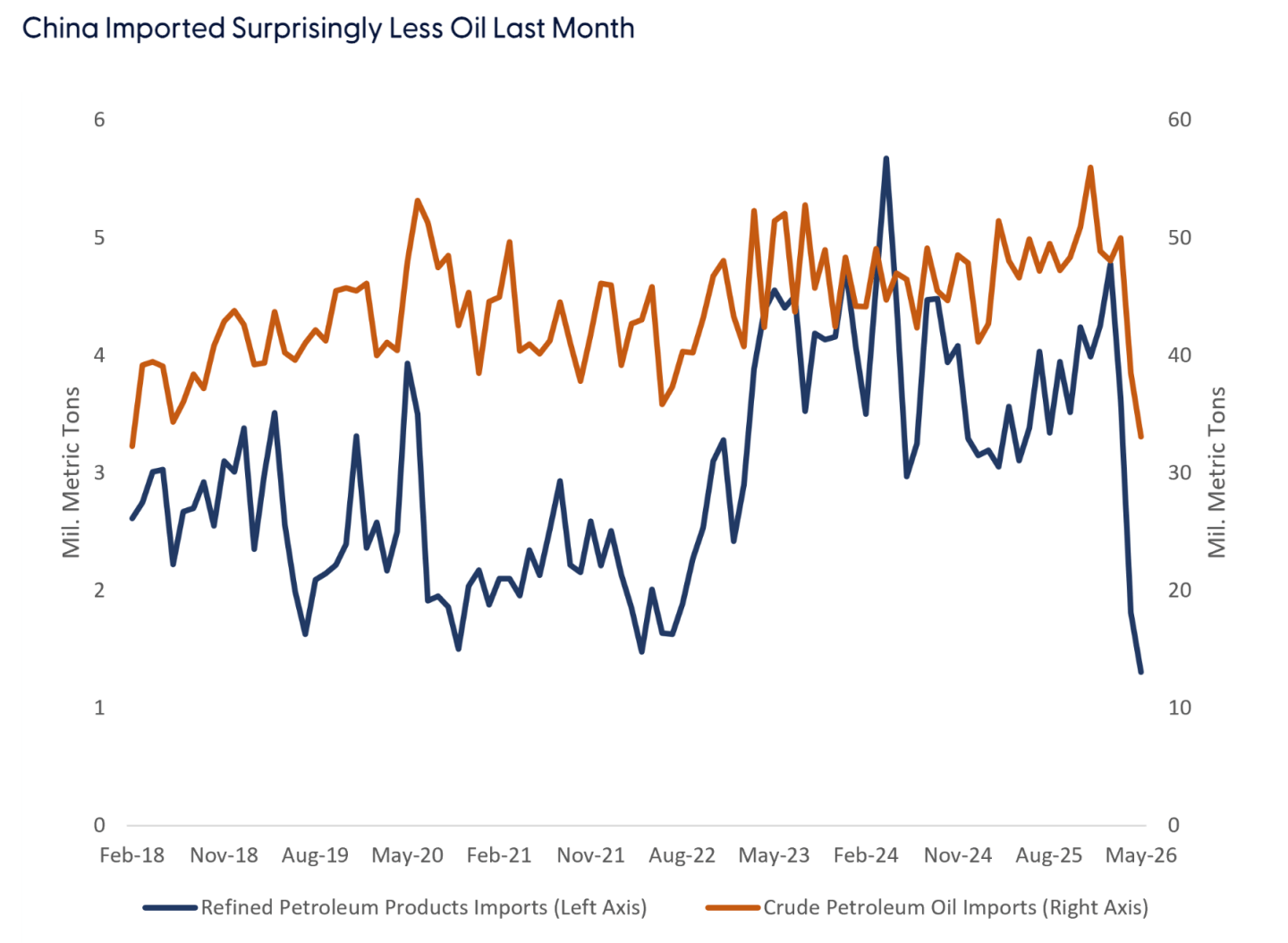
Thanks, China! Beijing simply stopped buying oil during the war
Why did the price of oil stay below $100 for much of the Iran war even though the Strait of Hormuz—which normally carries 20% of the world’s oil—was closed? Because China stopped buying oil, according to this chart (below) from Jeffrey Roach of LPL Financial. “Chinese crude imports by tanker fell to 6.7 million barrels a day last month, nearly 40% below the 2025 average. That reduction—roughly 4 million barrels a day—is enormous, equal to the combined oil consumption of Germany and France,” he said in an email to Fortune. “Beijing has somehow slashed imports without obvious economic damage.”
Chipmaker IPO looms: “SK Hynix is now South Korea’s most valuable company, with a market cap of 2,000 trillion Korean won ($1.35 trillion),” Fortune’s Nicholas Gordon tells me. “Shares in SK Hynix, which makes memory chips for firms like Nvidia, are up 330% for the year thus far. SK Hynix is planning a U.S. listing later this year.”
POLITICS
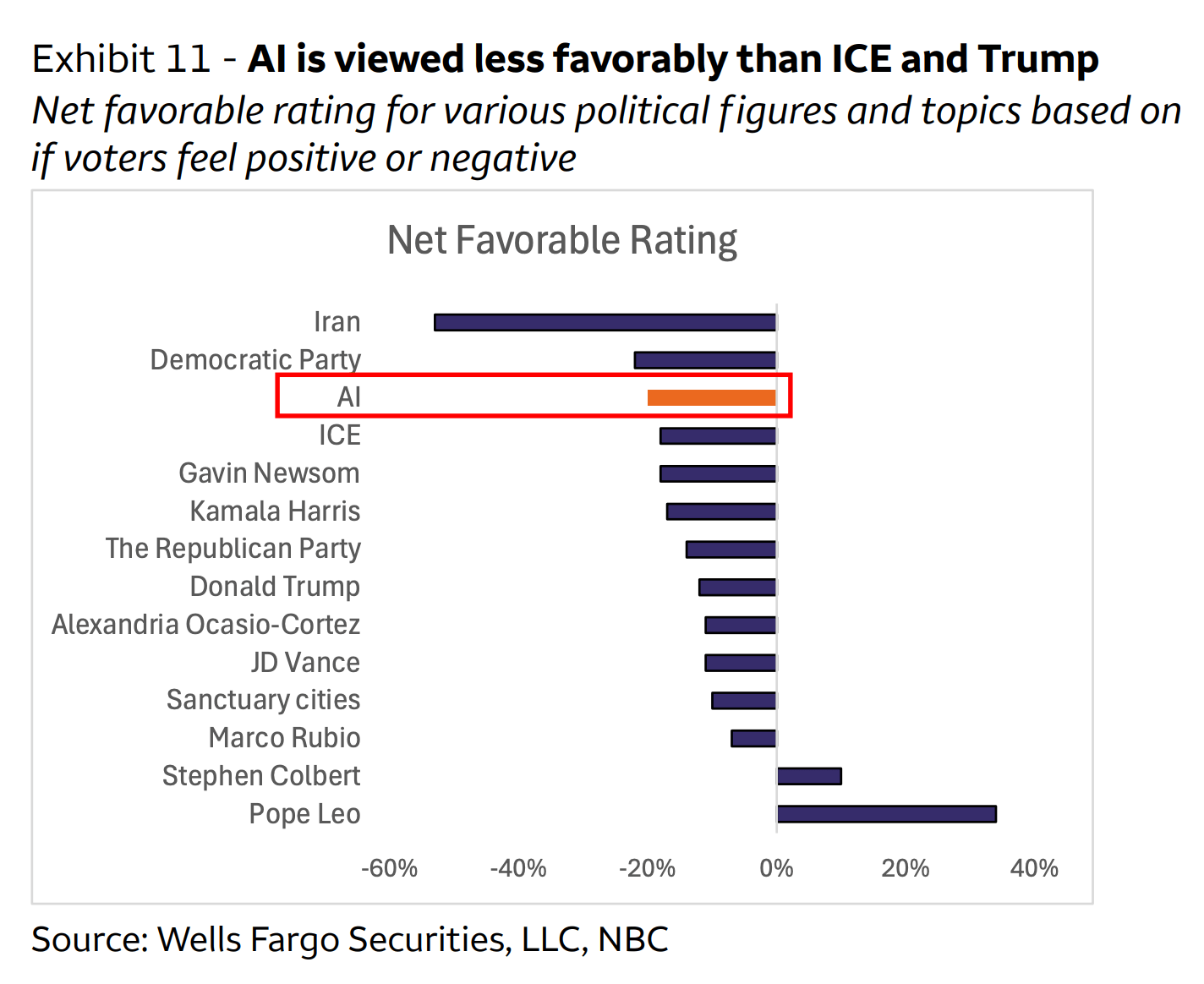
Who we hate right now, ranked
Here’s one explanation for why so many tech executives making university graduation speeches have seen student walkouts: People really hate AI. There are only two things they hate more than AI, according to this chart from Wells Fargo and NBC—the Democrats and Iran. Conversely, if Pope Leo and Stephen Colbert ran for the White House on a joint ticket, they might just win.
MORE FROM FORTUNE
If you’re surprised by how well the stock market is doing, so is Jamie Dimon—he says there’s a ‘little tsunami’ heading for the economy – Eleanor Pringle
The U.K. just banned social media for kids under 16. The founder of ‘safe TikTok’ says the U.S. is next – Nick Lichtenberg
QUOTE OF THE DAY
On the “memorandum of understanding” between Iran and the U.S.: “If the MoU really is the start of successful negotiations, we could eventually return to a macro world that we had actually expected at the start of this year: a gradually recovering global economy with risks of inflation undershooting and central bank rate cuts. An almost beautifully boring economic outlook, or is that wishful thinking?”—ING’s Carsten Brzeski.
CHART OF THE DAY
In oil economies, sovereign wealth funds are often bigger than their central banks
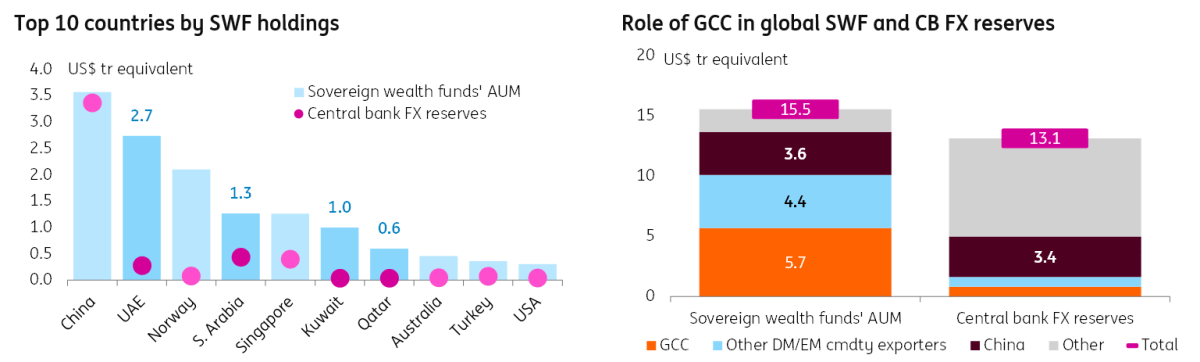
This chart from ING shows that of $15.5 trillion in assets held by the world’s sovereign wealth funds, $6.2 trillion are held by oil-producing Gulf states. Their government-driven investment funds are often bigger than their central banks.
NUMBER OF THE DAY
132
The number of words in new Fed chairman Kevin Warsh’s first rate-setting statement, which was much shorter than Jerome Powell’s last statement, at 341 words. It was the shortest Fed statement in about 20 years, according to BMO.
UBS’s Paul Donovan is unimpressed: “The Fed’s statement was somewhat troubling. Warsh seemingly believes that roughly 130 words can summarize an increasingly complex economic outlook in a global economy experiencing the most dramatic change in 250 years. The statement was 62% the length of [Donovan’s daily notes], which struggle to summarize a single day’s outlook,” he wrote in an email.
THE FRONT PAGES TODAY
Reflecting Pool repairs become personal for Trump – Axios
Welcome to America, World Cup visitors. Don’t forget to tip. – Axios
EasyJet rejects £4.7bn takeover bid from Castlelake – FT
What The Obsession With Belle Burden’s ‘Strangers’ Says About America – WSJ
Tide Already Dominates Detergent. Why Is P&G Pushing a New Version? – WSJ
Final design for NYC Penn Station’s redevelopment one step closer — including how much it could cost – NY Post
ONE MORE THING
‘Proteinmaxxing’ is ratcheting up prices and tempting snack companies to make recipes worse
When David Protein began selling its bars in late 2024, the whey protein used in the products cost $7 per pound. Today, it’s $12 per pound. Peter Rahal, David’s founder and CEO, said a wave of demand for high protein foods—dubbed “proteinmaxxing”—is behind the skyrocketing prices, according to Fortune’s Sasha Rogelberg. “People are trying to get more protein to look better,” Rahal told Fortune. “You’re seeing protein capitalism at play.”
The recent obsession with protein isn’t fueled by bodybuilding or diet fads, but rather by the increasing use of GLP-1 weight loss drugs, which can suppress appetite and require users to pivot to nutrient-dense foods, such as those high in protein, to avoid muscle loss.
Disclaimer : This story is auto aggregated by a computer programme and has not been created or edited by DOWNTHENEWS. Publisher: fortune.com