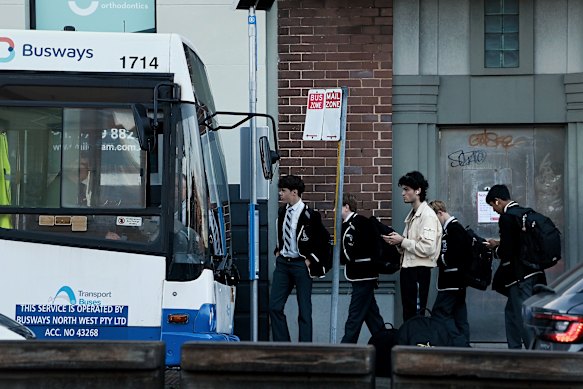

The NSW government has unveiled an extra 3000 weekly bus services just as drivers who work across a swath of Sydney routes including on the northern beaches and eastern suburbs escalate industrial action which authorities have warned could cause delays and cancellations.
The first indefinite work bans by about 2000 drivers represented by the Rail Tram and Bus Union started early on Wednesday, which involved them refusing to drive buses showing warning lights on dashboards.
From Thursday, they will expand the action to refusing to drive from depots any bus that does not have full fuel tanks or fully charged batteries.
The dispute over a new pay deal involves drivers who operate routes in Sydney’s eastern suburbs, northern beaches, lower north shore and inner north-west.
The escalation comes as the government announced an extra 3000 weekly bus services – including new 24-hour operations – which represents a 1 per cent increase in total services. It takes the total number of new services to 9000, or a 3 per cent rise, since Labor won the 2023 state election.
Two of Sydney’s busiest bus routes – the 343 between Kingsford and Circular Quay and the 370 between Coogee and Glebe Point – will operate 24 hours a day throughout the week. The 418 route between Sydenham and Burwood will also run around the clock on Friday and Saturday nights.
Days after the M1 metro rail line between Sydenham and Bankstown opened, inner west bus routes are being altered to improve connections to train stations along the southwest corridor.
In the eastern suburbs, a direct link between Bronte and the CBD through route 378 will be restored, combining route 389 with the Bronte leg of route 379. The 339X Clovelly to City Museum express service will have an extra 54 weekly services, while the 373 route from Coogee will be extended to Circular Quay.
As part of a boost to services in western Sydney, a new 848X route between Campbelltown and the fast-growing township of Wilton in the outer south-west will operate during weekday peak periods. A new 847 route between Wollongong and Picton via Wilton will also be introduced.
The extra services will be progressively rolled out between November 15 and 22.
Transport Minister John Graham said the changes would deliver more frequent buses in growing areas, better connections to other public transport and more services running through the night.
“We couldn’t afford to simply invest in the metro network, as good as that is. We do need to add to the bus network in order to cope with a growing city,” he said.
While buses operated by drivers involved in the latest industrial action will continue operating, Transport for NSW has warned that the indefinite actions could result in the delay or cancellation of some services where buses were unable to meet the requirements of the notified work bans.
“With the potential for longer wait times, passengers, including students sitting HSC exams this week, are encouraged to allow extra travel time, and consider travelling outside peak periods where possible,” the agency said.
Unions have been locked in a long-running dispute with private bus operators Keolis, Transdev John Holland and Busways over a new pay deal.
Drivers are seeking a pay rise of about 22 per cent over three years without changes to conditions. Unions said the base wage for a driver in Sydney was about $67,000 a year.
Rail Tram and Bus Union divisional president Peter Grech said the industrial action was aimed at putting pressure on the bus companies, and not inconveniencing passengers. “We have been negotiating for nine months, and we haven’t got an outcome,” he said, adding that actions will escalate unless a deal can be reached.
Grech said both sides were close to agreement on the pay rise but at odds over what he described as an attempted casualisation of the workforce by operators.
In a bid to reduce a workforce shortage, the government committed $200 million in July to support higher wages for more than 8000 bus drivers who are paid an average $33 an hour.
Graham said the government had put the $200 million on the table to assist negotiations between the union and operators in increasing driver wages.
“We wouldn’t have got to this point [of announcing extra services] without being confident that we can have the drivers to drive these buses,” he added.
Bus driver vacancies have fallen to 213 in September, from 372 in the same month in 2023, according to government figures.
Start the day with a summary of the day’s most important and interesting stories, analysis and insights. Sign up for our Morning Edition newsletter.
 Matt O’Sullivan is transport and infrastructure editor at The Sydney Morning Herald.Connect via X or email.
From our partners
Disclaimer : This story is auto aggregated by a computer programme and has not been created or edited by DOWNTHENEWS. Publisher: www.smh.com.au