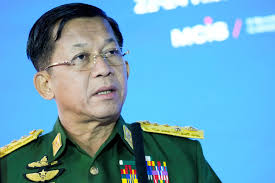
The elevation of Senior General Min Aung Hlaing to Myanmar’s presidency on April 10 is less a political transition than formalisation of a reality since the 2021 coup, with the military’s complete domination of the State. What has changed is not power, but its packaging. By shedding his uniform and assuming the civilian office of President, Hlaing has tried to put a veneer of constitutional legitimacy on what is, in essence, a junta-controlled administration.
The new government of the pro-military Union Solidarity and Development Party, dominated by former generals and military loyalists, signals continuity, not reform. All key ministries are in military hands, indicating military men are governing in civilian clothes while retaining their iron grip over the nation of 55 million people.
The election that brought him to office was widely criticised as exclusionary and engineered, with Opposition forces, like the party of Aung San Suu Kyi, either banned or absent. Hlaing’s presidency thus represents a strategic recalibration — from overt military rule to a quasi-civilian façade designed to ease diplomatic isolation, particularly within Asean. The isolation, of course, is because the 2021 coup took place under Hliang’s leadership and led to a staggering human cost. International monitors estimated that over 96,000 people were killed, while the UN says at least 3.6 million were displaced since the coup in 2021. Not to speak of the thousands of Rohingya Muslims who had to flee Myanmar since 2017.
For India, Myanmar remains a geopolitical hinge — linking South Asia to Southeast Asia and forming the land bridge for its “Act East” policy. New Delhi responded pragmatically, seeking to “step up engagement” with the new regime despite its lack of legitimacy. New Delhi’s approach is driven by three factors: Connectivity and economic integration because projects like the India-Myanmar-Thailand trilateral highway and Kaladan multimodal corridor depend on a functioning government in Naypyidaw; Security along the Northeast border as stability in Myanmar directly affects insurgency dynamics in states like Manipur, Nagaland and Arunachal Pradesh; and balancing China because Myanmar is a critical arena in the broader India-China strategic competition.
Some feel Hlaing may be “closer to New Delhi than Beijing”, compared to other factions, offering India a narrow window of opportunity. But China retains structural advantages: Beijing was among the first to recognise and congratulate Hlaing’s presidency. China has deep investments in infrastructure, including pipelines, ports, and economic corridors under the Belt and Road Initiative.
China’s strategy is not ideological but transactional: stability sufficient to protect its investments.
Hlaing’s presidency suits Beijing as it centralises authority and reduces unpredictability. The result is not a binary tilt towards either India or China, but a multi-vector balancing strategy by Naypyidaw. Hlaing may engage India for legitimacy, connectivity and diversification while leaning on China for economic lifelines and diplomatic cover.
For India, this means continued engagement without illusions: working with the regime while hedging against deeper Chinese penetration. Perhaps the most immediate and sensitive impact of Hlaing’s presidency will be felt in India’s Northeast. Historically, Myanmar’s military (Tatmadaw) has cooperated with India against insurgent groups like Ulfa, NSCN factions, and the People’s Liberation Army in Manipur and other outfits. This cooperation may continue under Hlaing, as it aligns with his interest in asserting territorial control and gaining favour with India.
There are, however, some constraints because Myanmar is in a prolonged civil war, with large swathes of territory controlled by ethnic armed outfits and resistance forces. The central government’s writ does not extend fully to border regions, where Indian insurgent groups often find sanctuary.
This fragmentation of authority creates a paradox: at the central level, India-Myanmar military cooperation may deepen, but on the ground, the control is weaker, potentially allowing insurgent safe havens to expand. The weakening of central authority in peripheral regions could complicate India’s counter-insurgency efforts, even if Naypyidaw is politically aligned with New Delhi.
India will need to move beyond state-to-state engagement and develop localised border management strategies, intelligence cooperation with multiple actors and build infrastructure and surveillance along the India-Myanmar border. In the ultimate analysis, Hlaing’s presidency offers continuity at the top but uncertainty at the edges; and it is the edges that matter most for Northeast security.
How will the big powers, the United States and Russia, look at Myanmar now? For the US, Hlaing’s presidency changes little. Washington has consistently viewed the Myanmar military as illegitimate since the coup and is likely to maintain or expand sanctions, support pro-democracy forces diplomatically and avoid direct engagement with the regime.
By contrast, Russia has emerged as one of Myanmar’s closest partners. Military cooperation agreements, arms supplies, and even nuclear collaboration underline a deepening relationship. Russia’s motivations are clear: expanding its footprint in Southeast Asia, securing defence markets amid Western sanctions and building alliances with regimes isolated by the West. For Hlaing, Russia offers strategic depth and diplomatic backing, especially at forums like the UN.
The broader picture suggests a Cold War-style alignment: US and allies: normative pressure, sanctions, limited leverage, and Russia (and to an extent China): pragmatic engagement, regime support. On the whole, Myanmar under Hlaing is firmly in the latter camp, even as it seeks selective engagement with others.
For Bangladesh, the regime in Myanmar brings Dhaka little hope. Because, for Dhaka, Myanmar’s political trajectory is inseparable from the Rohingya crisis. Over 700,000 Rohingya refugees remain in Bangladesh following the 2017 military crackdown led by Hlaing. His elevation to the presidency is unlikely to inspire confidence in Bangladesh for several reasons, the first being the lack of accountability as the same leadership accused of atrocities is now formally entrenched. The second, of course, is the low prospects of repatriation of the Rohingyas.
Even if Bangladesh’s “new government” adopts a pragmatic tone, its policy will likely combine diplomatic pressure for repatriation, engagement through Asean and China and continued hosting of refugees with international support. In essence, Dhaka will see Hlaing not as a partner for resolution, but as part of the problem.
Min Aung Hlaing’s presidency marks the consolidation of a military state under civilian guise. It may bring a degree of administrative stability, but not political legitimacy. For India, this creates both opportunity and risk: a partner for engagement, but one presiding over a fractured and volatile neighbour. China will remain the dominant external player, though India has space to compete. The most consequential impact, however, will not be in capitals but along borders — particularly in India’s Northeast — where the gap between central authority and ground reality in Myanmar could define the next phase of regional security.
Wasbir Hussain, author and political commentator, is editor-in-chief of Northeast Live, Northeast India’s only satellite English and Hindi news channel. The views expressed here are personal.
Disclaimer : This story is auto aggregated by a computer programme and has not been created or edited by DOWNTHENEWS. Publisher: deccanchronicle.com