Washington’s trade restrictions could leave the U.S.’s humanoid robotics market nearly 60% smaller than it would otherwise be by 2030, according to market research firm International Data Corporation (IDC).
The projection points to a widening split in the global robotics industry: Chinese vendors now ship almost all of the world’s humanoid robots, while U.S. rules curb the American market from much of that supply.
On July 28, the Federal Communications Commission (FCC) added “foreign-produced advanced robotic devices” to its Covered List, blocking new models from obtaining the authorization needed for U.S. imports and sales.
Previously authorized models can still be imported and sold, while some software and firmware updates are permitted through at least Jan. 1, 2029. Vendors can also seek conditional approval for new models, subject to a national-security review and commitments to shift production to the U.S.
U.S.-based robotics companies rely on China and other non-U.S. manufacturers for parts, including motors and batteries. Restrictions on those supply chains could raise costs and make it harder for American companies to scale production. U.S. startups have even resorted to smuggling robot parts in their luggage, The Information reported in early August.
“IDC’s trade policy model puts U.S. humanoid robot revenue 58% below the pre-restriction baseline by 2030,” IDC analysts wrote. The IDC’s model projects over $6 billion in lost revenue by the end of the decade, which in turn lowers the sector’s annual growth rate to about 9%, down from 13%.
Household cleaning robots, on the other hand, only shrinks by 18% by 2030, according to IDC.
IDC analysts argue that humanoid robots have shorter product life cycles than other types of robots, including household cleaning robots that have a deep-bench of already-certified models. In the case of humanoid robots, manufacturers are forced to update or replace these models more frequently.
Some companies are already getting a reprieve. On Oct. 23, the FCC granted a one-year waiver to Intel Corporation to keep updating and maintaining some of its robots. Intel had claimed that its automated guided vehicles were essential to domestic semiconductor manufacturing, and that no domestic alternative existed.
The world buys what China builds
IDC projects that the global market for humanoid robots will keep growing. Vendors shipped an estimated 25,000 humanoid robots during the first six months of 2026, 26% more than the 18,500 shipped in all of 2025. IDC projects that more than 750,000 humanoid robots will be shipped by 2030.
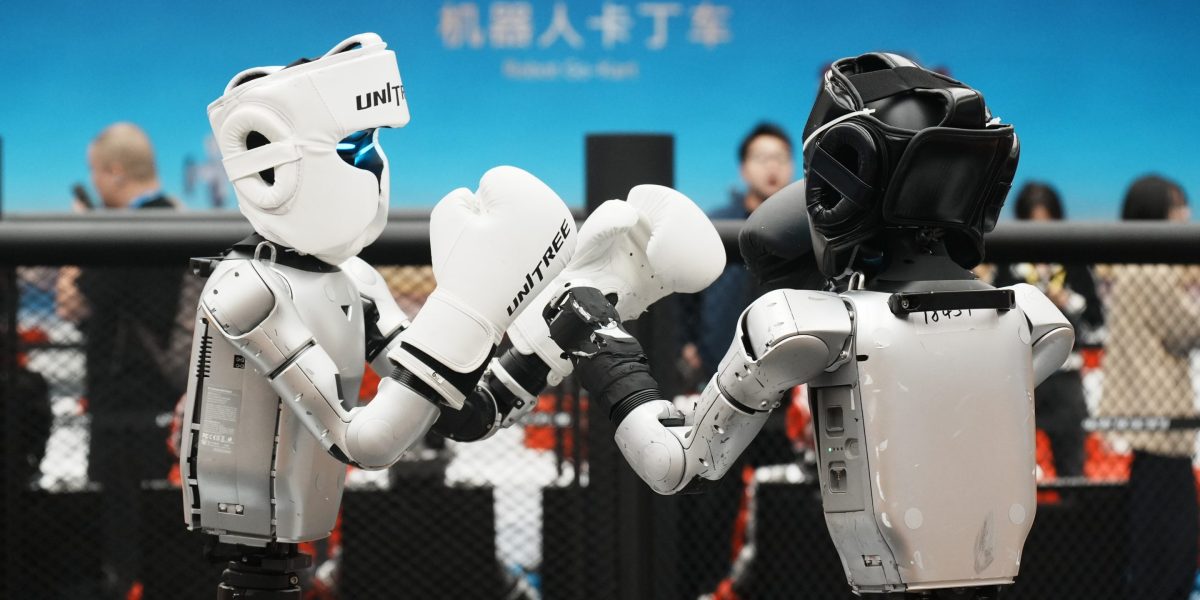
Chinese vendors, such as Unitree and AGIBOT, account for roughly 95% of global humanoid shipments, according to IDC. Chinese companies like Roborock and Dreame Technology also lead the global market for household cleaning robots. Competition from China helped send iRobot, the maker of the Roomba, into bankruptcy; the company was snapped up by its China-based supplier, Shenzhen Picea Robotics.
China and the U.S. made up 21% and 18% of global consumption respectively. Europe, meanwhile, buys more than double the U.S. share.
Disclaimer : This story is auto aggregated by a computer programme and has not been created or edited by DOWNTHENEWS. Publisher: fortune.com