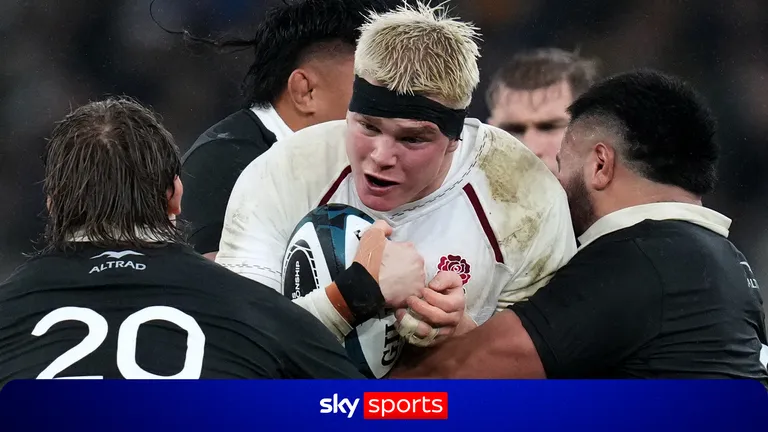
A week ago, England were being talked up as 2027 Rugby World Cup contenders after a comprehensive, near-flawless 25-point win over the All Blacks. Fast forward seven days and Steve Borthwick’s charges suffered an 18-point loss to the same opponent. How?
Consistent profligacy and errors in attacking areas matter
One element glossed over somewhat in the debrief of England’s highly impressive 37-12 record victory over New Zealand last week was just how many attacking opportunities they spurned early in the contest when on top.
It mattered not come full-time, as England had blown the All Blacks away, but making a habit of profligacy and errors in attacking areas is a dangerous trend, and one likely to come back round with consequences.
During the Six Nations earlier this year – when England lost four fixtures from five and finished fifth for the first time in history – losing contests despite having more 22 entries than their opponents was a repetitive theme.
It may not have mattered last week, but chances at key moments on Saturday passed England by, and this time, it certainly did matter.
Last week, England conceded breakdown penalties and knock-ons when attacking in the 22, and were held up over the try-line before they could establish a decent lead.
In the rematch, an early lineout deep in the New Zealand 22 was stolen, Alex Coles spilled possession on a charging run in the 22, Fin Smith produced a poor cross-field kick, Henry Slade kicked dead a penalty from hand when going to the corner, and Ben Curry was held up in-goal by Scott Barrett.
The All Blacks made England pay by notching the opening try through Wallace Sititi, and working themselves into a position where they could control the Test match in driving rain, and keep the scoreboard ticking over.
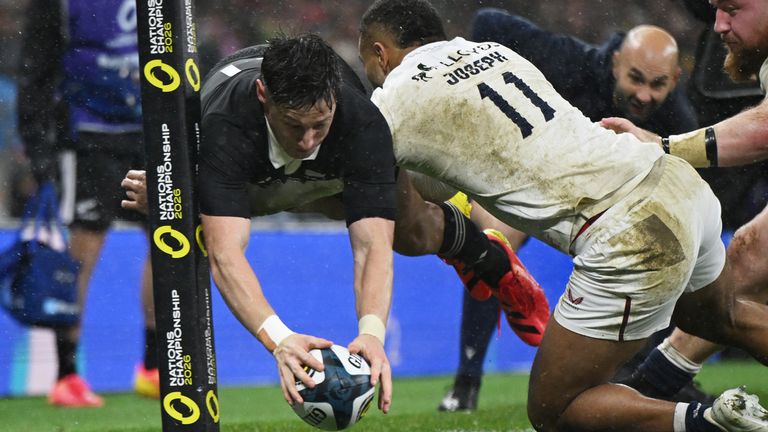
Cam Roigard produced a flying finish as the All Blacks completely outplayed England against expectations
England made more carries than the All Blacks (110 to 99) and gained more metres (343 to 253), but such stats matter for nothing when 22 entries aren’t converted into tries.
Borthwick’s side almost ended the contest try-less – Jamie George’s maul try with five minutes to go stopped that – but they scored less than 10 points in a Test for the first time in over three years (August 2023).
Into the second half, with England behind, their kicking strategy through Marcus Smith was so inaccurate the Twickenham crowd even booed the side as New Zealand marked three aimless kicks in succession – quite the comedown in the space of a week.
While knee-jerk reactions are almost never useful nor accurate, it’s clear England remain a massive work in progress under Borthwick, for all their talent.
Punishing England ill-discipline returns
The other main area of regression for England on Saturday proved to be their discipline. It was shockingly bad.
The hosts conceded 12 penalties in the Test all told, but shipped decisions from referee Angus Gardner in pretty much all areas.
They were penalised at the breakdown six times, the scrum (against the head) once, the lineout once, the maul once, once for a high tackle (with Alex Coles sin-binned), once for offside (with Henry Pollock sin-binned), and once for dissent as Tommy Freeman kicked the ball away to deny the All Blacks the chance to take a 50:22 quickly.

Alex Coles was sin-binned in the first half for England on Saturday for a costly high tackle
They also conceded penalties routinely when under pressure within their own half, allowing Richie Mo’unga to strike for 12 points off the tee, continually moving the Test further and further away from England.
Even with the amount of penalties given up, England still conceded 13 turnovers as well. Their discipline, both in terms of penalties and skill execution, was extremely poor.

Richie Mo’unga continually punished England conceding penalties with kicks from the tee
England’s Achilles heel in 2026 had been their yellow cards. Something they seemed to have fixed during this November.
But Saturday’s two costly yellows mean Borthwick’s side end the calendar year having been shown a staggering 18 cards in 12 Tests.
The Six Nations saw eight England sin-binnings and a 20-minute red card; July saw six yellow cards – including four in one match away to Argentina – and this November sees England end with three yellows (one vs Japan, two in defeat to New Zealand).
Playing such periods of time in Tests with fewer players is disastrous. The fact it is an ongoing issue will be of immense frustration for England’s coaching staff, no doubt.
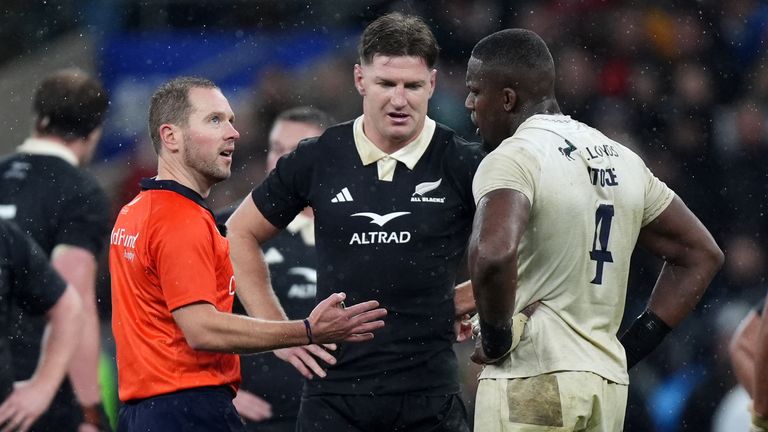
England conceded a wealth of penalties under pressure and two yellow cards in defeat – they have been shown 18 cards in 2026
Itoje: We failed to do fundamentals nor execute game plan – ‘Not finished article’
Speaking to media at England’s post-match press conference, some of the quotes that came from captain Maro Itoje could be read as fairly alarming.
A year out from a World Cup, Itoje spelled out pretty clearly that England failed to execute on the “fundamentals” of the sport, as well as their game plan.
Saturday’s Test came against an opponent England had handsomely put away the week prior and one suffering hugely from injuries, with Ardie Savea, Will Jordan, Codie Taylor, Tupou Vaa’i and Ruben Love out.
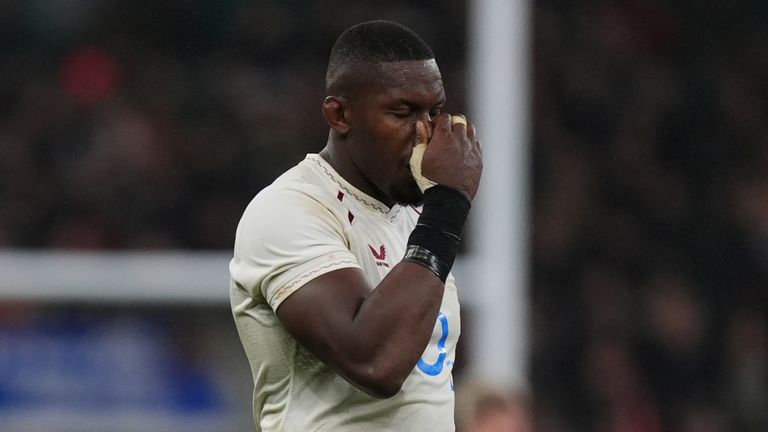
England’s Maro Itoje admitted Saturday’s defeat highlighted they ‘are not the finished article’
This weekend, at home again in Twickenham, should have been party time for England. They had the chance to end the autumn on a high and drive home their place back at the top table, to move on towards the 2027 Six Nations with a pep in their step.
After a 26-8 defeat very few people saw coming, it’s safe to say they have not done that.
“Essentially, if you don’t get the fundamentals right then you put pressure on yourself. It came from us not getting our fundamentals right,” Itoje said.
“We didn’t execute our plan. That’s essentially what the game comes down to, who can execute their game plan more effectively.
“If you look at the four games as a whole, I think as a team we have taken a step forward. We’re not finished article, we know that, and today highlighted that.
“But we’re making progress and a game like today just puts extra fuel in the fire to make sure we’re motivated to go forward.
“If we want to be the team that we want to be, we have to play these games and consistently play these games at top levels.
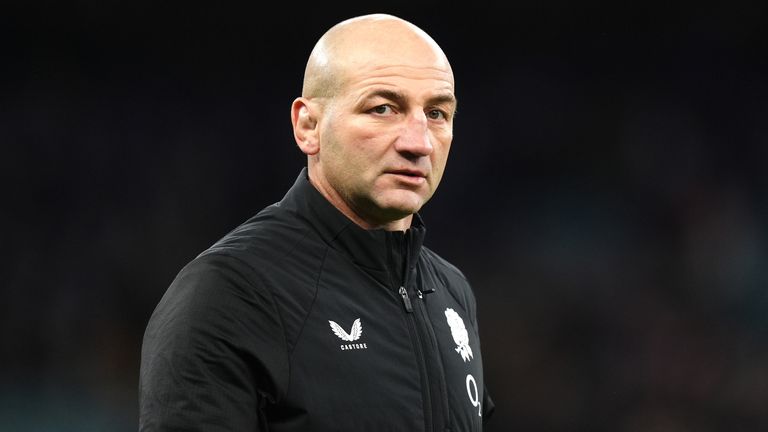
England head coach Steve Borthwick highlighted the conditions, taking chances and penalty concessions as central areas to their defeat
“They [All Blacks] brought more line-speed. We weren’t gaining as much in our attack as we did the previous week.
“But ultimately, it just comes from us not executing on what we wanted to do.
“Fair play to New Zealand, they played a good game, a smart game, and they frustrated us there as well.”
What’s next?
England are next in action during the 2027 Six Nations in February, when they start with a huge Test against Ireland in Dublin at the Aviva Stadium on Friday February 5 (8.10pm kick-off).
Australia are hosting the 2027 Rugby World Cup between October 1-November 13.
Disclaimer : This story is auto aggregated by a computer programme and has not been created or edited by DOWNTHENEWS. Publisher: skynews.com