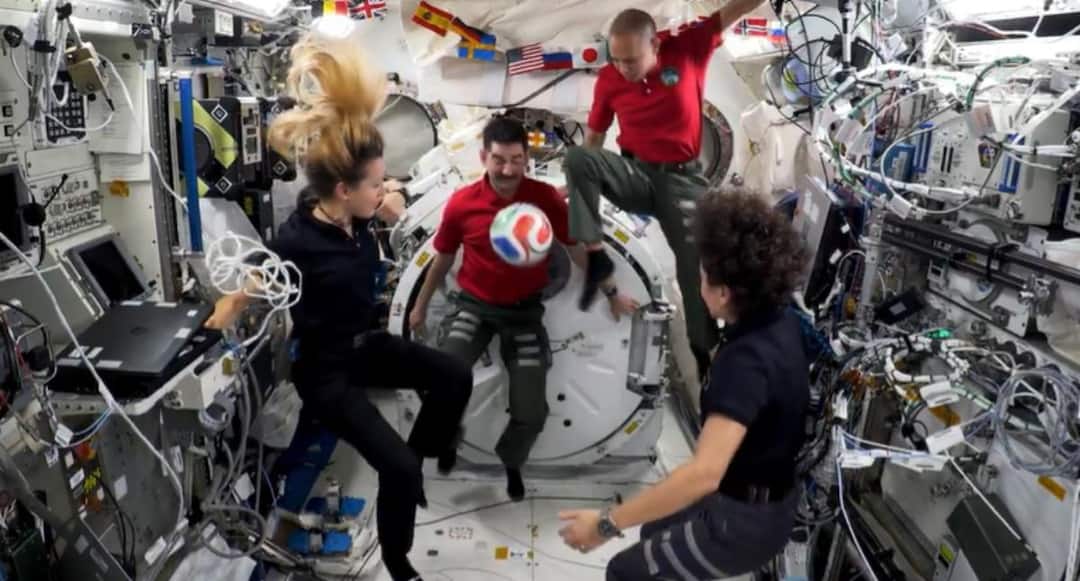
In a spectacular merging of cosmic exploration and sports science, the official match ball of the 2026 FIFA World Cup, Trionda, has traveled into low Earth orbit.
Astronauts aboard the International Space Station (ISS) have been conducting specialized microgravity experiments with the Adidas-engineered ball to better understand the physics, aerodynamics, and rotational behavior of modern sports equipment.
Watch Video
The official FIFA World Cup ball went to space!
We’re working to inspire the next generation by showing how space exploration inspires innovation in sports science — and everyday life. Learn more: https://t.co/CWbI8MFDtp pic.twitter.com/ebJtkpD5uM
— NASA (@NASA) June 20, 2026
Assessing Center of Mass in Zero Gravity
The National Aeronautics and Space Administration (NASA) revealed that the ISS crew recreated a landmark 2019 sports-engineering study. The core objective of the experiment is to examine how a football’s internal mass distribution and center of gravity dictate its stability and trajectory.
This research has become critically important due to modern soccer innovations. The Trionda is loaded with highly advanced connected-ball technology, housing a 500Hz motion sensor chip developed alongside tech firm Kinexon.
This side-mounted inertial measurement unit transmits real-time telemetry to the Video Assistant Referee (VAR) system to streamline offside and touch-recognition decisions. Because embedding hardware directly into a match ball adds localized weight, NASA’s space-based demonstrations help engineers analyze how counter-balances perform and ensure the ball travels predictably without erratic dipping or “knuckling” when struck.
Engineering Behind “Three Waves”
The name Trionda is pulled from the Spanish translation for “three waves,” paying homage to the historical partnership of the three host nations: Canada, Mexico, and the United States.
“Helping to improve the beautiful game is just one of the ways NASA science done on the International Space Station makes life better for people on Earth.”- NASA Official Statement.
Beyond its internal electronic core, the ball features several architectural advancements tailored for peak performance on Earth:
Four-Panel Geometry: The shell features a brand-new, thermally bonded four-panel structure – the lowest panel count in World Cup history – minimizing water absorption and optimizing aerodynamic flow.
Deep-Seam Integration: Intentionally deep seams generate evenly distributed drag as the ball moves through the air, preventing erratic flight paths.
Embossed Micro-Textures: The outer polyurethane skin is debossed with country-specific iconography (stars, maple leaves, and eagles) that elevates a player’s grip and control in humid or slick, rainy conditions.
Before You Go
Pakistan In Turmoil: India Celebrates, Pakistan Reacts in Anger After Crushing Defeat
Disclaimer : This story is auto aggregated by a computer programme and has not been created or edited by DOWNTHENEWS. Publisher: abplive.com