
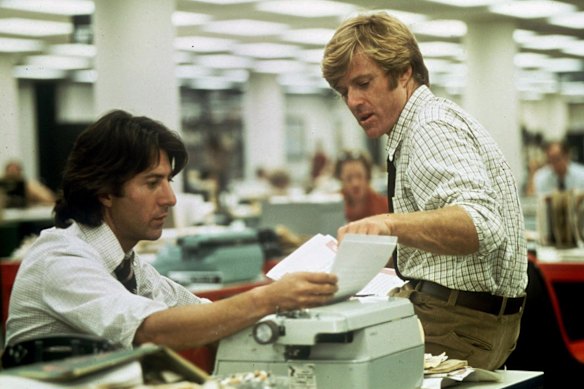
At a moment when a great country on the cusp of its 250th birthday is feeling the foundations beneath it shake, it’s worth thinking about a more recent but still potent American anniversary. It’s been 50 years since the release of All The President’s Men. That was the classic 1976 film adaptation of Bob Woodward and Carl Bernstein’s book, which detailed how their dogged reporting for The Washington Post on the Watergate break-in ultimately brought down a US president.
Woodward and Bernstein were young staffers on the local beat for the Post. They weren’t among the paper’s coterie of prestigious political reporters. Almost by chance, they ended up covering what seemed, as we Americans might say today, a “nothingburger” of a story: the arrest, late one night in 1972, of a group of men in an office building in the Watergate complex, a sprawling residential and commercial development on the west end of downtown Washington. The Watergate “burglars” were, in fact, placing surveillance bugs in the offices of the Democratic campaign committee – the people trying to defeat Republican president Richard Nixon that November. Woodward and Bernstein slowly, painstakingly, and not without mistakes, uncovered the dark forces behind the break-in.
Despite the attempts since by Nixon’s acolytes, and by Nixon himself, to minimise the scandal, scores of officials in his administration, and most of his top aides, went to jail for what seemed a spectacular panorama of crimes.
And yet, by today’s standards of fathomless corruption in the Trump administration, Watergate’s echo is more like a blip from a relatively innocent era. Now, with frightening regularity, we learn of one or another of US President Donald Trump’s executive departments embarking on crimes of far greater magnitude: the US military summarily executing people in boats; domestic enforcement agencies filmed killing American citizens with no apparent provocation; civil rights violations on an industrial scale.
The early 1970s recall a happier time for journalism. Back then, The Washington Post could send two local reporters to cover a break-in. Would it have the resources to do that today? It has just sacked a third of its staff; it is haemorrhaging revenue; and it suffered an exodus of at least 250,000 subscribers after proprietor Jeff Bezos overrode his editorial board’s plan to endorse Democrat candidate Kamala Harris against Trump in the 2024 presidential election.
So we have compelling reasons to celebrate those two young reporters. Their book recounting the adventure, All The President’s Men, would become a bestseller. It’s not well known that Robert Redford, before it was even written, came to them with a vision of making a movie about their work. It wasn’t easy getting it made. “It’s the same thing over and over,” screenwriter William Goldman would say later. “They go knock on your door. ‘Hello, we’re Woodward and Bernstein. Can we talk to you?’. A lot of people say no. No major studio wants to make this kind of movie.”
Redford persevered, and ended up with a very profitable hit and a best picture nomination. Redford took on the role of the upright Woodward; Dustin Hoffman played the scruffier Bernstein. Some scenes became landmarks, especially the spooky late-night meetings in a parking garage between Woodward and his now-legendary source, Deep Throat. “These are not bright guys,” Deep Throat says, referring to Nixon’s myrmidons. “And things got out of hand.” A subtle sense of menace set in. To paraphrase an old horror movie trope, the killer is inside the house. Make that the White House. Goldman would win an Oscar for his screenplay.
Now, as in 1972, all the president’s men, from the vice president down, deny and obfuscate. (There are more women these days.) Nixon’s men went on television, rattling off made-up numbers as distractions. Behind the scenes, they threatened staff and used intimidating tactics to prevent the real story from coming out. In public, they stayed on message, attacking the media as partisan and anti-American. Sound familiar?
The most poignant thing about watching All the President’s Men in 2026 is the sad state of The Washington Post. Its position is much more dire than most people realise. Bezos, the Amazon centibillionaire, bought the paper in 2013 and promised to revitalise it. His intentions took a sharp turn in 2024, when he halted the paper’s upcoming endorsement of Kamala Harris, saying the masthead would no longer make endorsements in the presidential race.
The suburbs around Washington DC are among the richest and most sophisticated in the country. A huge percentage of the professional workforce is part of the government or part of the industries that depend on it. When thugs inflamed by Trump invaded the US Capitol and savaged its protectors, to Washingtonians it was an assault on democracy and on a building that was at the centre of the work they did every day.
Then came Trump’s Department of Government Efficiency and its attacks on the federal bureaucracy. Folks in Washington know that the people inside the bureaucracy are for the most part underpaid and underappreciated; proud to do the people’s business; and that they work under severe ethical and professional constraints. The senselessness and cruelty of the redundancies and department cuts appalled professionals, whether Democrat or Republican.
In the meantime, Bezos has been cosying up to the Trump administration, posting gushing tweets and slipping the First Lady $US40 million ($56 million) via Prime Video for a tedious piece of filmic hagiography. All of those lost subscriptions have created a financial crisis at the paper, which produced the devastating 300 redundancies in February. That created a new dip in subscriptions. The Post alienated its core constituency; and then it vaporised what for many would be the last remaining reason to subscribe.
Does this sound like a business plan to you?
What is happening at the Post is not a repositioning. It’s the slow-motion dismantling of another important part of the country’s checks and balances. The institution we see in All the President’s Men is unrecognisable today. A friend of mine at the paper, a Pulitzer Prize winner, wrote to me recently. “The Post as we know it is dead,” she said.
Bill Wyman is a former assistant managing editor of National Public Radio in Washington. He teaches at the University of Sydney.
 Bill Wyman is a former assistant managing editor of National Public Radio in Washington. He teaches at the University of Sydney.
From our partners
Disclaimer : This story is auto aggregated by a computer programme and has not been created or edited by DOWNTHENEWS. Publisher: www.smh.com.au


