Opinion
In this series, My Happy Place, our writers reflect on the holiday destinations in Australia and around the world that they cherish the most.
It was over a bottle of Lambrusco during Sydney’s second lockdown that my husband, Mak, and I decided we’d spend a year living in Italy. Two years later, after navigating the visa process and settling in Florence, we found ourselves over another bottle (Chianti, this time) deciding we wanted to be somewhere else. Florence was beautiful, but we were craving the Italy we’d imagined, not an NYU campus full of Americans.
So we pulled up a map of Italy. I covered my eyes and blindly pointed, landing on a town called Monopoli, in Puglia, the heel of Italy’s boot. Within a fortnight, we’d packed up our apartment and booked a train south. It was there that we found the dolce vita we’d fantasised about during that tumultuous lockdown in Sydney.
We arrived around 1pm on a Sunday. Shop doors were shuttered, and there weren’t many people strolling the streets. I later realised this was just Southern Italy on a Sunday. It was the opposite of Florence.
Our apartment, though modest, had one feature I’d always dreamed of: a balcony overlooking a piazza. It became my office and bird’s-eye view of town life. There was a primary school, too. We’d watch the kids practise their Mother’s Day dance to Sarà perché ti amo, then put on their Easter performances. I’d spend hours out there writing, occasionally distracted by whatever was happening in the piazza below.
Sign up for the Traveller Deals newsletter
Get exclusive travel deals delivered straight to your inbox. Sign up now.
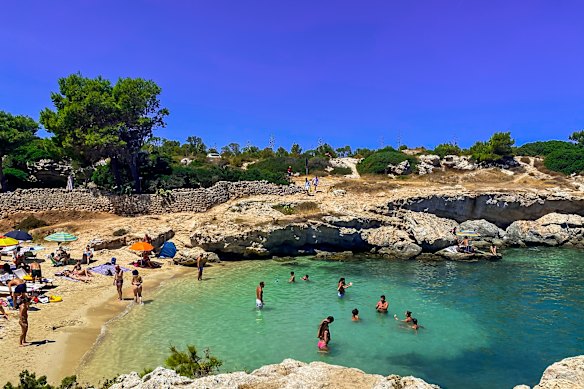
Puglia has the longest coastline of any mainland region in Italy, and Monopoli has about 10 beaches within walking distance. Most day-trippers head to Cala Portavecchia, the main town beach pushed up against the old city walls. It’s pretty, but for swimming I quickly followed the locals to Porto Rosso, a 10-minute walk away. The water is so clear it could pass for gin. Cliffs wrap around the little bay, keeping the waves down, which suits me just fine. I’d much rather float than tread water.
I got into the habit of heading there most mornings, throwing down a towel and staying for as long as I fancied. It sounds lazy, dare I say privileged, but it was a luxury I’d forgotten how to enjoy. I’d started working in media at 19 in New York and was an editor by 21, all while finishing college, jetting off on press trips and filing stories for the magazine. I once flew to Antigua on a Friday afternoon and made it back in time for my 2pm Spanish exam on Monday. I chased career opportunities as if my life depended on it. As my therapist once put it, I hadn’t stepped off the gas until COVID forced me to. By the time we arrived in Monopoli, I was 26 and already burned out.
I needed a slower pace, and Monopoli gave me one. We’d buy vegetables from a truck parked near the beach, its owner driving in from his farm 20 minutes out of town with the best tomatoes and strawberries I’ve ever tasted. As a port town, Monopoli has fishermen bringing in fresh octopus and whatever else they’ve caught that morning. We could pick up a bag of scampi for five euros. In the face of Sydney’s grocery bills, gosh, I miss those days.
We also got to know the locals. Our butcher was particularly generous, regularly handing us samples of whatever sausage or salami he was making and teaching us about the local produce. He’d throw in a few Italian words, too, giving our daily Duolingo lessons some real-world practice.
One of the first people we met was Eustachio Cazzorla, a local journalist who started leading walking tours after the newspaper folded. On his tour, he explained how Monopoli’s many conquerors had each left their mark on the town’s architecture. It explains the whitewashed buildings and honey-coloured stone churches, with Greek, Roman and Spanish influences. I loved that slightly mismatched mix.
At the time, Eustachio was the only person running an English-speaking walking tour in Monopoli. I wrote about it for Traveller, and when we caught up a year later, he told me how many Australians had since booked, referencing the story. I’ll take that as a win for travel journalism.
Monopoli had become much more than the place we’d picked on a map. In 2025, a year after leaving, Mak and I returned to Puglia to get married in a 13th-century masseria in Martina Franca, about a 30-minute drive inland through the olive groves. We wanted our family to see the place we’d called home, so we took them to Monopoli for the day. Eustachio generously showed everyone around, then joined us at our wedding reception, where he brought along a sabre for the rather grand task of cutting cake and opening champagne.
During my time there, I wasn’t thinking about the next project or where we’d go after Italy. I was just happy to be there. And I still miss it terribly.
 Natasha Bazika, an Italy-based travel writer, isn’t just about ticking destinations off a list. She’s a storyteller who uses food and local encounters to bring the heart of a place to life.
From our partners
Disclaimer : This story is auto aggregated by a computer programme and has not been created or edited by DOWNTHENEWS. Publisher: www.smh.com.au