
It lurks unseen in playgrounds and sandpits. There’s no smoking gun when lead poisons tiny bodies, except for what it steals from them: their IQ, their attention span, impulse control and emotional regulation. These are effects which last a lifetime.
Generations of children carry this fingerprint of Broken Hill’s toxic mining legacy in their blood.
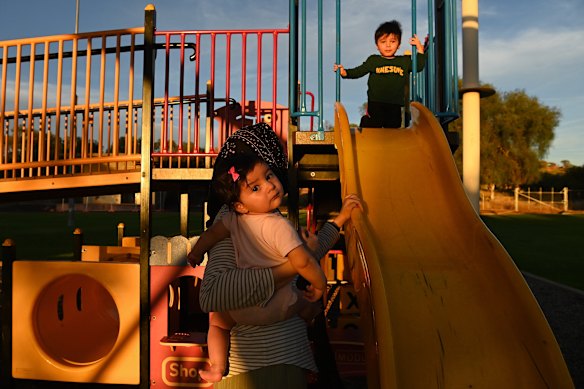
But decades after authorities first identified the problem, local mothers like Nayyab Tahir are still resorting to desperate measures to escape the poisonous lead dust, which is wind-blown off massive waste mounds in the heart of the outback NSW town and hitchhikes into homes on the bottom of dirty boots.
Tahir believes her boisterous toddler, Ismael, and infant daughter, Hiba, have only escaped the fallout because she doesn’t send them to daycare and won’t let them play in their own backyard.
“We don’t even open the windows,” she said.
The Herald can reveal the Minns government will on Wednesday launch a major multi-agency intervention to help curb the risk for Broken Hill’s children aged under five by targeting contamination across its 30 early learning centres.
Lead testing will become mandatory at the centres and the NSW Environment Protection Authority (EPA) will compel and fund clean-ups where a new expert panel determines they are needed. The intervention is a major overhaul of a system that previously left testing and remediation to childcare operators.
Four months ago, NSW Chief Health Officer Kerry Chant pledged to urgently intervene after this masthead revealed that five centres had failed to act on contamination levels over national health investigation thresholds.
The contamination readings were first uncovered by Greens MLC Cate Faehrmann through parliamentary questions.
“Clearly childcare centres need to be safe places,” Chant told parliament at the time. “Clearly these are sensitive settings; they need to be remediated.”
The interim chief executive of the EPA, Nancy Chang, was on the ground in Broken Hill this week to launch the program and meet with centre operators.
“I want them to understand that the CEO is here because this is very important to me,” Chang said.
She said that despite a drop of more than 75 per cent in average levels of lead in the blood of children in Broken Hill, they were still too high.
“Lead contamination is a complex issue,” she said. “If it was simple, we would have solved it in the last 140 years.”
Broken Hill’s humble mining cottages straddle one of the world’s largest veins of silver, zinc and lead ore which snakes through the centre of the township.
The spoils of the so-called “Line of Lode” are still being actively mined, generating an artificial mountain of toxic waste, built up over a century’s worth of mine tailings.
Alex, a local who asked to be identified only by his first name due to sensitivities around the topic, said his young family was fortunate to live on the northern side of the town, further away from the waste mounds and mining operations.
But there are parts of their yard they won’t venture into, and handwashing is a ritual for their daughter, Violet, and son, William.
“It does constantly feature at the back of your mind,” he said, adding that his children had been returning “some pretty nervous results” in their regular lead screening tests.
Both children attend daycare five days a week. Alex said their centre had been proactive about identifying issues and funding remediation activities.
But he welcomed news that the financial burden would now be shouldered by the state.
“They [childcare centres] have to pay out of their own pocket to fix it, and that’s coming out of a limited budget,” he said.
Testing will begin this month, spanning indoor and outdoor areas at all family daycares, preschools, long daycares, out-of-school-hours care and affected areas on school sites.
Chang stopped short of committing to remediation of any centre with lead above Australia’s health investigation threshold of 300 milligrams per kilogram, saying it would depend on whether children were at risk of being exposed to it.
“Look, if it is an area, and it is at that level, and the children have access to it, we will do something about it,” she said.
Earlier this year, the EPA argued results above the threshold were not necessarily unacceptable as long as children used risk management techniques, such as handwashing.
Remediation funding was previously also limited to family day care services under the Broken Hill Environmental Lead Program (BHELP) because the home environment was deemed the greatest risk.
Lead contamination experts were troubled by those approaches, given there is no safe level of lead in children’s blood.
Professor Donna Green, an environmental scientist at UNSW, said it was far more prudent to remove the risk entirely across all centres.
“Young children have normal hand-to-mouth activity that increases exposure,” she said. “Child-use areas should always be prioritised in remedial efforts.”
Dr Mark Laidlaw is a consultant environmental scientist who has spent years investigating children’s exposure to lead in soil dust.
“Handwashing alone is not a sufficient method for preventing exposure as lead in dust can be inhaled as well,” Laidlaw warned.
In parliament in August, Chant suggested she was disappointed after claiming she had not been notified by the EPA about the contaminated childcare centres.
“Of course we would have wanted to know about this,” she said. “I would have been exercised and extremely concerned about this issue.”
Asked about Chant’s comments, Chang said NSW Health had been kept aware of test results via a long-standing working group.
“I don’t want to cast aspersions on Dr Kerry Chant, I have great respect for her,” Chang said.
A Broken Hill lead coordination committee, including government agencies, council, partner organisations and community representatives, will now be established to address the recommendations of the NSW chief scientist’s report released this year.
The government has committed $37.3 million to address its recommendations, including doubling the number of homes to be remediated and enhancing air monitoring.
Start the day with a summary of the day’s most important and interesting stories, analysis and insights. Sign up for our Morning Edition newsletter.
From our partners
Disclaimer : This story is auto aggregated by a computer programme and has not been created or edited by DOWNTHENEWS. Publisher: www.smh.com.au