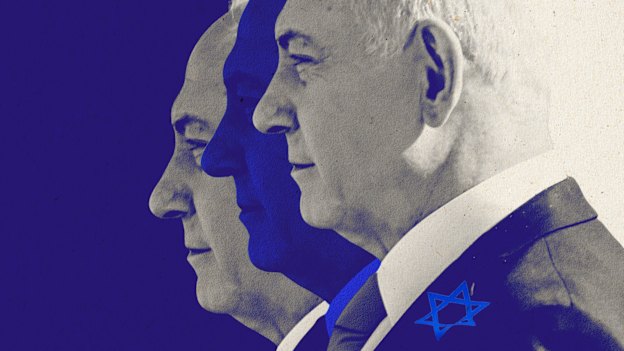
Israel’s youngest leader is now, at 77, its oldest and his reign hasn’t ended yet.
Tel Aviv: When Aviv Bushinsky thinks of a moment that defines Benjamin Netanyahu, he thinks back to a day just before the dawn of the new millennium.
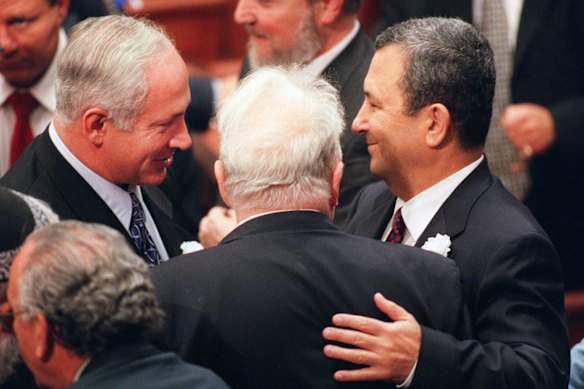
Bushinsky, a well-known former Israeli radio journalist, had worked as a media adviser for Netanyahu during his ill-fated first term as prime minister, which began in 1996. After Netanyahu was thrashed by Labor’s Ehud Barak in 1999, he quit parliament rather than stay on in opposition.
The political career of Israel’s youngest prime minister looked to be over at age 49. While helping Netanyahu transition to civilian life by unpacking books at his private office in Jerusalem, Bushinsky remembers Netanyahu turning to him and saying: “OK, now we are working on our comeback.” This wasn’t retirement, just a hiatus.
AP
“We worked on the comeback for two years – we called it the new Bibi campaign – and it worked. It really worked,” Bushinsky told this masthead during an interview in Tel Aviv in the lead-up to this week’s Israeli elections.
Netanyahu quickly returned to politics, serving as foreign minister, finance minister and opposition leader before returning to the prime ministership in 2009. He has been in power for almost the entire time since.
“He’s a hell of a campaigner,” Bushinsky said. “He’s a huge fighter, he will never bend down.”
Although Netanyahu’s polls looked grim ahead of Tuesday’s elections, Bushinsky was not writing off the possibility of his former boss remaining in office. Even so, he admits he was stunned by Netanyahu’s performance on election night.
Not only did his conservative Likud party easily win the most seats in the Israeli parliament, the Knesset, but his right-wing bloc outperformed the opposition “change” bloc led by former military chief Gadi Eisenkot.
With 99 per cent of the vote counted, Netanyahu and his allies secured 53 seats, ahead of the main opposition’s bloc of 48, but short of the 61-seat majority needed to rule without further backing. Israel’s two Arab party groupings are projected to win an unprecedented 19 seats.
The opinion surveys by three of Israel’s main television networks – Channels 11, 12 and 13 – had shown Eisenkot’s Yashar party winning the most seats and the change bloc outperforming Netanyahu’s.
While negotiations to form a government still have a long way to go, Netanyahu remains the prime minister throughout the process, which could take weeks, if not months.
“I was totally caught by surprise,” Bushinsky said after election day.
The systemic undercounting of Netanyahu’s support – a more glaring polling error than the one that occurred before US President Donald Trump’s surprise victory in the 2016 election – is already prompting soul-searching and public apologies from Israeli media outlets.
More substantially, Bushinsky says he was stunned that so many Israelis stood by Netanyahu despite his failure to prevent the October 7, 2023, massacre, his inability to resolve the issue of drafting the ultra-Orthodox refusing to serve in the military, and revelations that top staff members were on Qatar’s payroll while working for him. Hamas remains in power in much of Gaza and Hezbollah has not been dismantled in Lebanon.
Yet remarkably few voters abandoned the Likud for right-wing alternatives, let alone the more centrist opposition bloc trying to unseat him. To be sure, Netanyahu’s party went backwards from the last elections in 2022, but the swing against him was far less than expected.
“It was not a clear-cut victory but analysing the result, he did win the elections,” Bushinsky said.
When The New Yorker’s David Remnick arrived in Israel in 1998 to profile a more youthful Netanyahu, prominent critics of the new prime minister weren’t hard to find.
“He’s not a trustworthy man,” Yitzhak Shamir, the previous Likud prime minister, told Remnick. “I don’t believe he believes anything. He has a huge ego. People don’t like such people. I don’t like him.”
Labor’s Shimon Peres, whom Netanyahu narrowly defeated in 1996, said: “Netanyahu’s only consideration is his own coalition. He’s always worried about losing power – that is always his first priority.” Peres accused Netanyahu of damaging Israel’s global image by undermining the peace process with the Palestinians.
Three decades later, precisely the same criticisms are still made of Netanyahu – and with even more force.
Internationally, he is widely loathed and has brought Israel’s standing down with him. Seventy-eight per cent of Australians have little to no faith in him to do the right thing for world affairs, according to a June poll released by the Pew Research Centre that found he is among the world’s most unpopular leaders. He has been accused of war crimes in the International Criminal Court, and Israel faces genocide charges in the International Court of Justice for its conduct in the war in Gaza. Within Israel, he is a polarising figure, loathed by the left but still commanding remarkable loyalty, and even devotion, among Likud’s conservative base.
The fierce bond between Netanyahu and his supporters was on display ahead of election day at Jerusalem’s thriving Mahaneh Yehudah Market.
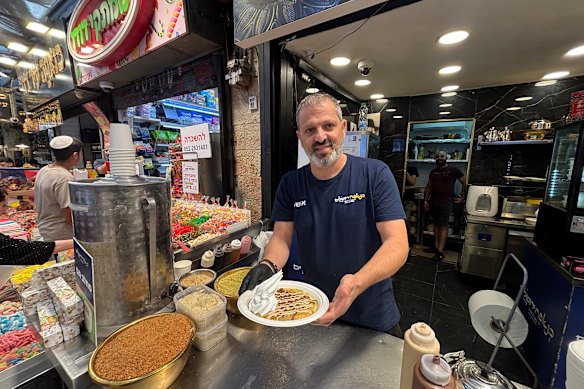
Selling knafeh desserts at a market stall, Asher Biton, 53, said Israel had been “in chaos” and “very tense” over the past three years.
“We want a normal life,” he said. “We don’t want wars.” But he didn’t want a change in leadership: “I hope Bibi can win and make a good government.”
None of the other contenders seemed like viable options to run the country. “We don’t have any leaders like Bibi,” he said. “We need a real leader.”
While he blamed Netanyahu for October 7, it was not a dealbreaker. “Everybody makes mistakes,” he said. “This is Israel, war can happen any time.”
Matthew Knott
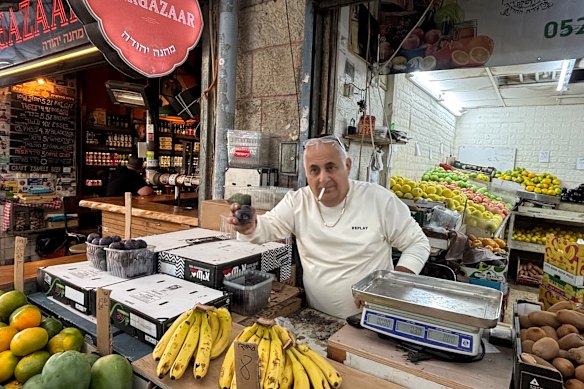
A few stalls away, fruiterer Sasson Mordechai also lamented the state of Israel today.
“Everybody hates each other and it didn’t use to be this way,” he said. But he wasn’t abandoning Netanyahu. “I want Bibi to be PM. He’s the one I know.”
Mordechai, who was born in Iraq, typifies Netanyahu’s supporter base: working-class Mizrahi Jews with roots in the Middle East who often feel marginalised by Israel’s Ashkenazi (European) elite. The fact Netanyahu himself is a Harvard-educated son of an Ashkenazi historian doesn’t bother his voters, in the way Trump’s status as a billionaire businessman hasn’t prevented him from becoming a working-class American hero.
Like Trump, Netanyahu’s bond with his supporters is so strong that critics often dismiss it as a cult of personality.
They point to the self-reinforcing echo chamber of right-wing news outlets such as Channel 14 (Israel’s equivalent of Fox News) that keep Netanyahu’s supporters hermetically sealed from bad news about their favourite politician. There is even a term for it: Bibism, which describes his followers’ unwavering support for him.
Eylon Levy, who became a prominent spokesman for the Israeli government during the war in Gaza, said: “His base of supporters cannot imagine anyone else as prime minister. They view him as a once-in-a-generation leader.”
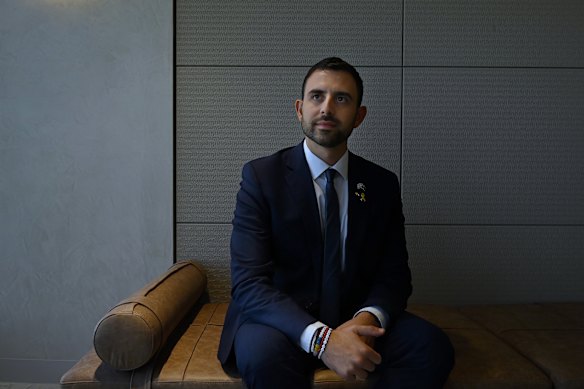
Levy says Netanyahu convinced his voters that only he can stand up to international pressure and finish the job against the Iranian regime and Hamas.
After the election, many left-wing Israelis in places like Tel Aviv are questioning their own echo chambers and their inability to win over conservative voters.
Nearly two-thirds of Jewish Israelis now identify with the political right and a quarter as strongly right-wing, according to a study released this month by the Jewish People Policy Institute. Just 22 per cent of Israelis identify with the left.
Likud’s vote tally held solid in cities such as Sderot in Israel’s south and Kiryat Shmona in the north, places where the impact of October 7 and its aftermath is far from theoretical.
Sderot, near the Gaza border, came under ferocious attack by Hamas on October 7. Kiryat Shmona, on the Lebanese border, became a ghost town when Hezbollah began firing rockets on the city. These residents had every reason to be angry at Netanyahu, and many are. But they didn’t believe any other candidate would do a better job at keeping them safe.
In his 1996 election campaign, Netanyahu used a new slogan: “Netanyahu – good for the Jews.”
The implication was that his left-wing opponents were on the side of the Palestinians and Arab citizens of Israel. During the 2015 campaign, he rallied his supporters by warning them that “Arab voters are heading to the polling stations in droves” – a tactic he used again on election day by posting photos of long voting lines with women in hijabs and burqas.
His slogan at this election was “Right or Palestine”, meaning anyone not from his conservative coalition would usher in a Palestinian state. While the Netanyahu bloc’s hostility to Arab Israelis drove up turnout in Arab areas, it also appealed to its own base.
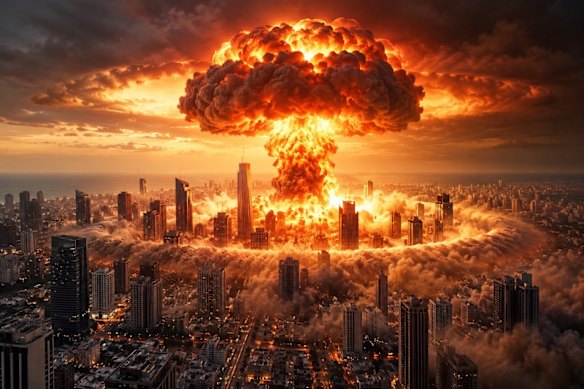
Days before the election, he posted an AI-generated image of a nuclear bomb blowing up Tel Aviv. “He played the fear campaign very hard,” Levy said.
Although most Israeli voters did not support him, Netanyahu stands in a better position than Eisenkot. He will remain as prime minister while the post-election negotiations take place, and has authority as the leader of the biggest party.
There is a broad consensus in Israel that he would probably perform even better if Israelis returned to elections next year: left-wing Israelis would not fly in en masse once more to vote against him, Arab turnout would decline, and the momentum for change would dissipate (so the theory goes).
“The fact our politics has been dominated by the personality of one man – whether you support Netanyahu or not – for decades has poisoned Israeli politics and made it impossible to govern from the centre,” Levy said.
Not enough Israelis agreed with him to consign Netanyahu to history. Israel’s youngest leader is now, at 77, its oldest, and his reign hasn’t ended yet.
Get a note directly from our foreign correspondents on what’s making headlines around the world. Sign up for our weekly What in the World newsletter.
Disclaimer : This story is auto aggregated by a computer programme and has not been created or edited by DOWNTHENEWS. Publisher: www.smh.com.au