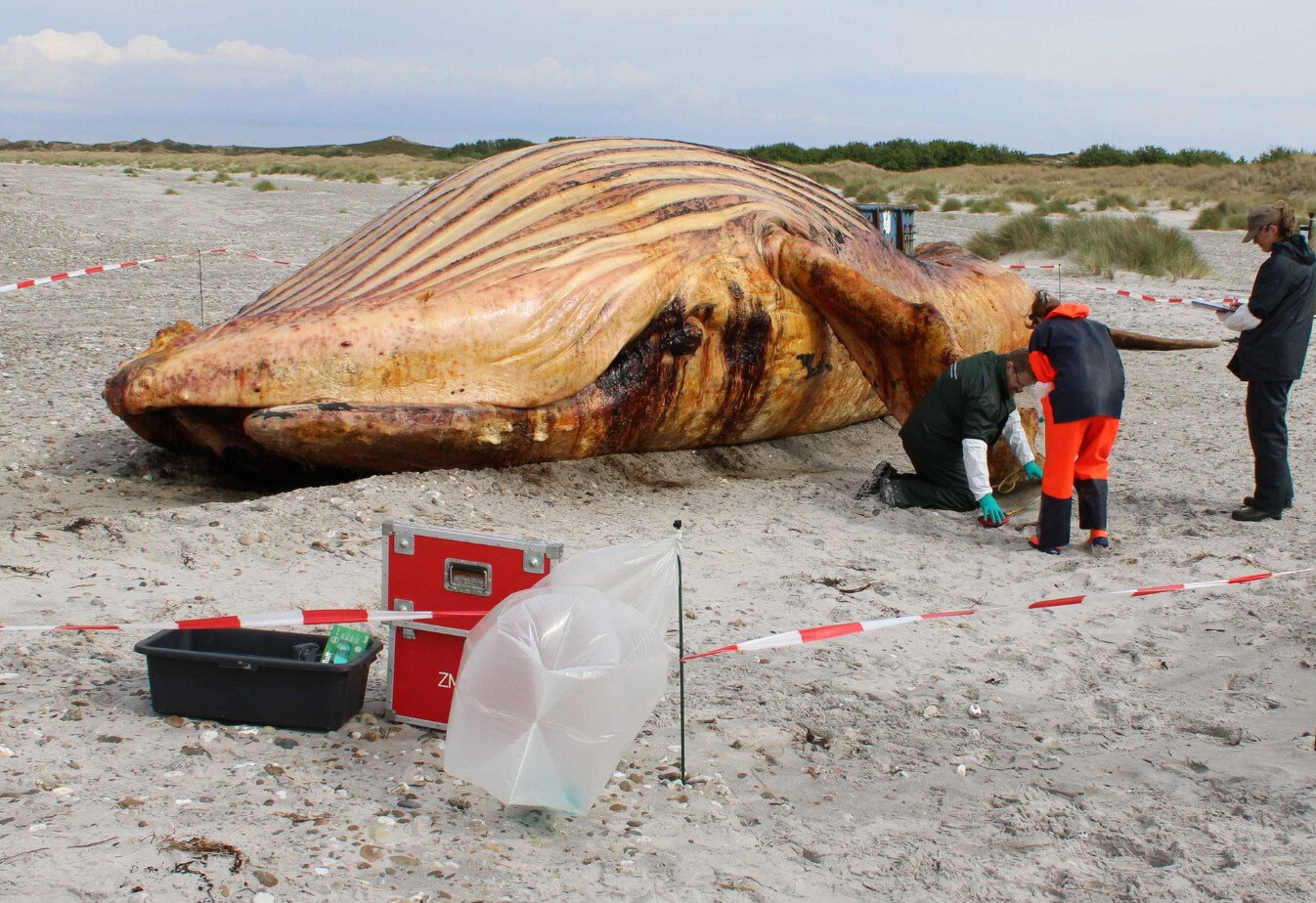
Scientists have completed a public autopsy on Timmy, the humpback whale whose rescue attempt captured attention across Germany and Denmark earlier this year.
The whale’s body was examined on a beach on the Danish island of Anholt after washing ashore dead in May. Researchers say it could take up to six months before the final results are known.
During the examination, experts removed organs, tissue samples and parts of the skeleton to help determine what caused the whale’s death and to learn more about humpback whales.
Fishing net and parasite found
Researchers discovered a piece of netting in the whale’s intestine during the autopsy. They also found a parasitic worm in one of the animal’s kidneys.
Samples were also taken from the whale’s brain, heart and other organs for further laboratory analysis. Because the carcass had been decomposing for several weeks, some tissues were already badly damaged.
One surprising discovery was that Timmy was not male.
Scientists found a cervix during the autopsy, confirming that the whale was female. The animal had been widely referred to as a male in media reports since first becoming stranded near the German seaside town of Timmendorfer Strand.
Researchers said the whale was not pregnant at the time of death.
A rescue that captured public attention
Timmy became a major news story after becoming stranded several times in the Baltic Sea. Wildlife experts and authorities launched a large rescue operation and transported the whale to the Kattegat Sea between Denmark and Sweden in the hope that it could return to deeper waters.
Many marine experts had warned that the whale’s chances of survival were low. Two weeks later, the carcass was found near the Danish island of Anholt.
The autopsy lasted several hours and attracted scientists, journalists and members of the public. Parts of the whale’s skeleton will be preserved for scientific research and museum collections, while the remaining carcass will be removed and cremated.
Researchers say the final findings may help explain why the whale entered the Baltic Sea and what ultimately led to her death. Full results are expected within the next six months.
Disclaimer : This story is auto aggregated by a computer programme and has not been created or edited by DOWNTHENEWS. Publisher: theanimalreader.com